
Nissan is preparing for Chinese automakers to move from exporting vehicles into North America to building them in Mexico. Christian Meunier, chairman of Nissan Americas, said Chinese brands could start local production within two or three years. The estimate was made at Nissan’s headquarters in Yokohama and reported by Automotive News.
Why Mexico changes the calculation
Mexico already has a deep vehicle manufacturing base, an established supplier network and direct logistics links with the United States and Canada. A Chinese automaker building there would be closer to North American customers and could reduce the cost and time associated with shipping finished vehicles from China.
Meunier did not identify a company, factory site or confirmed programme. His comment is therefore a forecast rather than an announcement of a Chinese investment. “It will happen probably in the next two to three years, so we need to be ready,” he said, referring to Chinese automakers establishing production in Mexico.
Local assembly would not automatically give a Chinese brand unrestricted access to the United States. The United States-Mexico-Canada Agreement has automotive rules of origin that determine whether a vehicle can receive preferential treatment. The U.S. Trade Representative says passenger cars and light trucks need 75 percent North American content to qualify under the agreement, alongside requirements covering parts, steel, aluminium and labour value content.
That distinction matters. A plant in Mexico could improve logistics and provide a North American manufacturing footprint, but the vehicle and its parts would still have to meet the applicable rules. A Chinese company could also sell vehicles made in Mexico without qualifying for every USMCA benefit, depending on the final supply chain and trade policy in force.
Nissan sees a cost problem
The warning is closely tied to Nissan’s cost structure. Chinese automakers have built scale in batteries, software and electrified vehicles, while many established manufacturers are still carrying older factories, fragmented supply chains and longer development cycles. Meunier described cost competitiveness as the central rule of the next five years.
For Nissan, the issue is not simply that another group of cars may arrive with lower sticker prices. Production in Mexico could combine China-developed products and lower-cost engineering with a factory located close to the United States. That would weaken the protection created by distance and make it harder for established brands to rely on tariffs or transport costs as a buffer.
Nissan is already working through its Re:Nissan recovery plan. The company has said the plan includes cost reductions, a revised product and market approach, and stronger partnerships. Ivan Espinosa is Nissan’s president and chief executive officer. The company’s own description of the plan points to a simpler operating structure and more focused investment, both of which are relevant if Nissan has to compete with manufacturers that can bring new electric models to market quickly.
Nissan is also using China as an export base
Nissan’s response is not limited to protecting its existing production footprint. The company is increasingly using its Chinese operations to develop vehicles for export. Nissan’s investor presentation lists the N7 and Frontier Pro as Dongfeng Nissan export products and describes local development and production in China as part of its partnership strategy.
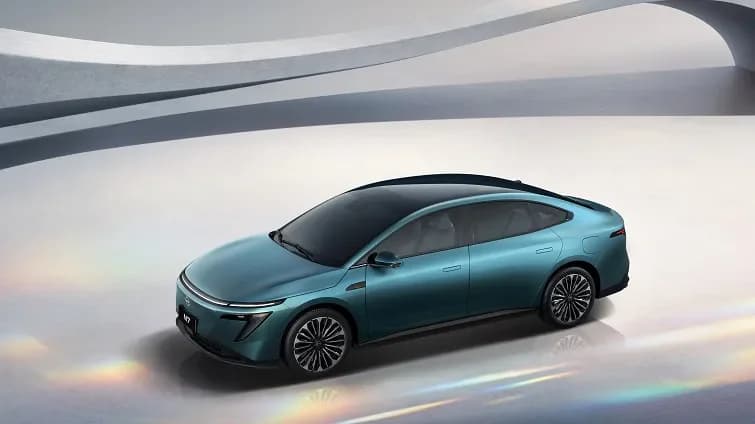
The N7 is an electric sedan developed and built in China by Dongfeng Nissan. In its official November 2024 release, Nissan called it the first model based on Dongfeng Nissan’s new modular architecture for electrified vehicles. The release lists a 4,930-millimetre overall length, a 2,915-mm wheelbase and an infotainment system using Qualcomm’s Snapdragon 8295P platform.
Nissan said the N7 was developed and produced in China and that its longer-term plan was to accelerate the development and export of new-energy vehicles from the country. That is a useful example of how the company is trying to borrow some of the advantages it sees in the Chinese market instead of treating China only as a difficult sales region.
The Frontier Pro is a plug-in hybrid pickup prepared for China. Nissan’s preliminary specification sheet lists five seats, a 10-inch driver display, a 14.6-inch infotainment screen, a panoramic roof and vehicle-to-load outlets. Nissan has identified Mexico as an initial Latin American market for the model and said it would expand the pickup elsewhere in the region. There is no official confirmation that either the N7 or Frontier Pro will be sold in the United States.
The US market is a separate challenge
Meunier expects Chinese brands to take at least five years to enter the United States directly. Barriers are higher than in many other markets, and U.S. lawmakers have considered measures that would block Chinese automakers from selling or manufacturing vehicles in the country.
Chinese-built vehicles have nevertheless reached U.S. customers under established international badges. Motor1’s report points to the Buick Envision, Volvo S90, Polestar 2 and Lincoln Nautilus as examples from different periods and market arrangements. Nissan’s concern is what happens if a Chinese company builds a factory south of the U.S. border and sells a vehicle under its own brand.
That distinction also explains why a Mexican factory would matter before a Chinese-branded vehicle appears in a U.S. dealership. A plant could create a regional footprint, develop supplier relationships and give a manufacturer more time to adapt its products and compliance strategy. None of those steps guarantees access to the U.S. market, but they would make the competitive threat more concrete.
What is confirmed
There is currently a public estimate from a Nissan executive, not a confirmed Chinese factory project in Mexico. The company, site, investment and future models remain unknown. The timing is also a forecast, and it may change with trade policy, investment conditions and the economics of North American production.
What Nissan has confirmed is a broader shift in its own product strategy. The company is cutting costs, developing vehicles with Dongfeng Nissan in China and planning exports of China-developed products. The N7 and Frontier Pro illustrate that direction, but they do not prove that Nissan will bring either model to the United States.
If Chinese automakers do establish Mexican production, the debate will move from whether distance and tariffs can keep them away to whether established brands can match their cost base, software pace and model cycle. Nissan is preparing for that possibility before the answer is visible in North American showrooms.


