Commercial-offer information was rechecked on 9 September 2026.
Short answer
The Dacia Logan Eco-G 120 is the right choice if you want a new Logan and care about cost per kilometre. The 1.2-litre turbo engine makes 120 hp on LPG, and Dacia offers it with a six-speed manual or a six-speed dual-clutch automatic.
Official WLTP figures are 6.6 l/100 km on LPG and 5.3 l/100 km on petrol for the manual, and 6.7 l/100 km on LPG and 5.4 l/100 km on petrol for the automatic. The consumption gap between gearboxes is small on paper. The choice comes down mainly to price, comfort in traffic and how much you want to change gears yourself.
In short:
- choose Eco-G 120 manual if you want the lowest purchase price and a simpler configuration;
- choose Eco-G 120 auto if you spend a lot of time in congestion and accept the extra cost of the transmission;
- calculate savings with prices at the stations you use, not with an advertising percentage;
- treat range of up to about 1,500 km as a theoretical figure for both tanks full;
- ask for the final offer in writing, because a campaign price may include a scrappage voucher, finance and time-limited discounts.
This is a buying and cost guide, not a road test. For driving impressions and space, read separately the 2026 Dacia Logan facelift test.
1. What the Eco-G 120 engine on the Logan is
Eco-G 120 is a three-cylinder turbo engine with 1,199 cc and factory dual petrol-LPG fuelling. Dacia's technical sheet lists 120 hp on LPG, 115 hp on petrol and a maximum torque of 197 Nm. Drive is to the front wheels.
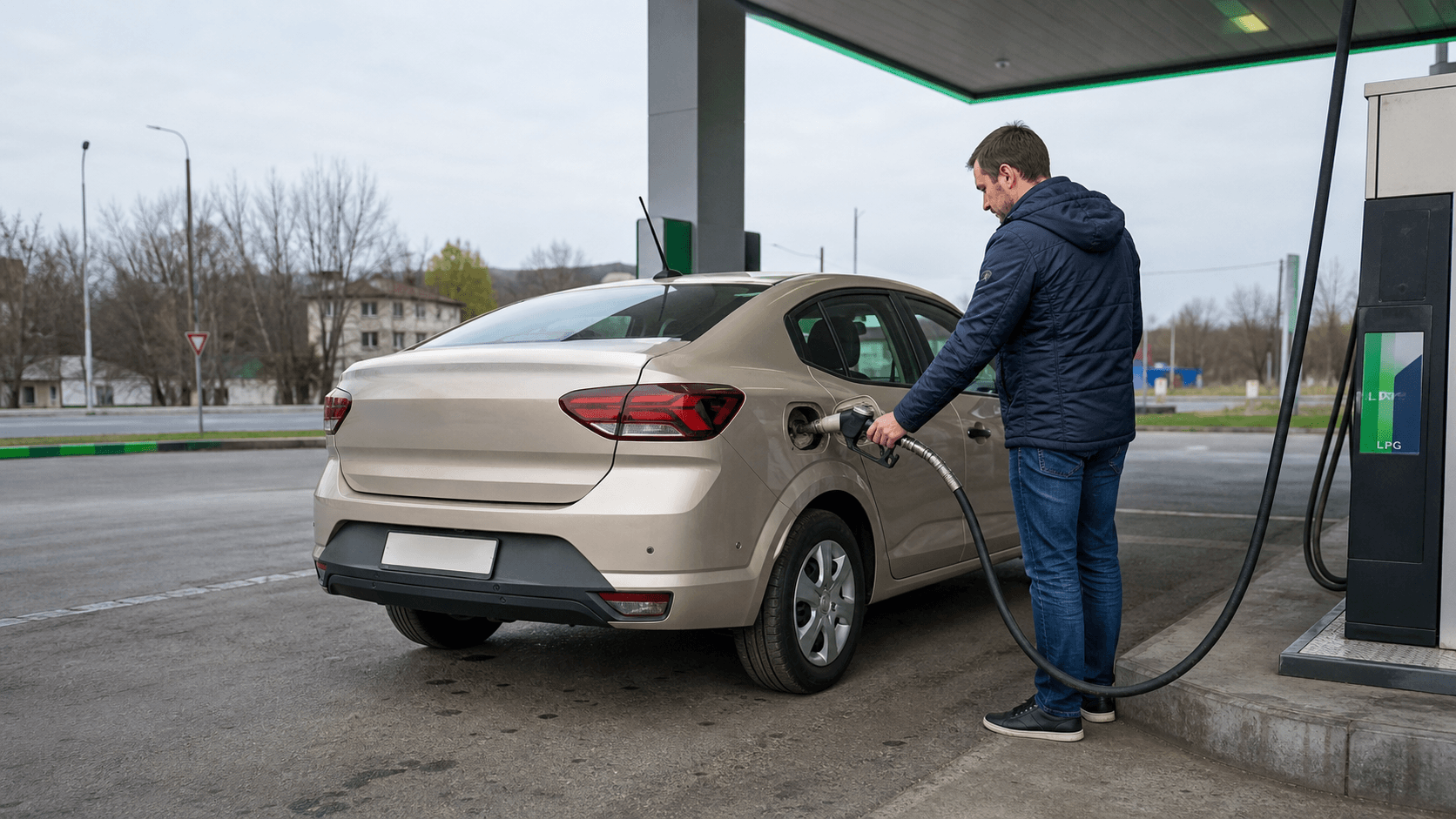
The engine is not a hybrid. The Logan has a single combustion engine and two fuel circuits. The car starts on petrol, then can switch to LPG when operating conditions are met. The driver can select the fuel with a button, and if LPG runs out, the system switches to petrol.
Dacia uses an LPG tank in place of the spare wheel. The Logan brochure from March 2026 lists a tank of about 49 litres for LPG and 50 litres for petrol; the launch communication gives the more precise capacity of 49.6 litres for LPG. The layout keeps usable boot volume, but a spare wheel is not available on LPG versions. The repair kit therefore becomes something you should check at delivery.
2. Official consumption: manual versus automatic
Homologated data in the Romanian brochure allow a direct comparison:
| Version | LPG consumption WLTP | Petrol consumption WLTP | 0-100 km/h on LPG | Minimum kerb weight |
|---|---|---|---|---|
| Eco-G 120 manual, 6 speeds | 6.6 l/100 km | 5.3 l/100 km | 10.3 s | 1,194 kg |
| Eco-G 120 auto, dual clutch, 6 speeds | 6.7 l/100 km | 5.4 l/100 km | 9.9 s | 1,235 kg |
The automatic adds about 41 kg to the minimum weight and, in the official combined cycle, 0.1 l/100 km of consumption on each fuel. The difference is too small to decide a purchase on consumption alone. Traffic, temperature, speed, load, tyre pressure and the share of urban driving can change the result more than the 0.1 litres in the table.
WLTP figures are useful for comparison; they are not a promise for every route. Record consumption separately on LPG and petrol after several full fill-ups. The trip computer and a single short drive are not enough for a sound calculation.
3. What 100 km costs with the Logan Eco-G 120
The formula is simple:
cost for 100 km = consumption in l/100 km × price of one litre of fuel
A strictly mathematical example, not a guaranteed current price: at €0.80/l for LPG and €1.80/l for petrol, the result would be:
| Version | Cost/100 km on LPG | Cost/100 km on petrol | Theoretical difference |
|---|---|---|---|
| manual | €5.28 | €9.54 | €4.26 |
| automatic | €5.36 | €9.72 | €4.36 |
At 15,000 km a year, the manual example would mean about €792 on LPG versus €1,431 on petrol, a theoretical difference of €639. The calculation does not include petrol used at start-up, deviations from WLTP, servicing, insurance or changing pump prices.
Replace the two prices with the real figures in your area. If you have a convenient LPG station on your daily route, the saving is easier to keep. If you detour to fill up or drive very little, the time needed to recover a purchase-price difference lengthens.
4. What range it has in practice
Dacia quotes for the Logan a combined range of up to about 1,500 km, and the European presentation statement mentions 1,590 km for Sandero and Logan. The gap between the two official figures shows why range should not be treated as a guaranteed distance.
A simple calculation with the 49.6-litre LPG tank and WLTP consumption of 6.6 l/100 km gives about 752 km on LPG for the manual. The petrol tank theoretically adds about another 943 km at 5.3 l/100 km. The mathematical sum exceeds the rounded brochure figure, but in use you do not empty every tank to the last drop, and real consumption can be higher.
For planning a long trip, work with a reserve:
- start from the average you measured on the last three fill-ups;
- use the capacity actually filled, not the nominal capacity;
- subtract 10-15% for wind, cold, motorway, load and a safety margin;
- check LPG stations in advance, but keep enough petrol for routes without an LPG pump.
The large range is useful, but it does not force the driver to carry both tanks full all the time. For urban use you can fill less and recalculate mass and budget according to your routine.
5. Manual or dual-clutch automatic
When the manual makes sense
The manual is the logical direction for a buyer who puts the initial price ahead of comfort in congestion. It has six speeds and offers almost the same performance and homologated consumption as the automatic.
The manual is worth it if:
- you drive a lot extra-urban and change gear rarely;
- you want the Essential version or the lowest entry cost;
- you keep the car a long time and prefer a simpler transmission;
- clutch work in town does not bother you;
- the extra cost of the automatic would eat the budget for useful equipment, tyres or insurance.
When the automatic makes sense
Eco-G 120 auto uses a six-speed dual-clutch transmission. Dacia also fits it with paddles behind the steering wheel. The main gain is comfort at pull-away, manoeuvres and slow traffic, not fuel economy.
The automatic is worth it if:
- you spend time every day in congested traffic;
- several family members will drive the car;
- you want factory LPG without giving up an automatic gearbox;
- you have included the purchase difference and transmission maintenance in the budget;
- you have tested cold starts, a slope, parking and slow traffic.
Do not buy the automatic only for the 0.4-second better acceleration figure on LPG. On the Logan, the usefulness of the transmission is felt mainly in daily routine.
6. The price in Romania and the trap of “from” offers
When orders opened, on 19 December 2025, Dacia published the following prices including VAT:
| Trim | Eco-G 120 manual | Eco-G 120 auto |
|---|---|---|
| Essential | €14,950 | unavailable at launch |
| Expression | €15,950 | €17,550 |
| Journey | €16,950 | €18,550 |
These are launch references, not guaranteed prices in September 2026. At the 9 September check, Dacia listed Logan Essential Eco-G 120 from €12,650 including VAT, through the Rabla programme. The offer was stated as valid until 30 September 2026, subject to stock and available funds.
The sum included the 10,000 lei eco-voucher, calculated by Dacia at €1,909, and a commercial discount of €391. The finance offer could include a separate discount, but also costs and services belonging to the credit contract. For that reason, the €12,650 price should not be compared directly with the list price of a car bought without Rabla and without finance.
For a fair comparison, ask on the same day for three figures:
- the list price of the chosen configuration and colour;
- the price after the commercial discount, without finance;
- the final price with eco-voucher, finance, fees, services and compulsory insurance.
A low monthly instalment does not prove a low total cost. Check the deposit, interest, APR, fees, residual value, comprehensive insurance and the total amount payable. Compare the manual and automatic at the same trim level and on the same payment terms.
For launch context, see also the article on 2026 Logan facelift prices.
7. Essential, Expression or Journey
Essential is the budget choice. It has the mandatory safety systems, manual air conditioning, cruise control and a phone-based multimedia solution; the 10-inch screen appears as an option. It is the version to compare if you want a Logan Eco-G for a fleet, commuting or a family and are not chasing decorative equipment.
Expression adds practical features, including the 10-inch centre screen, electric rear windows and electrically adjustable mirrors. It is also the threshold from which the automatic appears in the range structure published at launch. For many buyers, this is where usual equipment and a still-controllable price meet.
Journey brings automatic air conditioning, a 7-inch digital instrument cluster, 16-inch alloy wheels, keyless access and other equipment. Check every option in the concrete offer: the brochure separates standard from optional items, and cars in stock may have packs and colours that change the price.
The boot remains the model's practical argument. The brochure lists 528 dm³ VDA or 628 litres under ISO 3832, two different measuring methods. Do not compare the 628 l figure with a rival's VDA volume. Take the pushchair, suitcases or boxes you use to the showroom and check the opening, the sill and the 1/3-2/3 folding rear seat.
8. Who the Logan Eco-G 120 is for
Commuting 15,000-30,000 km a year
Eco-G makes most sense when you drive enough for the lower LPG price to matter. Compare, though, the distance to the station, pump hours and the share of motorway. Use your own cost formula, with consumption measured after running-in.
A family that wants a new car and a large boot
The Logan offers a three-person rear bench and a large boot for the price. Before ordering, try child seats, the driving position, boot access and the maximum authorised mass. For seven seats or tall objects, the 2026 Dacia Duster and Jogger answer other needs; they are not direct substitutes.
Town and daily traffic
The automatic is more comfortable, but the Logan is 4.41 m long. If a saloon boot is not needed, a hatchback can be simpler to park. Compare with Sandero on the same engine, trim and payment type, not only on the advertised price.
Low mileage, under 8,000-10,000 km a year
LPG can still be cheap per kilometre, but the absolute annual saving will be smaller. In that scenario, price, gearbox comfort and equipment can matter more than the fuel difference. Compare TCe 100 manual as well, then calculate total cost over the period you will keep the car.
9. What to check on a test drive and at delivery
Eco-G is factory-fitted, but the car should be checked as carefully as any new vehicle.
- Start the car from cold and watch the switch from petrol to LPG without warning lights or error messages.
- Check the separate LPG gauge and the manual switch between fuels.
- On the manual, test hill starts, the gearshift and clutch-pedal position.
- On the automatic, repeat slow pull-aways, reverse, a slope and stops in traffic; ask for an explanation of the paddles and transmission modes.
- Check the petrol and LPG filler caps, the filling adaptor if included, and easy access to the connector.
- Confirm the presence of the repair kit, compressor, warning triangles, first-aid kit and fire extinguisher provided at handover.
- Try the screen, phone connection, camera, sensors, climate control and all USB-C sockets in the ordered specification.
- Check tyres and wheels: 185/65 R15 or 195/55 R16, depending on version.
- Inspect the paint in natural light, door edges, the boot and plastic parts.
- Ask for the VIN, configuration sheet, warranty certificate and the maintenance plan valid for that VIN.
- Note the first service interval from the car's documents, not from a general article about LPG.
- Insist that any missing item, scratch or commercial promise appears in the handover report.
Checklist before you sign the order
- List price and final price appear separately.
- The Rabla discount is not presented as a commercial discount offered to everyone.
- Deposit, APR, fees and total amount payable are written in the offer.
- The trim is clearly identified: Essential, Expression or Journey.
- The engine is Eco-G 120, 1,199 cc, not the old Eco-G 100.
- The gearbox is noted as manual or dual-clutch automatic, both six-speed.
- Colour, wheels, upholstery and optional packs are listed in the configuration.
- Estimated delivery time and deposit-return conditions are written down.
- The warranty covers the car and the factory-fitted LPG system.
- The maintenance plan is the one for that VIN and the Eco-G 120 engine.
- You have calculated cost per 100 km with local LPG and petrol prices.
- You have included petrol used at start-up and a realistic deviation from WLTP.
- The LPG station used daily is accessible on the usual route.
- You have tried the chosen gearbox in traffic, on a slope and when parking.
- You have checked that the boot and rear seat match the family's objects.
- You know the LPG tank occupies the spare-wheel space.
- The repair kit and filling accessories are included at handover.
- The final offer does not rely on a campaign that expires before delivery.
Frequently asked questions
How much does the Dacia Logan Eco-G 120 use on LPG?
The official WLTP figure is 6.6 l/100 km for the manual and 6.7 l/100 km for the dual-clutch automatic. Real consumption depends on route, temperature, speed, traffic, load and tyres.
How much does it use on petrol?
The Dacia brochure lists 5.3 l/100 km for the manual and 5.4 l/100 km for the automatic, in the WLTP combined cycle. The engine starts on petrol, so you will use petrol even if you mostly run on LPG.
What range does the Logan Eco-G 120 have?
Dacia quotes up to about 1,500 km with both tanks, and the European launch material lists 1,590 km. For planning, use the consumption you have measured and keep a 10-15% reserve.
Is the manual or automatic better?
The manual is more suitable if you want the lowest price and simplicity. The automatic is worth it mainly in congested traffic. Official consumption differs by only 0.1 l/100 km, so comfort and budget decide more than fuel.
Does Eco-G 120 have direct injection?
The sheet of a 2026 Logan car in official Dacia stock lists direct injection for petrol and indirect for LPG. The engine is a turbo three-cylinder with 1,199 cc. For parts and service operations, use the data for the VIN.
Does the Logan Eco-G lose boot space because of the LPG tank?
The tank is installed in place of the spare wheel, under the floor, so it does not occupy the declared usable boot volume. The practical drawback is that the LPG version cannot be ordered with a spare wheel; it gets a repair kit.
How often is the LPG system serviced?
Follow the maintenance plan handed over with the car and linked to the VIN. Dacia's general LPG page mentions a service at 20,000 km or annually and an extra valve operation at 120,000 km, but intervals can depend on model, market and version. The contract and the car's service book take priority.
Is the Logan Eco-G 120 worth it for short trips?
It can work without problems, but the annual saving is smaller if you drive little, and part of the distance is covered on petrol at start-up. Calculate total cost and compare with TCe 100, not only the price of a litre of LPG.
Is it the same engine as the old Eco-G 100?
No. Eco-G 120 has 1.2 litres, 120 hp on LPG and can be paired with a manual or automatic transmission. The previous Eco-G 100 had a different displacement and power. Do not automatically use the old version's intervals, consumption or parts for Eco-G 120.
Official sources consulted
- Dacia Logan brochure, March 2026: engines, consumption, masses, equipment and dimensions
- Dacia Romania: Logan technical data
- Dacia Romania: opening of orders and launch prices
- Dacia Romania: Eco-G 120, tank and range
- Dacia Romania: questions on LPG use and maintenance
If you are looking at a used car, the procedure is different: check the system, paperwork and servicing of a used LPG car and compare separately with used Dacia Sandero.