
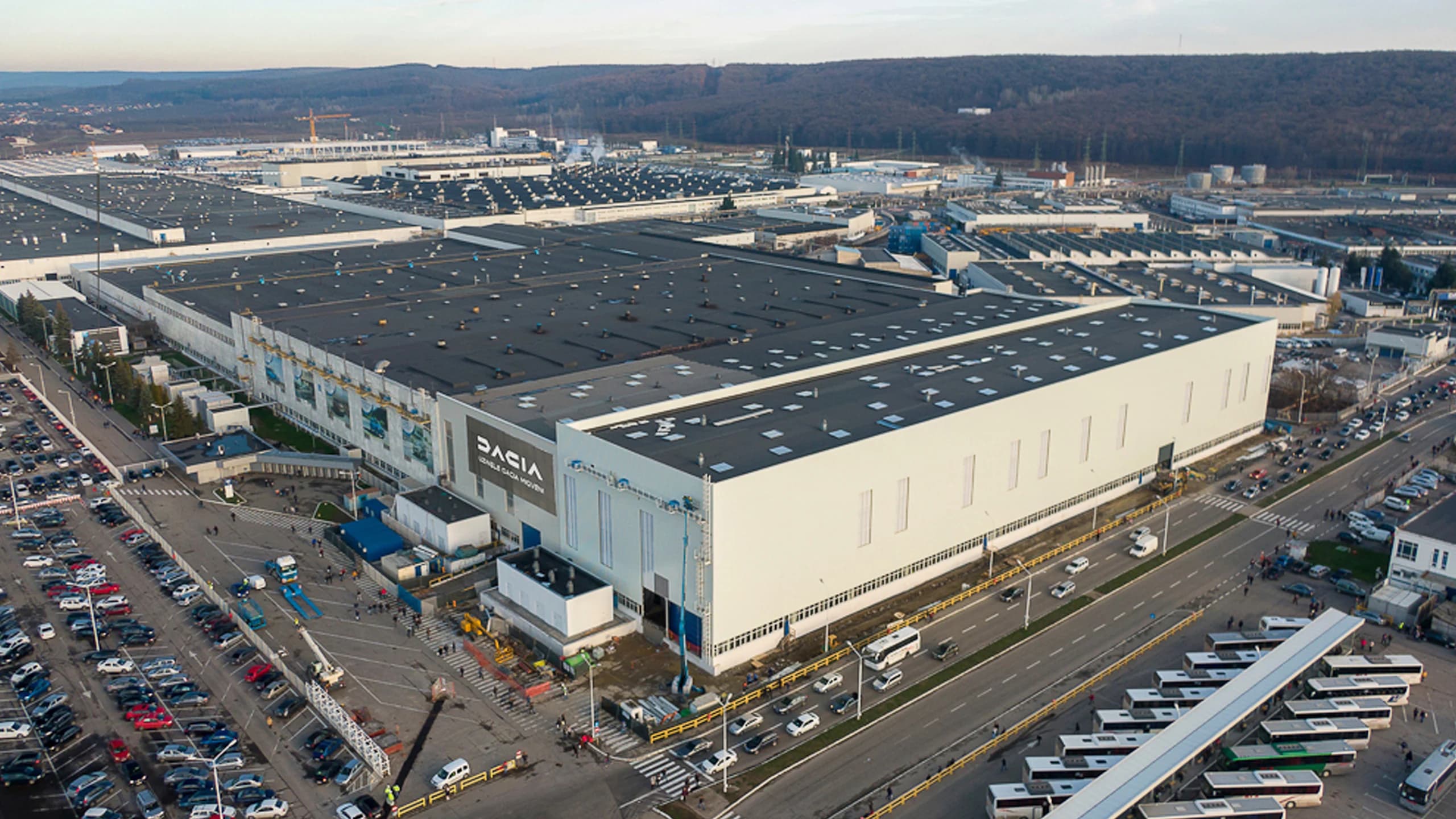
Dacia will temporarily stop vehicle production at its Mioveni plant for four consecutive days in October. The company confirmed the interruption after employees were informed that weaker demand for Dacia vehicles required the production schedule to be adjusted. The measure is a temporary operating decision; it is not an announcement that the Romanian plant is closing or that a current model is being withdrawn.
The pause comes during a year in which Dacia’s output has fallen in Romania and its sales have declined in several European markets. Dacia’s director has estimated a double-digit production decrease for 2026, linking the pressure to weaker demand for traditional combustion-engine vehicles while electric-car sales continue to grow in Europe. Romanian registration data also show a smaller new-car market during the first eight months of the year.
What the production pause means
The employee notice covers four consecutive days in October. The Mioveni industrial platform is larger than the vehicle assembly line alone. It includes pressing, body, chassis, paint and assembly departments, as well as logistics and component-related activities that support other Renault plants.
The reported measure concerns vehicle manufacturing. The available information does not establish that every operation across the industrial platform will stop at the same time. The exact work arrangements and employee rights are governed by the internal notice and the collective labour agreement. Dacia has not described the pause as a permanent change to the plant’s capacity.
Production is expected to resume after the announced interval, but the pace for the rest of the year will depend on incoming orders and on demand in the markets supplied by Mioveni. A few days without vehicle assembly therefore provide a clear signal about short-term scheduling, but they do not by themselves define the plant’s long-term future.
Mioveni output is down by more than 14%
Figures reported for the plant through the end of August show 159,200 vehicles produced in the first eight months of 2026, more than 30,000 fewer than in the same period of the previous year. That represents a decline of more than 14%. The production trend helps explain why the company is matching factory output more closely to the orders available to the commercial network.
The Romanian Automobile Manufacturers Association, known as ACAROM, reported that the two Romanian vehicle plants produced 319,750 cars in the first eight months of 2026. Dacia accounted for 169,014 units at Mioveni, while Ford Otosan built 150,736 units in Craiova. The combined national total was 7.8% below the comparable period in 2025.
Monthly data show why a single month should not be read without context. Dacia built 25,869 cars in July. In August, Mioveni production was 3,741 vehicles, while Ford Otosan produced 8,866 cars in Craiova. August normally includes holiday and maintenance periods, so the monthly comparison is affected by the seasonal production calendar. The first-eight-month total is a more useful measure of the year-to-date trend.
A changing Romanian market
ACAROM recorded 86,142 new passenger-car registrations in Romania during January to August 2026, compared with 95,843 in the same period of 2025. The decrease was 10.12%. August alone brought 9,552 new registrations, down 36.85% year on year.
The powertrain split was uneven. Full-electric registrations increased by 50% to 7,018 units in the first eight months, while hybrids reached 49,282 units, up 2.1%. Petrol registrations fell by 31.3% and diesel registrations by 39.7%. This does not mean that Dacia has lost its position in Romania: the brand remained first in the January-August new-car ranking with 17,114 registrations.
A market leader can still produce fewer cars when the total market contracts, when the mix of powertrains changes or when deliveries and dealer orders slow down. That distinction is important in the Mioveni case. The pause reflects the relationship between factory output and current demand, not a simple conclusion that Dacia has stopped selling vehicles in Romania.
Renault Group reported 327,077 Dacia sales in the first half of 2026, down 8.1% from the first half of 2025. The group pointed to fast growth in electric-car sales and the increasing presence of Chinese brands in Europe as part of the market context. It also said Dacia’s Duster and Bigster were supporting a strong increase in the brand’s hybrid sales.
Which vehicles are built at Mioveni
Dacia’s official description of the Mioveni industrial platform identifies Duster and Bigster as the vehicle models produced there. The vehicle plant has more than 6,000 employees and a stated capacity of 1,160 cars per day across three shifts. More than 88% of its output is exported.
Mioveni also manufactures parts for Renault plants that assemble Logan, Sandero and Duster. Dacia lists destinations including France, Morocco, Slovenia, Turkey, Brazil, Colombia, India, South Africa, Algeria and Argentina. These component and logistics activities are separate from the finished-car production volumes reported by ACAROM.
Renault Group says the Mioveni plant reached a cumulative milestone of eight million Dacia vehicles by the end of 2025. In 2026, the plant produced the 100,000th Bigster. Those milestones show the scale of the site, but they do not guarantee that future production volumes will remain unchanged.
A pause is not a plant closure
A temporary production interruption caused by weaker orders is different from a decision to close a factory. Dacia continues to build the current Duster and Bigster at Mioveni, and the company has not announced that those programmes are being removed from Romania. The October pause also does not determine where the next generations will be built.
For the plant, the immediate issue is aligning assembly volume with cars ordered by dealers and export markets. For employees and suppliers, lower production can mean fewer hours, revised shifts or voluntary workforce measures, but the exact consequences depend on decisions by the company and on the order flow in the coming months.
Dacia is also working on electrification and energy projects. In September, the company announced a photovoltaic power plant for self-consumption at Mioveni, supported by European funding through Romania’s Modernisation Fund. That project does not explain the October pause, but it shows that the site remains part of Renault Group’s industrial plans and continues to receive investment.
Sources
- Dacia Romania – Dacia’s Mioveni industrial platform
- Renault Group – Mioveni Plant
- ACAROM – Romanian car production in the first eight months of 2026
- ACAROM – Romanian new-car registrations in August 2026
- Renault Group – Dacia commercial results in the first half of 2026
- Dacia – photovoltaic power project for Mioveni


