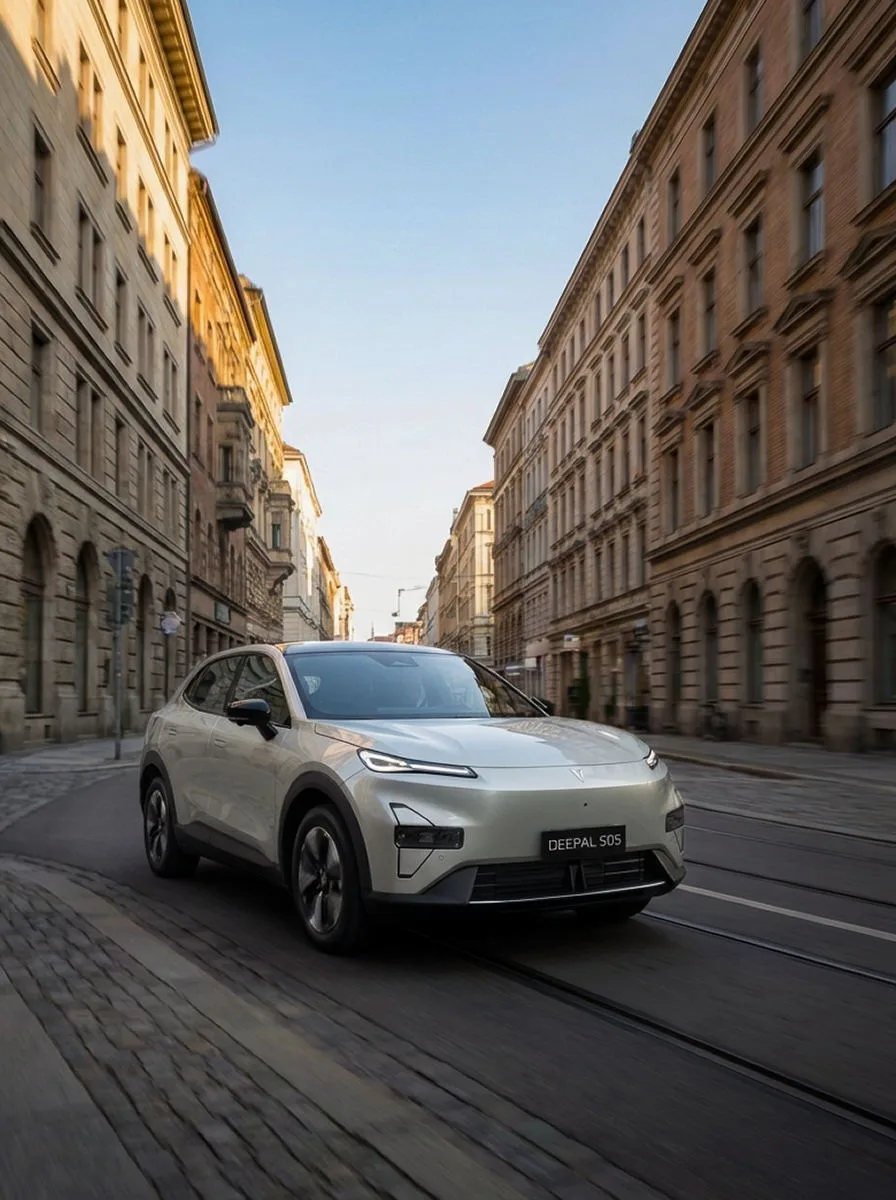
The European Changan Deepal S05 PHEV uses a 190 kW, or 258 hp, plug-in hybrid system built around a 172 kW electric motor and a 1.5-litre petrol engine rated at 63 kW. Changan’s European material gives the SUV a 100 km WLTP electric range, an 18.4 kWh LFP battery and DC charging at up to 55 kW. Local price and availability still depend on the country.
These figures come from Changan Europe’s June 2026 press material and the model’s European technical overview. The PHEV is a separate powertrain from the battery-electric Deepal S05. It should not be described as the same car with a small range extender: the battery, drivetrain layout, charging limits and official consumption figures are different.
The Ultra-Hybrid system
Changan calls the powertrain Ultra-Hybrid. Its permanent-magnet synchronous motor produces 172 kW and 290 Nm, while the four-cylinder petrol engine has 63 kW and 122 Nm. The stated combined system output is 190 kW, equivalent to 258 hp. The European product overview lists front-wheel drive and a top speed of 180 km/h.
The electric motor draws energy from an 18.42 kWh LFP battery, rounded to 18.4 kWh in Changan’s press release. The battery is large enough to support daily electric driving for some users, while the petrol engine provides another energy source for longer trips. The system’s real operating split will depend on the selected drive mode, battery state and journey conditions.
The 258 hp figure is a manufacturer specification for total system output. It is not a Carboratory dyno measurement, and the combined number should not be interpreted as the simple arithmetic sum of every peak from both power sources. Hybrid systems manage the engine, motor, battery and transmission according to operating conditions.
WLTP range and consumption
Changan quotes 100 km of pure electric range in the WLTP cycle. That is an official homologation figure, not a guarantee for every trip. Weather, speed, cabin heating, payload, tyre pressure and driving style can all reduce the distance available from a full charge.
The European figures list weighted combined consumption of 2.03 litres per 100 km and weighted combined CO₂ emissions of 47 g/km. With the battery discharged, the combined fuel-consumption figure is 5.4 litres per 100 km. The weighted value is produced by the WLTP methodology and assumes a defined use of electric energy during the test. For an owner who rarely charges, the discharged-battery figure is the more practical reference for long-term running costs.
Official PHEV figures need to be read with the charging routine in mind. A driver who charges at home and uses the S05 for short urban trips can spend a large part of the week using electricity. A driver who treats the vehicle like a conventional hybrid and does not plug it in will not reproduce the 2.03 l/100 km weighted figure. Carboratory has not independently tested this vehicle.
Charging and V2L
The S05 PHEV supports AC charging at up to 11 kW. Changan also lists DC fast charging at up to 55 kW. The maximum power does not describe the entire charging session: the battery’s temperature, state of charge and the station’s actual output affect the time needed.
Vehicle-to-Load is standard equipment. V2L allows the battery to supply compatible external equipment through the vehicle’s outlet and adapter. That can be useful for tools, outdoor equipment or temporary power needs. It does not automatically mean that the car can power a house or feed electricity back into the grid. Those functions require separate hardware and approvals that Changan has not confirmed for this model.
Space and equipment
The European technical data lists a length of 4,598 mm, a width of 1,900 mm, a height of 1,600 mm and a 2,880 mm wheelbase. Boot capacity is quoted at 552 litres with the rear seats in position and up to 1,310 litres with the rear seats folded. The PHEV hardware changes the packaging compared with the battery-electric version, but the car remains a compact-to-mid-size SUV for European buyers.
Changan offers Pro and Max trim levels in the European press material. Pro equipment includes 17 advanced driver-assistance systems, a 15.4-inch central touchscreen, over-the-air updates, Android Auto, Apple CarPlay, online navigation and a 360-degree camera with a Transparent Chassis view.
The Max adds equipment such as heated and ventilated front seats, a heated steering wheel, an augmented-reality head-up display, 64-colour ambient lighting, 50 W wireless charging and memory functions for the front seats. A tow bar rated for up to 1,600 kg is available for both trims. A panoramic glass roof and 20-inch wheels are listed as Max options, depending on the market.
European development and safety context
Changan says the S05 PHEV was developed with European requirements in mind. The model’s design was largely developed at the company’s European Design Center in Turin, while the Birmingham research and development centre was involved in adapting the vehicle for European customers.
The company says the PHEV was developed in line with five-star Euro NCAP safety standards. The battery-electric Deepal S05 achieved a five-star Euro NCAP result at the end of 2025, with 94 per cent for adult occupant protection, 87 per cent for child occupant protection, 78 per cent for vulnerable road users and 76 per cent for safety assist.
Those results belong to the battery-electric version. They should not be presented as a separate crash-test result for the PHEV. A plug-in hybrid with different mass and powertrain packaging needs its own test result if Euro NCAP publishes one.
Changan Europe lists a seven-year or 160,000 km vehicle warranty and an eight-year or 200,000 km warranty for the vehicle’s three electrical systems. The exact terms, exclusions and servicing requirements must be checked in the local contract rather than assumed from another European market.
Launch timing and the Romanian question
Changan Europe announced left-hand-drive pre-orders and deliveries from the end of July 2026. Changan UK announced a later UK launch window and said UK pricing and final specification would be confirmed. Neither announcement proves that the S05 PHEV is already orderable in Romania.
Country-specific price, tax treatment, trim content, warranty administration, service coverage and charging support will determine the real ownership proposition. The Romanian buyer needs a local importer’s price list and delivery terms, not a figure copied from the UK or Germany.
The Deepal S05 PHEV therefore has a clear technical proposition: 258 hp, a 100 km WLTP electric range, external charging, a petrol engine for longer journeys and standard V2L. Whether those numbers make it competitive in Romania will depend on the local price, the service network and how often the owner can charge the battery. Those questions remain market-specific.