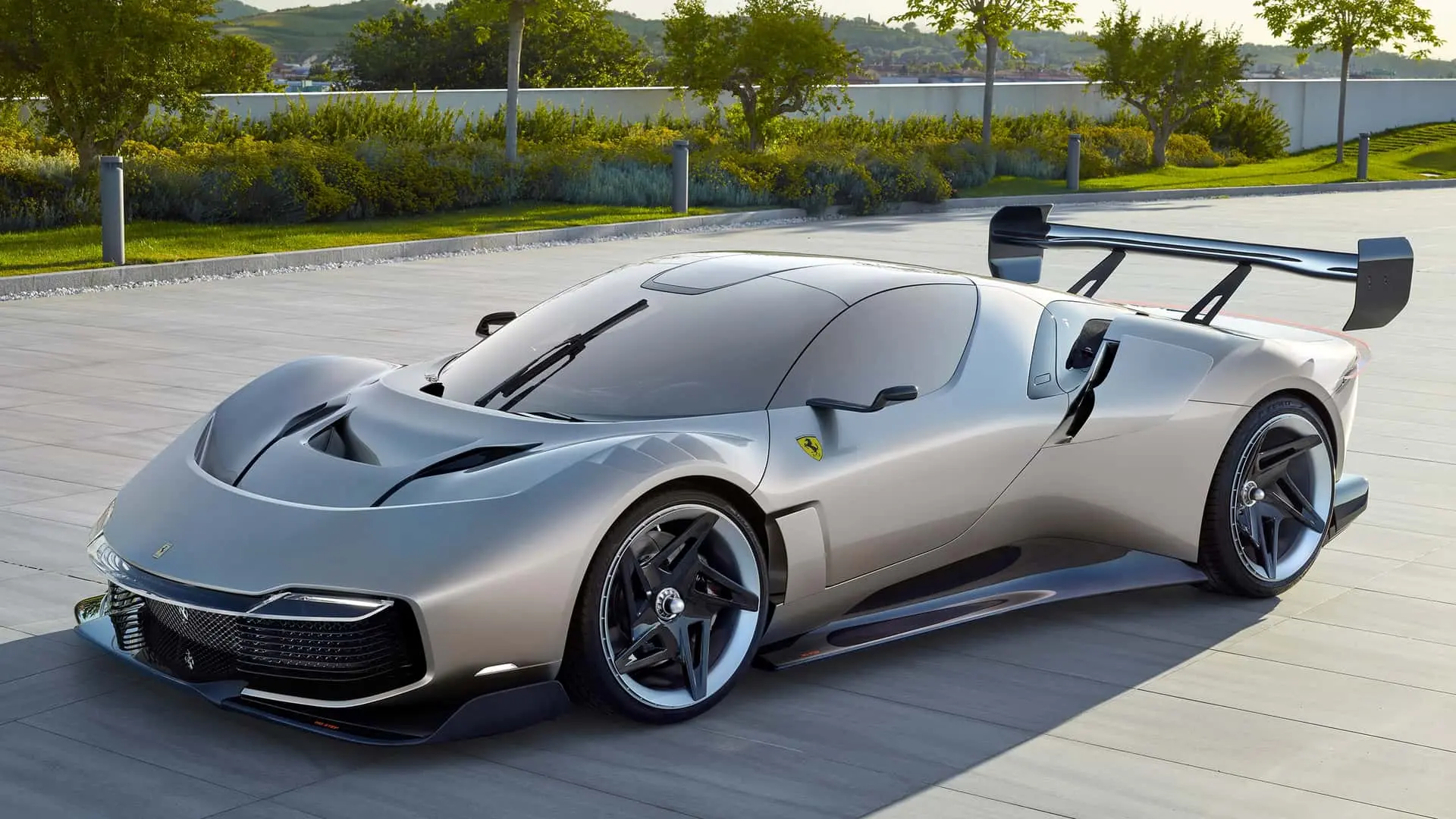
Image for illustration: Ferrari KC23. Photo: Ferrari
Ferrari wants to turn taillights into active-aerodynamics parts
Ferrari has filed a patent in the United States for a system in which the rear light units no longer serve only for illumination. The taillights can move relative to the spoiler, enter the airflow and help change aerodynamic downforce on the rear axle.
The US patent application US 2026/0242013 A1, titled “Sport road vehicle with variable rear aerodynamic load”, was published on 20 August 2026. The applicant is Ferrari S.p.A., and the inventors named are Salvatore Sedda and Jason Lopes Furtado.
The document describes the operating principle and several possible configurations. It does not announce a new model and does not confirm that the solution will reach a production car.
How Ferrari’s movable taillights work
In the normal position, the lighting assembly remains integrated in the rear and functions as an ordinary taillight. In the second position, an actuator moves it up and rearwards, so that part of the housing extends beyond the spoiler’s trailing edge.
Once in the path of the air leaving the spoiler, the taillight housing becomes an additional aerodynamic surface. The purpose stated in the patent is to increase rear aerodynamic load, that is, the force pressing the axle onto the road at speed.
One variant includes an aerodynamic channel bounded by the spoiler and a lower surface close to the diffuser. The taillight can occupy three positions:
- fully retracted, with no contribution to aerodynamic downforce;
- raised and extended beyond the spoiler edge, to work together with it;
- repositioned inside the channel, where it changes the section through which the air passes.
The patent describes both a translational movement and a tilting one. The choice of mechanism would depend on body shape and on how the manufacturer integrates the spoiler, diffuser and lights.
The two taillights can work separately
The documentation provides for two lighting assemblies, one on the left and one on the right, which can be commanded independently. In theory, the car could alter the airflow differently on each side of the rear axle.
The patent does not publish figures for downforce, actuation times or the speeds at which the system would come into operation. It is therefore impossible to say how large the advantage would be over a conventional active spoiler, or whether asymmetric movement would be used for cornering stability or for another control strategy.
The principle advantage is using a mandatory car component for two functions. Instead of adding another visible flap, Ferrari could integrate the moving surface into the taillight body. In return, the solution brings actuators, joints, wiring and seals into an area exposed to water, dust and high temperatures.
The drawings are not necessarily a future Ferrari
The document includes sketches with supercar proportions and another implementation close to the shape of a front-engined model. These drawings are technical examples used to explain the patent claims, not official images of a car under development.
A patent application shows that Ferrari wanted to protect the idea and the mechanism. It does not oblige the company to produce them. Manufacturers frequently file documentation for solutions that remain at the study stage, are modified before launch or appear only after several years.
Ferrari already uses active aerodynamics on road models, but the patent published in August 2026 proposes integrating the function into an element that is normally static. Until an official company announcement, movable taillights should be treated as a possible technical direction, not as confirmed equipment for the next Ferrari.
Frequently asked questions
Will Ferrari launch a car with movable taillights?
There is no confirmation. The document is a patent application and does not mention a model or a production timetable.
Do the taillights move only for design?
No. According to the patent, their movement alters the airflow and contributes to the aerodynamic load generated at the rear.
Can the system act differently on the left and the right?
Yes, the documentation provides for independent control of the two assemblies. The patent does not, however, offer a production calibration or figures on the effect achieved.