
Image: Motor1 / Ford. Image from the source article, used at the editor’s explicit request.
Ford Mustang GT3 brings a 1901 racing story back to the track
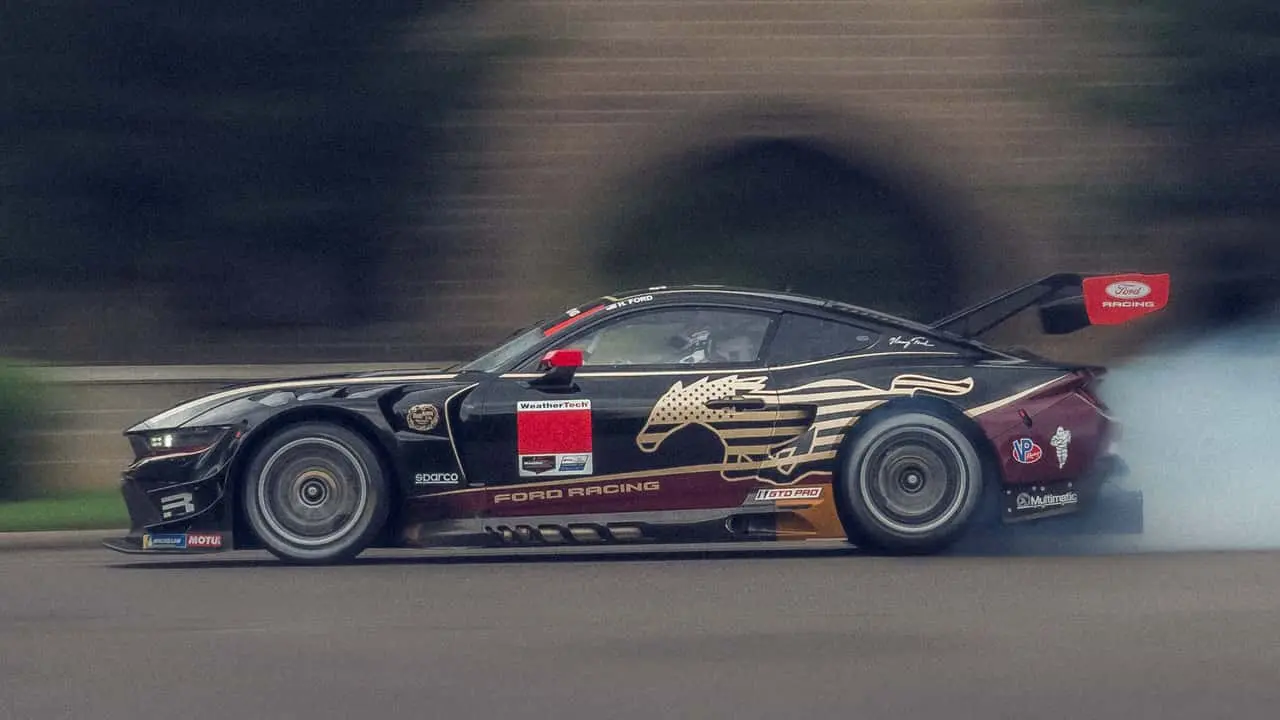
Ford is using two current Mustang GT3 race cars to tell a story that started 125 years ago. The cars will run a special livery inspired by Sweepstakes, the two-seat racer Henry Ford drove to victory in 1901. The design is planned for the No. 64 and No. 65 cars at Petit Le Mans, but it does not change the underlying GT3 specification. It is a historical interpretation applied to a modern endurance-racing programme.
The 1901 race behind the design
Henry Ford drove Sweepstakes in a 10-mile race at Grosse Pointe, Michigan, on 10 October 1901. He defeated Alexander Winton, a prominent manufacturer and racer of the period. Ford later used the result to help attract investors for his next automotive venture. Ford Motor Company was incorporated in June 1903.
The historical comparison needs some care. Sweepstakes was not a production Mustang and was built for a very different competitive environment. Ford describes its speed as roughly 60 mph, or about 97 km/h. That figure explains why the car was impressive in its own period, but it should not be compared directly with the lap speed or endurance capability of a present-day GT3 car.
A livery built around colour and detail
Ford says the design team recreated the original car’s colour palette instead of simply applying an old company badge to a modern race car. The result uses black as the background, with burgundy and gold graphics. The early Ford Motor Company logo appears in gold, while “Racing Since 1901” is written across the bonnet. Other graphics refer to Ford’s 1903 founding.
The tribute continues away from the bodywork. The drivers’ firesuits are styled after the three-piece outfit associated with Henry Ford when he raced Sweepstakes. These choices have no measurable effect on the car’s aerodynamics, power delivery or tyre performance. Their purpose is narrative: the livery allows the factory team to connect a current racing car with an early chapter in Ford’s corporate history.
Two cars in the GTD Pro field
The tribute cars are scheduled to compete in the GTD Pro class during the 10-hour Motul Petit Le Mans at Michelin Raceway Road Atlanta on 3 October. Dennis Olsen and Ben Barker are assigned to the No. 64 Mustang, while Christopher Mies and Frédéric Vervisch are listed for the No. 65.
Petit Le Mans is the season finale of the IMSA WeatherTech SportsCar Championship. A 10-hour race places demands on more than a car’s qualifying pace. Traffic between classes, pit-stop timing, tyre management, driver changes and reliability can all decide the result. A striking livery can define the appearance of a team, but it cannot compensate for a lost lap or a mechanical problem.
The illuminated Pony is part of the tribute
The Mustang GT3 already has an illuminated outline of the Mustang emblem on the rear fender, known as the “Glow Pony”. Ford says the Petit Le Mans cars will take that idea further by illuminating the full pony for the first time on a factory Mustang GT3. Inside the emblem is a black-and-gold American flag, linking the race-car theme with the United States’ 250th anniversary.
This is a visual feature rather than a performance upgrade. Ford has not presented it as a change to the engine, suspension, aero package or homologation specification. At night, however, it gives the cars a recognisable signature and reinforces the connection between the old racing story and the modern team identity.
What the Mustang GT3 actually is
Ford unveiled the Mustang GT3 at Le Mans in 2023. The race car is based on the seventh-generation Mustang family, including the Dark Horse connection, and entered FIA GT3 competition from 2024. Ford Performance developed the programme with Multimatic and M-Sport. The official specification lists a 5.4-litre naturally aspirated Coyote-based V8, bespoke suspension, a rear-mounted transaxle, carbon-fibre body panels and a dedicated aerodynamic package.
Ford Racing lists a target output of 550 horsepower and a six-speed rear-mounted manual transaxle. The manufacturer also notes that the figures are based on pre-production targets and can change. This matters because GT3 racing uses Balance of Performance to keep different cars within a comparable competitive window. IMSA describes GT3 cars as typically operating in a broad range around 500–600 horsepower and 1,200–1,300 kilograms, with traction control and ABS, subject to the series rules.
A programme with a longer horizon
The Sweepstakes livery is tied to Petit Le Mans, but the Mustang GT3 is not being presented as a one-off publicity project. The car has raced in IMSA and the FIA World Endurance Championship, and Ford used its Le Mans programme to connect the modern GT3 with the Mustang’s wider competition history. The brand has also committed to continue the same GTD Pro line-up for the 2027 season.
That commitment does not guarantee a result at Road Atlanta, nor does it mean the historical livery will become a permanent design. It does indicate that Ford sees the factory Mustang GT3 as a continuing sports-car programme rather than a single anniversary appearance.
Why this tribute matters
The two cars bring together very different forms of racing. Sweepstakes was a compact early racer involved in a short contest that helped Henry Ford attract financial backing. The Mustang GT3 is a heavily engineered endurance car built to share a circuit with several classes for 10 hours. The link is therefore not technical continuity; it is continuity of purpose. Ford is using competition to demonstrate capability, then using the visual language of competition to explain where its racing identity began.
The result will be judged twice: first by whether the livery communicates the 1901 story, and then by how the two Mustangs perform in the GTD Pro finale. For a modern GT3 programme, that combination of heritage and measurable racing pressure is more meaningful than a commemorative badge alone.


