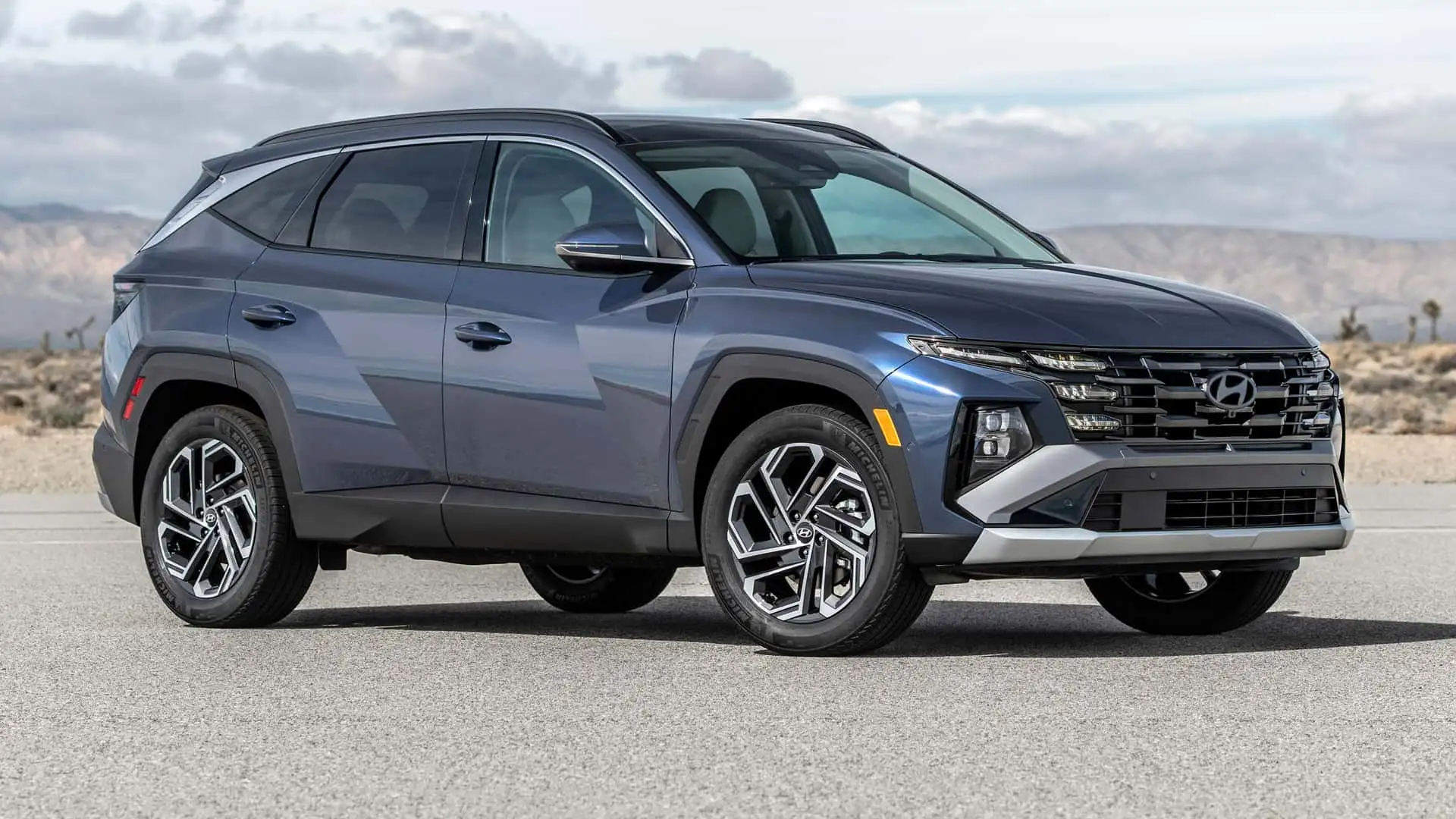
Tucson is Hyundai’s best-selling model worldwide and will get a new generation, including a hybrid version. Photo: Hyundai
Hyundai wants half of its North American sales to be hybrids by 2030
Hyundai is expanding its hybrid car offer in North America and wants this powertrain to account for 50% of its regional sales in 2030. The South Korean manufacturer is preparing more than ten hybrid models for the North American market and will produce several of them in the United States.
The plan was presented at CEO Investor Day on 26 August 2026. It is a regional target, not an announcement that half of all Hyundai cars sold worldwide will be hybrids. In Europe, the company is keeping a different strategy, with a stronger emphasis on fully electric models.
More than ten hybrid models for North America
Hyundai has not yet published the full list of the more than ten cars. The range will cover several sizes and price categories, and regional production will take place at Hyundai Motor Manufacturing Alabama and at the Hyundai Motor Group Metaplant America complex in Georgia.
The expansion starts from an already substantial base. Cumulative sales of Hyundai hybrid models in North America have exceeded one million units. In the first half of 2026, the company sold 595,457 cars in the region, its best half-year result in its history, according to figures given to investors.
In the United States, Hyundai delivered 489,656 units in the first six months, 3% more than in the same period of 2025. Tucson, Palisade and hybrid versions supported the increase. The manufacturer did not detail in the statement how many of those deliveries were hybrids.
The new Tucson Hybrid opens the next stage
The new-generation Hyundai Tucson and its hybrid version will reach the first markets in the fourth quarter of 2026. The model matters for this strategy because it has passed ten million cumulative sales and remains Hyundai’s best-selling family worldwide.
The company has not yet published all hybrid-system specifications for each region. Powertrains, drive, consumption and equipment can differ between North America, South Korea and Europe, so data from a US version should not automatically be used for the future Tucson destined for Romania.
Hyundai is also extending hybridisation to the Genesis brand. At the 2026 event it presented the GV80 Hybrid, the luxury brand’s first hybrid model. Genesis is also preparing an extended-range electric car, alongside the GV90 electric SUV.
Hyundai moves more directly onto Toyota’s ground
Motor1 interprets the expansion as an attack on Toyota’s position, the manufacturer that developed one of the broadest hybrid ranges and has sold the technology at scale for more than two decades. Hyundai did not name Toyota as a target in the investor statement.
The comparison is justified by overlapping ranges. Tucson Hybrid competes with the Toyota RAV4 Hybrid, Santa Fe Hybrid with Highlander Hybrid in some markets, and the two brands’ hybrid saloons address similar customers. Even so, an offer of more than ten models does not guarantee a 50% share; the outcome will depend on prices, factory capacity and demand in 2030.
For Hyundai, hybrids also have a financial role. The company estimates an operating margin of more than 9% in 2030, versus the previous 8–9% range. Management links the improvement to the expanded hybrid range, the launch of models with better margins and cost cuts.
The plan also includes EREV models, not only classic hybrids
Hyundai will launch in the first half of 2027 a Santa Fe EREV produced in Alabama. In an extended-range electric car, the wheels are driven mainly by electric motors, and the combustion engine generates energy when the battery can no longer cover the journey.
The manufacturer estimates total range for the Santa Fe EREV of more than 965 km, a figure converted from the US target of more than 600 miles. Battery capacity, consumption and electric range have not yet been announced. The figure is a development target, not a final homologation result.
The EREV occupies a different space from a conventional full hybrid. A Tucson Hybrid does not need to be plugged in and uses a small battery, charged through recuperation and by the combustion engine. An EREV has a larger battery and is designed to offer daily use close to that of an electric car.
What the hybrid push means for Europe and Romania
The 50% target applies to North America. For Europe, Hyundai announces 41 launches or updates by 2030 and wants its electrified models to cover 85% of the market. The company aims to raise European electric sales from 116,000 units in 2025 to more than 420,000 in 2030.
The term “electrified” can include full hybrid, plug-in hybrid and electric, depending on the company’s presentation, and should not be confused with “fully electric”. Hyundai has launched Ioniq 3 in Europe and still keeps hybrid powertrains on volume SUVs.
For buyers in Romania, the US plan does not automatically confirm that all ten hybrids will appear in the local offer. The relevant signal is that Hyundai continues to invest in this technology, rather than moving directly from petrol to an exclusively electric range.
A full hybrid can suit a driver who covers a lot of urban miles and has nowhere to charge. The advantage over a conventional version still has to be assessed using the Romanian price, WLTP consumption and real-world consumption, insurance cost and the expected period of ownership.
Hyundai is not dropping electric cars
Higher hybrid investment does not equal stopping the electric programme. Hyundai maintains the target of 5.55 million cars sold globally in 2030, of which 60% would be electrified models. The plan includes battery-electric cars, hybrids, EREVs and solutions adapted to each region.
In Europe, Ioniq 3 is meant to extend the electric range into a more accessible segment than Ioniq 5 and Ioniq 9. In North America, the company is betting more on hybrids and local production, in a market where infrastructure, distances and demand differ from Europe’s.
Frequently asked questions
How many hybrid models will Hyundai have?
Hyundai announces more than ten hybrid models in North America by 2030. The company has not yet published the full list.
Will half of all Hyundai cars be hybrids?
No. The 50% target refers to Hyundai’s North American sales in 2030, not to global sales.
Will all these models reach Romania as well?
There is no such confirmation. The European and Romanian offers will be set separately, and powertrains can differ from the North American versions.
Is Hyundai dropping electric cars?
No. The manufacturer is continuing electric launches and wants to sell more than 420,000 electric cars a year in Europe by 2030.
What is a Hyundai EREV?
It is an extended-range electric car. Electric motors provide propulsion, and a combustion engine can produce energy to continue the journey. The first announced model is the Santa Fe EREV, scheduled for 2027 in North America.