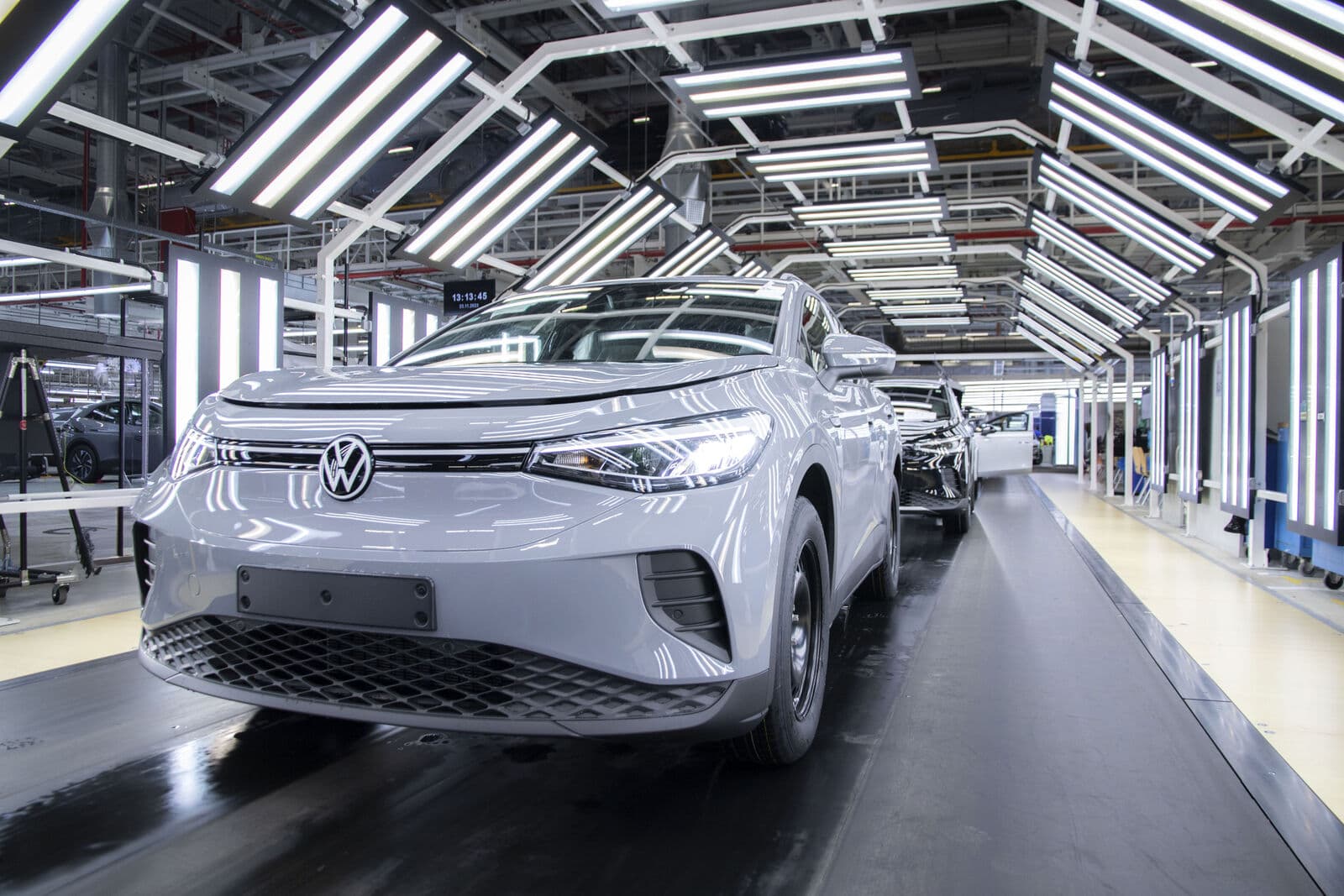
Photo: Volkswagen. Press image for illustration.
The restructuring of Europe’s car industry no longer affects only a few plants or components linked to combustion engines. Data published by Eurofound and the supplier association CLEPA show that staff cuts are spreading through the whole industrial chain, and component companies are absorbing a larger share of the losses than carmakers.
CLEPA counted 104,000 job cuts announced by European auto suppliers in 2024 and 2025: 54,000 in the first year and 50,000 in the second. At the same time, only 7,000 new posts were announced for 2025.
These figures represent restructuring plans communicated by companies; they do not mean that all contracts have already ended. Some programmes stretch over several years, and the final number can change after talks with unions or a shift in market conditions.
Suppliers are more exposed than manufacturers
Eurofound’s analysis of the period 2022–first half of 2026 shows that suppliers generally concentrated a larger share of the contraction in employment than vehicle manufacturers. Their situation can be even more difficult than the statistics indicate, because many small and medium-sized companies do not appear in databases dedicated to large-scale restructurings.
Producers of parts for engines, transmissions and exhaust systems are directly exposed to falling demand for combustion cars. The pressure is not limited to those activities, however. Still-modest European auto demand, energy and labour costs, the investment needed for electrification and Asian competition also affect companies that make electronics, chassis or systems for electric vehicles.
In a CLEPA survey published in March 2026, 24% of participating suppliers estimated they would record losses this year, compared with 15% in the previous edition. At the same time, 76% expected a profit margin below 5%, a level the association considers insufficient for sustained investment in capacity and technology.
Germany concentrates the largest cuts
Germany remains the centre of the restructuring. Eurofound shows that the country accounted for more than three-quarters of the net job losses included in the major announcements of 2024 and about two-thirds in 2025.
In absolute terms, the monitored announcements indicated more than 70,000 net posts eliminated in Germany in 2024 and another more than 40,000 in 2025. An important part comes from the Volkswagen programme agreed in December 2024, which provided for the reduction of more than 35,000 jobs by 2030.
The concentration in Germany does not, however, make the crisis a strictly German one. Plants in northern Italy, France and Central and Eastern Europe are integrated into the same supply networks and depend on orders from German manufacturers.
Electric production is rising, but remains below estimates
The shift to electric cars creates investment and new posts, but not fast enough to offset the cuts. According to CLEPA data, production of electrified cars in the EU rose in 2025, but the total of 3.3 million electric vehicles remained below the 4.8 million forecast formulated in 2023.
Total vehicle production in the EU in 2025 was about 20% below the 2019 level, equivalent to a shortfall of around 3.1 million units. New lines for batteries, electric motors and power electronics do not automatically cover the posts lost in traditional activities, because they require other skills and are sometimes located in other regions.
Why it matters for Romania
Romania has two large car plants, Dacia in Mioveni and Ford Otosan in Craiova, as well as an extensive network of component makers. That means a reduction in orders in Europe can reach local companies even if the restructuring is first announced in Germany, France or Italy.
The European data do not allow the 104,000 posts to be attributed automatically to Romania, nor do they announce a concrete wave of layoffs in the country. Local risk depends on each supplier’s contracts, the type of components produced and the plants’ ability to win projects for electric vehicles, hybrids and automotive software.
In the medium term, the stake is not only keeping the number of employees, but also moving skills towards the activities that attract new investment. Retraining technicians, competitive energy costs and access to European projects for batteries and electronics will matter as much as the volume of cars assembled.
Sources: Eurofound – the uneven reshaping of Europe’s automotive industry, CLEPA – 104,000 job cuts announced in two years, CLEPA – supplier survey for 2026, Automotive News Europe – job losses in the car industry