Jeep has confirmed that the Renegade will return to the European line-up by 2030. The announcement is part of the brand’s wider European product plan, but it is not yet a specification sheet for a production SUV. Jeep has not released the new model’s engine range, battery size, output, dimensions, price or exact market launch date.
The next Renegade is expected to sit between the Avenger and the Compass. That places it in the part of the market occupied by value-focused family SUVs such as the Dacia Duster. Jeep’s stated aim is to reach a broader audience while keeping the model recognisably rugged and easier to buy and run than a larger C-segment SUV.
What Jeep has actually confirmed
Xavier Peugeot, head of Jeep Brand Europe, presented the product direction at the Paris Motor Show. Stellantis says the next-generation Renegade will arrive by 2030 and strengthen the European range. The wording refers to a new generation, rather than a simple equipment update for the outgoing car.
The original Renegade was launched in 2014. Jeep says more than 610,000 examples have been sold in Europe since then. That volume explains why the name remains part of the company’s European strategy even though the previous generation has left several markets.
Jeep’s roadmap calls for up to six European models by 2030, using multiple platforms and powertrain technologies. The company also says a four-wheel-drive version will be available across the line-up. It has not specified whether the new Renegade itself will offer four-wheel drive in every market or whether it will be restricted to a particular trim or powertrain.
The same roadmap includes a European return to the D-SUV segment with the Recon and another model planned for 2028. The Renegade is a separate, smaller product and should not be confused with those larger vehicles.
A gap between the Avenger and Compass
Jeep has not published the new Renegade’s length. In an interview with Auto Express, Jeep’s European product team described an opportunity between the Avenger and the Compass. The Avenger is 4.08 metres long, while the new Compass is about 4.55 metres. A vehicle around 4.3 metres would be a reasonable journalistic estimate for the gap, not a confirmed Jeep dimension.
That positioning would put the Renegade close to the Dacia Duster in practical terms. The goal would be to provide more usable rear-seat and luggage space than a small B-SUV without moving into the price and footprint of the Compass. Jeep has not confirmed luggage capacity, wheelbase, rear legroom or the final number of seats.
The company has also not announced a European price or a Romanian price list. Estimates published by automotive media are not Jeep data and should not be used as a final buying guide. Production location, European homologation and the exact importer strategy remain unknown as well.
Rugged styling with a more efficient package
The new Renegade will retain a boxy, upright character and Jeep’s seven-slot grille. The company is treating the design as more than a retro exercise. Short overhangs and a relatively long wheelbase could improve interior packaging while also helping approach and departure angles.
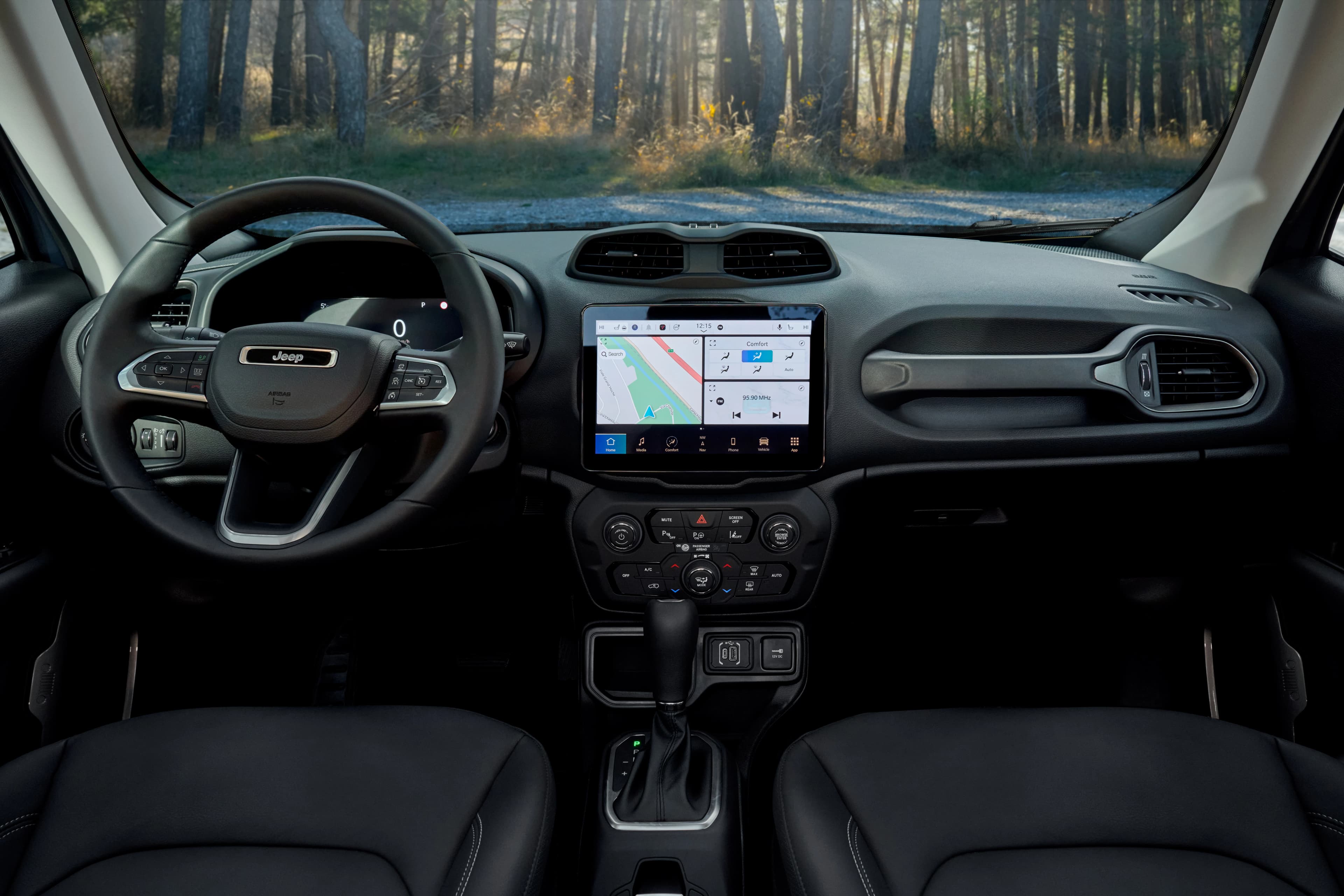
Jeep’s European design chief Daniele Calonaci said the new vehicle will not simply copy the front end of other Jeep models. The brand wants different vehicles to have their own identity while sharing the same family values. That means the current Renegade photograph used with this article is a reference image only; it is not a preview of the 2030 car.
The design team is also addressing weaknesses identified in the previous model. Jeep has discussed the need to use the space in front of the driver more efficiently and to reduce CO2 emissions. A taller body can help cabin space, but it also increases aerodynamic challenges, so the next car will have to balance upright styling with efficiency.
Ground clearance, water-wading depth, approach angle, departure angle and towing capacity have not been released. It is therefore too early to label the future Renegade as an off-road specialist. Jeep’s direction points to a capable compact SUV, but the engineering data will determine how much of that ability is genuine equipment and how much is brand positioning.
Powertrains and cabin priorities
Jeep describes the European plan as multi-energy. Depending on the model and market, that could include combustion, hybrid, plug-in hybrid and electric systems. The Renegade’s own mix has not been announced. There is no official range, consumption, charging figure, emissions value or power output to quote.
The cabin is expected to prioritise durability and storage over luxury materials. That approach is consistent with the price-sensitive segment in which the Renegade will compete. It will still need modern digital interfaces and equipment that can make the vehicle attractive in a showroom, but Jeep has not published the screen sizes, software functions, safety systems or trim structure.
Jeep says the project is being shaped around four values: capability, protection, versatility and storage. These are design objectives, not production specifications. They suggest that the new Renegade will focus on family use, flexible space and light off-road driving, but they do not confirm a particular suspension system, drive mode or safety rating.
What remains open
The confirmed information is limited but clear: the Jeep Renegade is returning to Europe by 2030, will sit between the Avenger and Compass, and will form part of a wider multi-platform, multi-powertrain range.
The unanswered questions are more important for buyers: price, dimensions, engines, battery capacity, production site, trim levels, four-wheel-drive availability and the timing of orders in each country. Until Jeep releases those details, the Renegade is a confirmed product direction rather than a vehicle that can be compared line by line with the Dacia Duster.
Image: Stellantis Media, Jeep Renegade MY24. Official photograph of the current model; it does not show the confirmed design of the Renegade planned for return by 2030.