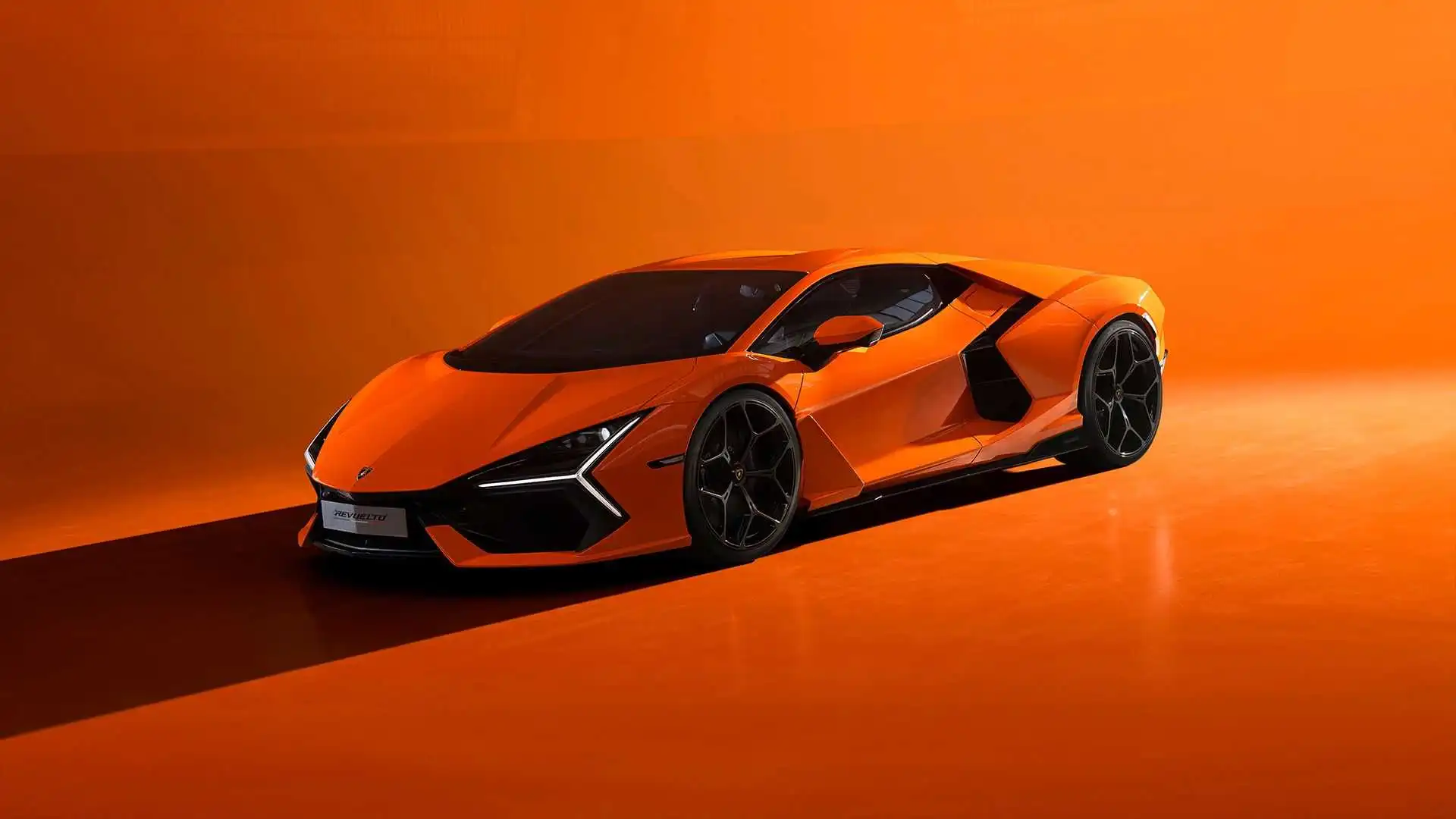
The Lamborghini Revuelto combines a naturally aspirated V12 with three electric motors. The Italian brand considers that a hybrid system currently offers the experience its customers want. Photo: Lamborghini
Lamborghini’s boss says Chinese supercars are not yet a threat. The bet remains on hybrid engines
Chinese manufacturers can launch electric cars with more power and faster acceleration than Lamborghini models, but they do not yet compete directly with the Italian brand, according to chief executive Stephan Winkelmann.
His position is not based on the idea that Chinese industry has remained behind technologically. Winkelmann acknowledges progress in software and performance, but argues that current electric supercars address a different customer from the one looking for the sound of a V8 or V12, mechanical responses and the history of a brand such as Lamborghini.
The statement is an assessment by the company’s leadership, not an independent measurement of competitiveness. Winkelmann added that the situation can change and summarised his caution with the phrase “never say never”.
The Denza Z shows how quickly Chinese performance has grown
The discussion took place at the Goodwood Festival of Speed, where Denza, a brand of the BYD group, presented the electric supercar Z. The manufacturer quotes about 1,600 hp, acceleration from 0 to 100 km/h in less than two seconds and a top speed close to 350 km/h.
Those figures have not yet been validated by a full test of the production version. On paper, however, they exceed the numbers of current Lamborghinis and show that power is no longer a technological barrier for new manufacturers.
BYD already has experience in this area through the Yangwang U9, another electric supercar with four motors and active suspension. Denza and Yangwang models use acceleration, individual wheel control and software as their main technical arguments.
Lamborghini says performance is not reduced to acceleration
Winkelmann considers that peak power and the 0–100 km/h time do not fully describe a supercar’s experience. For Lamborghini, steering response, braking, chassis behaviour, engine sound and the way the driver perceives all those elements matter.
The brand’s positioning also includes factors that do not appear on the specification sheet: company history, recognisable design, limited production, the Ad Personam personalisation programme and the residual value of some models.
Those advantages are hard to build in a short interval, but they are not permanent by definition. Chinese brands can gain experience, develop an identity of their own and create rare models. Software, one of the areas in which Winkelmann already sees high competence, is itself becoming an increasingly important part of a supercar’s experience.
Lamborghini has chosen plug-in hybrid for the whole range
The current Lamborghini range is electrified, but not fully electric. The Revuelto uses a 6.5-litre V12 and three electric motors, for a total of 1,015 hp. The Temerario combines a 4.0-litre twin-turbo V8 with three electric motors and develops 920 hp, and the Urus SE is an 800 hp plug-in hybrid SUV.
The solution allows short-distance electric running and energy recovery, while keeping the combustion engine at the centre of the experience. On the Revuelto and Temerario, the electric motors are also used for response, torque vectoring and all-wheel drive.
In 2023 Lamborghini had presented the electric Lanzador concept and then planned a fourth, fully electric model for the second half of the decade. Later, management postponed the move to a battery-only car and indicated that the future model would first use a plug-in hybrid configuration.
The reason given is weak demand for electric supercars and the fact that current battery technology does not yet offer the balance of mass, range, charging and performance that Lamborghini considers suitable.
Financial results allow the brand to keep this strategy
In the first half of 2026, Lamborghini recorded revenue of €1.74 billion, 7.4% higher than in the same period of 2025. The company delivered 5,422 cars, 4.6% fewer.
Revenue rose while volume fell, a result compatible with a strategy of protecting exclusivity and the value of each car, rather than increasing production at any cost.
Lamborghini says the relevant luxury-market segment contracted 7.7% in the same period, against a backdrop of duties in the United States, geopolitical instability, a slowdown in the Chinese market and uncertainty in Europe.
Those figures do not show immediate commercial pressure from Chinese supercars. They do show, however, that even luxury brands are exposed to slowing markets and regulatory changes.
China is both a market and a source of competition
For Lamborghini, China is not only the origin of some potential rivals. It is also an important market for luxury cars. A slowdown in local demand can affect the Italian brand even if a Lamborghini customer does not directly compare a Revuelto with a Denza Z.
In addition, Chinese manufacturers do not need to copy Lamborghini’s business model to influence its position. They can change customer expectations on power, software, screens, electronic assistance and the price of technology.
The long-term risk appears if those manufacturers succeed in adding reputation, design and driving experience on top of the technical and industrial advantage they already have.
Why the claim is valid only “for now”
Lamborghini currently has three strong arguments: its customers are not massively asking for a fully electric model, the hybrid range is delivering good financial results, and Chinese supercar brands do not yet have the same history or international network.
On the other hand, electric performance is evolving quickly, and a car’s development cycle is long. A technology that does not meet Lamborghini’s standards in 2026 may become light and capable enough in a few years.
Winkelmann’s statement should be read this way: Chinese electric supercars are not a direct commercial threat to Lamborghini in the current market configuration. It is not a promise that the balance of forces will remain unchanged.
Sources
- Auto Express — interview with Stephan Winkelmann on Chinese supercars
- Lamborghini — financial results for the first half of 2026
- Lamborghini — Direzione Cor Tauri electrification strategy
- Lamborghini — presentation of the Lanzador concept
- Lamborghini — Temerario specifications
- Lamborghini — Revuelto specifications