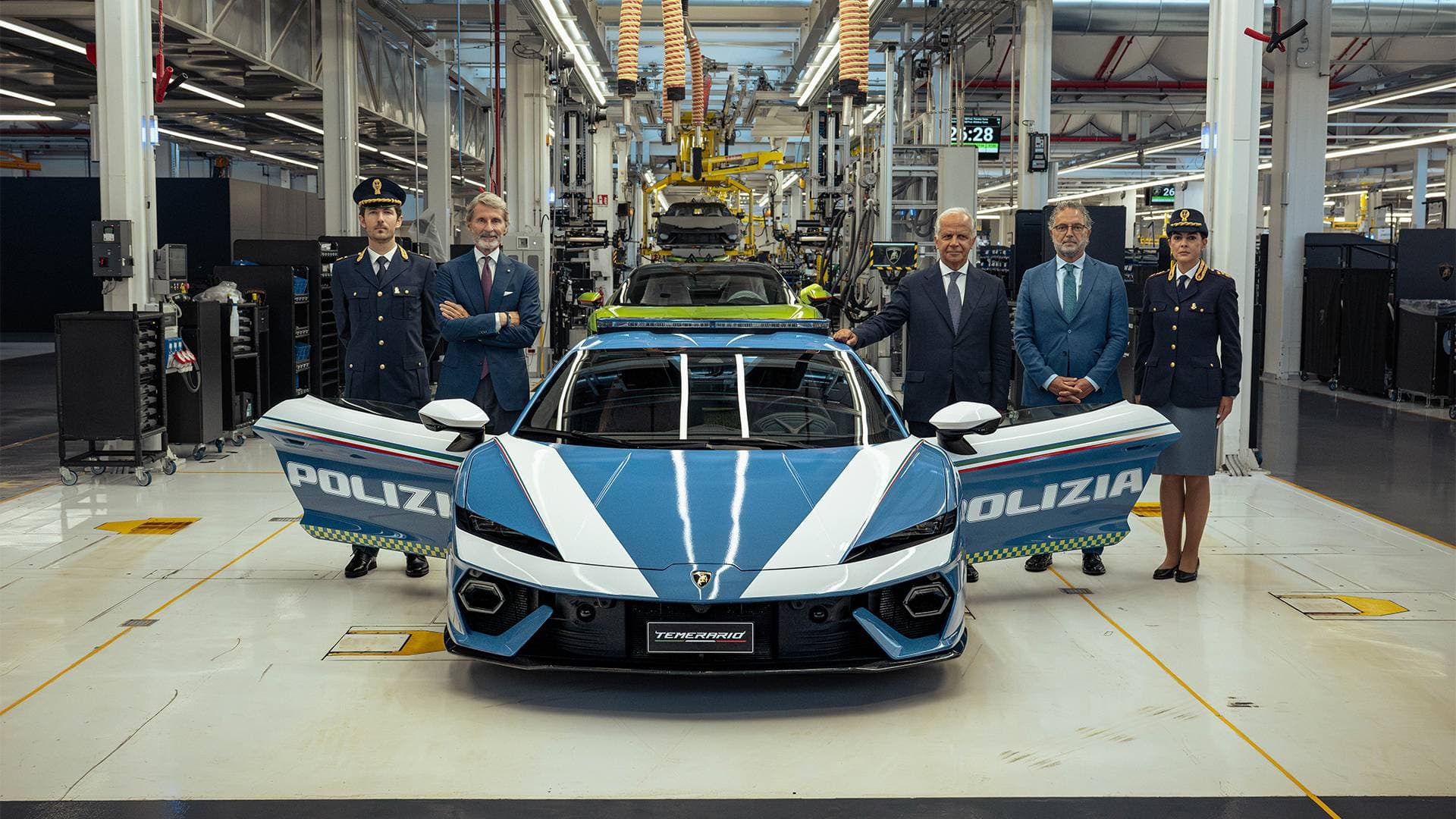
The Lamborghini Temerario destined for the Italian police, presented at the Sant'Agata Bolognese plant. Photo: Automobili Lamborghini.
Lamborghini Temerario enters Italian police service: 920 hp will help with organ transport
Italy’s Polizia di Stato will receive a 920 hp Lamborghini Temerario, prepared for urgent medical missions. The car is not intended for ordinary patrols or everyday pursuits, but for interventions in which time is critical, including the transport of organs and medical materials.
The car was presented on 4 September 2026 at Lamborghini’s headquarters in Sant'Agata Bolognese. The ceremony was attended by Italian interior minister Matteo Piantedosi, Lamborghini chief executive Stephan Winkelmann and prefect Renato Cortese, representing the leadership of the Italian police.
Temerario is the first hybrid Lamborghini police car
Temerario replaces the Huracán in the manufacturer’s range and brings a new mechanical layout for the brand. The 4.0-litre twin-turbo V8 works together with three electric motors, and total output reaches 920 hp or 677 kW.
The production model’s technical data indicate acceleration from 0 to 100 km/h in 2.7 seconds and a top speed of 343 km/h. Lamborghini has not announced power or performance changes for the police example, so the figures come from the civilian version’s specification sheet.
| Characteristic | Lamborghini Temerario |
|---|---|
| Combustion engine | Twin-turbo V8, 4.0 litres |
| Electric motors | 3 |
| Total power | 920 hp (677 kW) |
| 0–100 km/h | 2.7 seconds |
| Top speed | 343 km/h |
| Powertrain type | plug-in hybrid |
The special equipment includes the Polizia di Stato blue-and-white colour scheme, “Polizia” lettering, elements in the colours of the Italian flag and the lighting system mounted on the roof. The launch statement does not detail every interior modification or the medical equipment fitted to the Temerario.
Main role: urgent medical transports
The Italian traffic police will use the car for services considered of high social interest. The examples mentioned officially are the urgent transport of organs and medical materials, not ordinary roadside interventions.
In such missions, the car does not operate alone. The transport of an organ is coordinated with the National Transplant Centre, hospitals and traffic-police crews. Lamborghini cars used previously were fitted with special refrigerated compartments, temperature-monitoring systems and defibrillators.
Lamborghini has not yet specified whether the Temerario has exactly the same medical configuration as the Huracán and Urus Performante. Therefore, the presence of a particular type of refrigerator, a data logger or a defibrillator should not be assumed until the complete equipment list is published.
The partnership began with a Lamborghini Gallardo in 2004
The first Lamborghini to enter the Italian police fleet was a Gallardo, in 2004. The car carried out its first organ-transport mission in September of the same year.
It was followed by the Gallardo LP 560-4 and two Huracán examples, used including on Italy’s main motorways. Since 2023, the police have also had a Urus Performante prepared for medical missions.
According to Lamborghini, more than two decades have seen six cars from the brand enter the fleet. They have taken part in more than 200 organ transports in Italy and more than 1,500 road-safety education actions.
The Temerario joins the cars still in operation; it does not automatically replace all of them. Lamborghini states explicitly that the new model will work alongside those already in service.
Why the police use a supercar for these missions
A 920 hp car does not by itself shorten the entire route between two hospitals. The advantage appears on long stretches of fast road, where a specially trained crew can maintain a high average speed in controlled conditions and with the support of other police units.
There are also practical limits. Urban traffic, weather, range, stops and medical procedures can matter more than top speed. For certain distances or emergencies, helicopters and aircraft are used, and the choice of transport belongs to the medical system and the authorities coordinating the mission.
The car also has a public role. The police Lamborghinis have taken part in exhibitions, parades and road-safety education programmes. The manufacturer and the institution thus use the partnership both for real medical missions and to communicate safety rules.
Consumption remains that of a 920 hp supercar
The Temerario is a plug-in hybrid, but that does not turn it into a low-emissions car in every condition. Lamborghini quotes weighted WLTP consumption of between 10.3 and 11.2 l/100 km, together with energy consumption of 4.3–6.4 kWh/100 km.
With a depleted battery, official consumption rises to 14 l/100 km, and the model sits in emissions class G. The electric system is used primarily for performance, rapid response and traction control.
Frequently asked questions
Will the Italian police use the Lamborghini Temerario for patrols?
The announced role focuses on services of high social value, especially urgent transports of organs and medical materials. It has not been presented as a car for everyday patrols.
How much power does the police Lamborghini Temerario have?
The hybrid system made up of a 4.0-litre twin-turbo V8 and three electric motors develops 920 hp. A mechanical specification different from the civilian model has not been announced.
Is it the first Lamborghini used by the Italian police?
No. The partnership began in 2004 with the Gallardo and continued with the Gallardo LP 560-4, Huracán and Urus Performante.
How many medical missions have these cars carried out?
Lamborghini reports more than 200 organ-transport missions in more than 20 years of partnership with the Italian police.
Sources
- Automobili Lamborghini – official presentation of the Temerario for the Polizia di Stato
- Polizia di Stato – announcement of the presentation of the new Lamborghini Temerario
- Automobili Lamborghini – Temerario technical specifications
- Automobili Lamborghini – review of 20 years of partnership with the Italian police
- Italy’s National Transplant Centre – organisation of organ transport