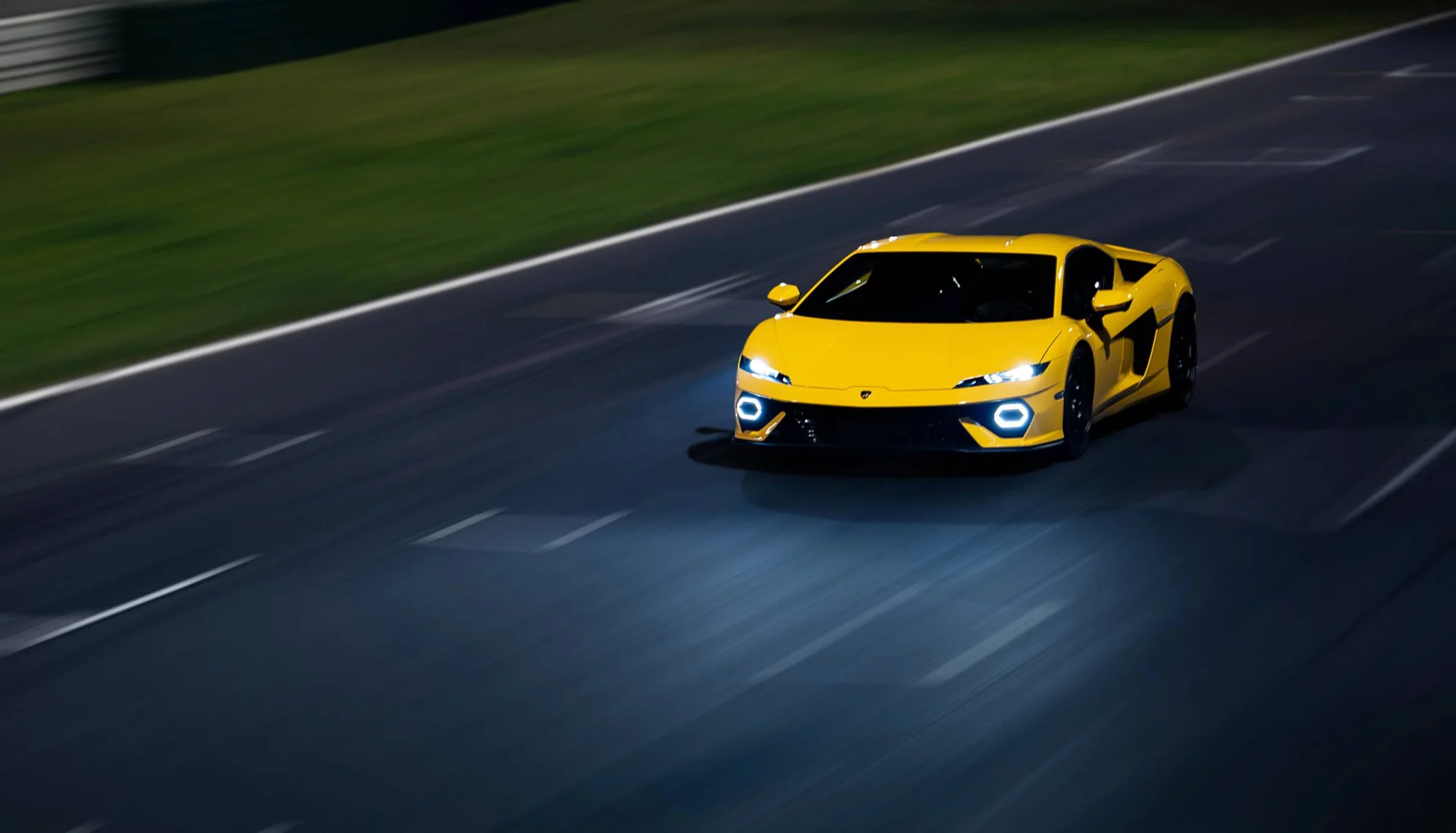
The photograph shows the standard Lamborghini Temerario. Lamborghini has not unveiled or confirmed a Temerario Sterrato. Image: Automobili Lamborghini S.p.A.
Lamborghini leaves the door open to a Temerario Sterrato
Lamborghini is considering several directions for future Temerario derivatives, and a car conceived in the spirit of the Huracán Sterrato is among the possibilities its executives are willing to discuss. As of 26 September 2026, however, there is no confirmed production programme, launch date, official prototype, price or technical specification for a Temerario Sterrato.
That distinction is the substance of the story. Speaking to CarExpert, Lamborghini product line director Paolo Racchetti said a Sterrato-like car could exist, but immediately clarified that he was not saying Lamborghini planned to build one. His answer demonstrates the flexibility of the Temerario architecture; it does not amount to product approval.
What Lamborghini actually said
Racchetti framed his answer around the unusually broad family created from the Huracán. During its life, the previous-generation model spawned open-top, lighter, circuit-focused and loose-surface variants. He said the new Temerario architecture had been designed to cover several specific missions and to offer development potential through both its combustion and electric elements.
Asked directly whether the Sterrato formula could return, he said such a car was possible and declined to exclude another one in the future. In the same interview, though, he said he could not confirm that it was on Lamborghini’s radar. The only additional body style identified as being in development was the Temerario Spyder.
The remarks follow earlier comments by Lamborghini chief marketing and sales officer Federico Foschini. He described more Sterrato models as an opportunity the company could evaluate, while stressing that its resources are finite. Technical possibility and a commercial green light are therefore two separate matters. Engineering capacity, homologation, production planning and the order of model priorities still have to align.
The confirmed Temerario baseline
The production Temerario, introduced in August 2024 as the Huracán’s successor, uses a plug-in hybrid system built around a 4.0-litre twin-turbo V8 and three electric motors. Lamborghini quotes a total output of 920 CV, a 0–100 km/h time of 2.7 seconds and a 343 km/h maximum speed.
The combustion engine alone produces 800 CV. Two electric motors drive the front axle, while a third is installed between the V8 and the eight-speed dual-clutch gearbox. Lamborghini says the body-in-white is made entirely from aluminium and gives a dry weight of 1,690 kg for the standard car.
Those numbers apply only to the regular production Temerario. They cannot be assigned automatically to a theoretical Sterrato. Lamborghini has disclosed nothing about the ride height, tyres, underbody protection, suspension tune, mass, output or performance of such a derivative.
Huracán Sterrato is a precedent, not a specification sheet
The relevant reference point is the Huracán Sterrato, for which Lamborghini planned a run of 1,499 cars. Compared with the four-wheel-drive Huracán EVO, it had 44 mm more ground clearance, a front track widened by 30 mm and a rear track widened by 34 mm. Its changes included aluminium front underbody protection, reinforced sills, protected wheel arches and a roof-mounted intake intended to help the engine breathe in dusty conditions.
Specially developed Bridgestone Dueler AT002 tyres were fitted to 19-inch wheels, and the drive-mode software gained a Rally setting. The naturally aspirated 5.2-litre V10 produced 610 CV and 560 Nm. Lamborghini quoted 3.4 seconds from 0 to 100 km/h and a maximum speed limited to 260 km/h.
That hardware shows why Sterrato was more than a cosmetic package. It adapted a low supercar for broken roads and low-grip surfaces. Yet the Temerario has a new platform, a hybrid powertrain and a different mass distribution, so copying the Huracán’s measurements would be unsupported speculation.
What the formula might require
If Lamborghini approved the project, its own precedent points to several plausible measures: increased clearance, extra underbody protection, tyres suited to mixed surfaces, and dedicated suspension and stability-control calibration. These are logical inferences from the Huracán Sterrato and the executives’ comments, not leaked or announced Temerario specifications.
An electrified Sterrato would also present new engineering questions. Hybrid hardware beneath and within the car would need appropriate impact protection. Cooling for the twin-turbo V8, battery and electric motors would have to remain effective in dust and at lower speeds. Raising the suspension would alter the airflow and centre of gravity, while more compliant tyres would affect steering response, braking and maximum speed. Lamborghini would have to decide the balance through testing and homologation.
Foschini has said, in a broader discussion of potential derivatives, that different tyres, suspension settings and a stronger off-road focus can create a new proposition without fundamentally rebuilding a vehicle. That describes one possible development method. It does not identify a signed-off model or a timetable.
Why a Spyder is likely to arrive first
Racchetti confirmed that the open-top Temerario is already under development. It is a familiar part of Lamborghini’s model cycle and addresses an established market, making its position more certain than that of experimental derivatives. The executive also referred to scope for more focused or circuit-oriented editions, echoing the Tecnica and STO branches of the Huracán family.
The company has not said which idea follows the Spyder, how many derivatives it can develop in parallel or whether a Sterrato ranks ahead of a lighter road car or track-biased version. Production constraints matter too: a niche model may attract attention, but it still consumes engineering, validation and factory resources.
What would turn the rumour into news of a product
Meaningful evidence would include an officially acknowledged prototype, a model name filing linked to a programme, a product-plan confirmation or technical details published by Lamborghini. None accompanied the present comments. Digital images showing a lifted Temerario with cladding and all-terrain tyres should therefore be treated as independent renderings, not photographs of a Lamborghini vehicle.
For now, the factual conclusion is narrow. Lamborghini designed the Temerario to support a family of derivatives, and two senior executives have declined to rule out another Sterrato. The project itself, its configuration and its timing remain unconfirmed. Until the manufacturer moves beyond conditional language, “Temerario Sterrato” describes a credible possibility rather than a forthcoming model.