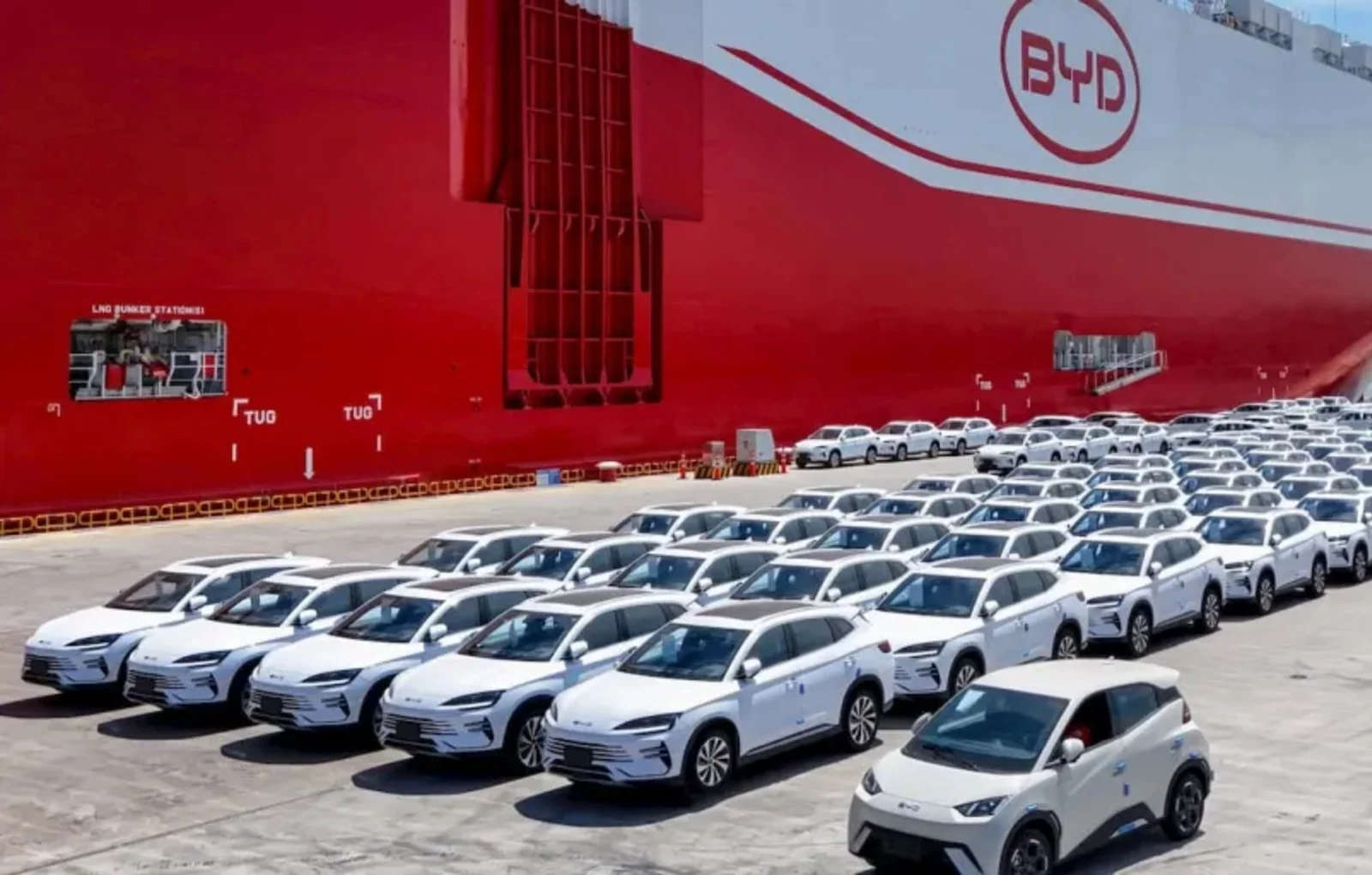
BYD cars prepared for export. Chinese manufacturers are expanding their ranges, distribution networks and industrial capacity outside China at the same time. BYD press image.
Chinese cars have reached a record share in Europe. BYD moves ahead of Chery and MG
Chinese car brands took 11.2% of the European market in July 2026, the highest monthly share recorded so far. Their registrations rose 107% compared with the same month in 2025, in a total market that advanced only 4.1%.
Preliminary Dataforce figures cover about 98% of registrations in the European Union, the United Kingdom, Norway, Iceland and Switzerland. The classification refers to Chinese brands, not to all companies owned by groups from China: Volvo, for example, is controlled by Geely but is counted separately as a European brand.
BYD, together with the premium brand Denza, took first place among Chinese groups in July. It was followed by Chery, which in the report groups the Chery, Omoda, Jaecoo and Jetour brands, and by SAIC Motor, owner of MG.
One new car in nine already carries a Chinese brand
The 11.2% share means that more than one in nine new cars registered in Europe in July belonged to a Chinese brand. In June, the share had been 10.9%, with 150,272 units and growth of 118%.
The advance can no longer be explained by a single brand or a single type of propulsion. Manufacturers from China sell electric cars, plug-in hybrids, full hybrids and conventional petrol models. That diversification protects them from changes in national electric-car programmes and from the extra duties the EU applies to certain BEVs made in China.
In July, the figures communicated for the main groups were:
| Group or brand | Change versus July 2025 | Relevant detail |
|---|---|---|
| BYD, including Denza | +150% | first Chinese group of the month |
| Chery, Omoda, Jaecoo and Jetour | +202% | second place among Chinese groups |
| Leapmotor | +294% | 9,306 cars |
| Xpeng | +270% | 5,244 cars |
| SAIC/MG | +22% | slower growth, but high volume |
| Geely | +21% | rapid expansion of its own brand |
Very large percentages must be read together with the comparison base. Xpeng, Leapmotor or the Geely brand had low European volumes in 2025, so expansion in a few markets can produce growth of several hundred percent.
The BYD Seal U entered Europe’s volume models
The BYD Seal U was the most visible Chinese model in July’s overall ranking. With 10,007 registrations, it took 21st place in Europe, ahead of the Audi A3, Nissan Qashqai and BMW X1. Volume rose 60.9% versus July 2025.
After the first seven months, the Seal U had reached 58,074 units, 48.4% more than last year. The total includes both the fully electric version and the DM-i plug-in hybrid, which is much better suited to markets where charging infrastructure or BEV incentives are limited.
The BYD Atto 2 recorded 7,679 units in July, more than 12 times as many as in the previous year, when the model was at the start of sales. The MG ZS had 8,497 registrations, and the MG HS reached 49,246 units after seven months.
Chery grows through several brands and several technologies
Chery is not entering Europe with a single badge. Omoda and Jaecoo are already available in several markets, the Chery brand is expanding its network separately, and Jetour is aimed mainly at the SUV area.
In July, the group grew 202%. The Chery brand alone registered 5,868 cars, compared with 107 in July 2025. The result reflects entry into new markets and cannot automatically be extrapolated for the whole year.
The strategy combines petrol models with full-hybrid and plug-in hybrid systems. The group therefore does not depend exclusively on electric cars imported from China, on which the European Union applies extra countervailing duties.
Leapmotor benefits from the Stellantis network
Leapmotor reached 9,306 cars in July, 294% more than in the same month of 2025. The European expansion is managed through Leapmotor International, a company in which Stellantis holds control.
The partnership provides access to an already existing distribution and service network, reducing one of the largest difficulties for a new brand. At the same time, Stellantis quickly obtains price-competitive electric models without developing every platform itself.
Leapmotor’s growth should not automatically be added to the volume of Stellantis brands when different reports are compared. Some statistics treat it as a separate Chinese brand, and others present Stellantis results including Leapmotor.
European duties have not stopped the growth
Since 2024 the EU has applied countervailing duties to electric cars produced in China, on top of the usual 10% customs tariff. The level differs by manufacturer and by how it cooperated with the European Commission’s investigation.
The measure does not cover plug-in hybrids and cars with combustion engines in the same way. Manufacturers have responded in three directions:
- they have increased the share of PHEVs and full hybrids in the European offer;
- they have accelerated production projects in Europe;
- they have entered partnerships with local groups and plants.
BYD is developing production in Hungary and Turkey, Chery is working on the industrial project in Barcelona, and Leapmotor can use Stellantis infrastructure. In parallel, SAIC is examining European production options to reduce logistics costs and exposure to duties.
Romania: BYD and Chery entered the top ten brands
In Romania, the rise became visible in July’s statistics. BYD took fifth place in the total market, with 672 cars and a 5.72% share. Chery was tenth, with 341 units.
The BYD Seal U entered the models ranking, in eighth place, with 240 examples. In the exclusively electric segment, BYD had 220 units, and the Dolphin Surf was the BEV with the most registrations, according to APIA data and analyses based on DGPCI reports.
After the first seven months, BYD had reached 2,812 cars in Romania. The volume is still small versus Dacia, Toyota, Škoda or Volkswagen, but the pace shows that Chinese brands no longer occupy only a niche.
The local result must be put in context: the total market fell 28.2% in July. A brand in launch, with stock and campaigns concentrated in a single month, can climb the ranking quickly. The annual total and the evolution of the service network will show whether the position can be held.
What a buyer in Romania should check
Rising sales reduce part of the perceived risk, but they do not replace checks made before purchase. For a new brand, the following matter:
- distance to the nearest authorised workshop;
- availability and delivery time of parts;
- the exact warranty conditions for the car and the traction battery;
- the cost of comprehensive insurance and the insurer’s policy;
- the likely resale value after three to five years;
- compatibility of the app, updates and connected services in Romania.
A long equipment list and a promotional price do not automatically compensate for an insufficient service network. At the same time, growing European volumes can speed parts supply and the development of the used-car market.
A structural change, not just a good month
The 11.2% share is a monthly record, but the trend already has continuity. Chinese brands had 10.9% in June, and in the first half they exceeded 660,000 registrations on the extended European market.
BYD, Chery and SAIC/MG form the core of this growth, while Leapmotor, Xpeng and Geely add volume from smaller bases. The next stage will be decided less by imports and more by their ability to build cars in Europe, support service networks and keep prices competitive after production is localised.
Sources
- Dataforce — report on the car market in 30 European countries
- European Commission — countervailing duties on electric cars produced in China
- APIA — monthly releases on the Romanian car market
- BYD Romania — local range and network
- Chery Romania — locally available range
- Stellantis — information on Leapmotor International