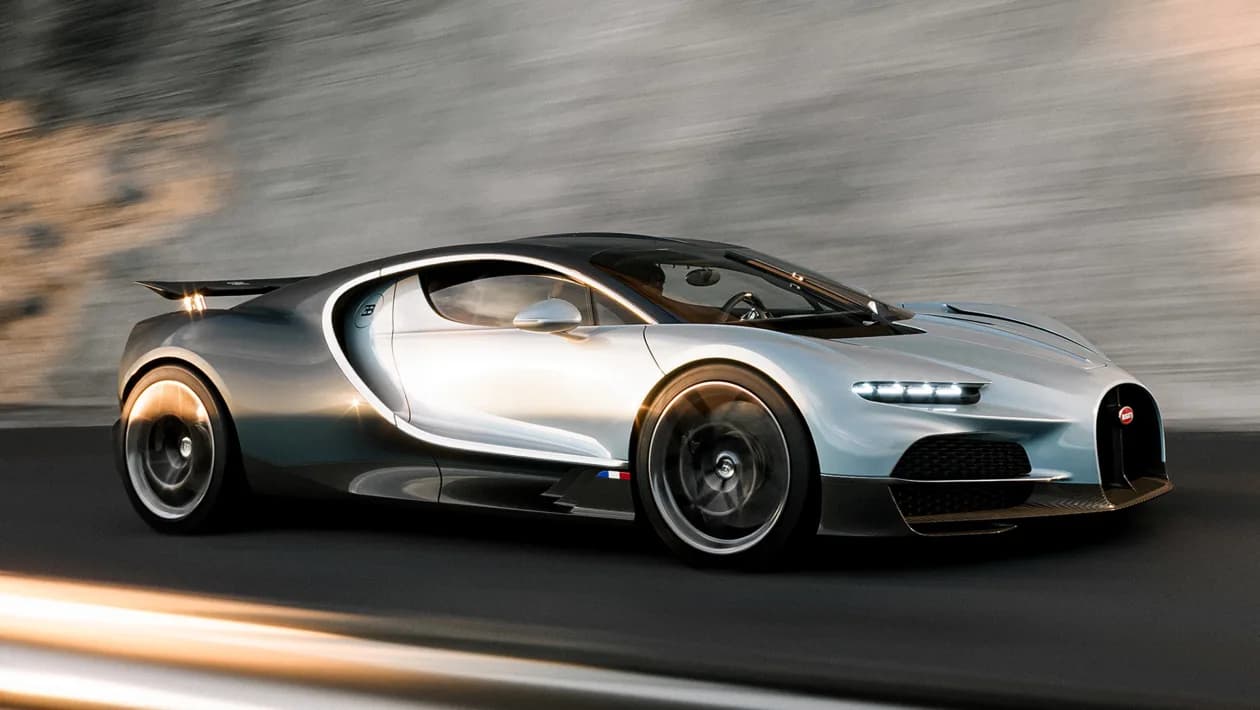
The Bugatti Tourbillon combines a naturally aspirated V16 with three electric motors. Photo: Bugatti
Mate Rimac believes combustion supercars will last a long time
Mate Rimac, founder of the Croatian electric hypercar maker and chief executive of Bugatti Rimac, does not expect combustion engines to disappear soon from the most expensive part of the car market. He argues that most ordinary cars will become electric, but supercar and hypercar customers will keep asking for internal combustion.
The comments were made in an interview with CNBC and picked up by the US publications Motor1 and Road & Track. They are an industry executive’s estimate, not an independent forecast and not confirmation of a shared strategy for every performance brand.
Rimac compares supercars with mechanical watches
Rimac explained his view with a comparison to the watch industry. A smartwatch offers more functions and very good accuracy, but collectors pay large sums for Swiss movements, materials and finishing. In his view, the combustion engine will occupy a similar place: rarer, expensive and bought for the experience, not for efficiency.
That logic applies to a niche with very small volumes. It cannot be transferred directly to family cars, commercial fleets or urban models, where energy cost, taxes, infrastructure and emissions limits weigh more heavily in the choice of powertrain.
Rimac also acknowledged the irony of his position. The entrepreneur built his reputation by proving what electric propulsion can do, and he now leads Bugatti while it develops an 8.3-litre V16, the largest combustion engine fitted to a new car from the company.
Tourbillon keeps the V16, but uses electrification heavily
The Bugatti Tourbillon is not a return to purely combustion propulsion. The hypercar has a hybrid system made up of a naturally aspirated 8.3-litre V16, two electric motors on the front axle and a third electric motor at the rear.
The package develops 1,800 hp: 1,000 hp from the combustion engine and 800 hp from the electric side, according to Bugatti’s published specification. The 25 kWh battery operates at 800 V and allows a claimed electric range of more than 60 km.
The electric motors are not limited to moving the car without starting the V16. They provide immediate throttle response, fill the gaps where the naturally aspirated engine does not deliver peak power, and allow individual torque control on the front axle. For Bugatti, electrification complements the combustion engine rather than replacing it.
Tourbillon will be built in 250 examples, with a starting price of €3.8 million before taxes. Such a series does not say how the wider car market will evolve, but it shows that there are buyers for a very expensive hybrid system built around mechanical sensation.
Nevera proved electric performance, not unlimited demand
Mate Rimac’s position carries extra weight because his own brand produces the Nevera, one of the fastest electric hypercars. The model showed that electric propulsion can beat combustion cars on acceleration and can control torque very precisely at each wheel.
Measurable performance does not automatically solve the demand problem. Rimac has previously spoken about the difficulty of selling all 150 planned Nevera examples and about the preference among some buyers in this category for sound, gear changes and visible machinery.
That situation does not prove that every electric supercar will fail. Price, brand, design, rarity and the relationship with collectors strongly influence sales in such a small segment. Nevera also remains a product through which Rimac presents the electric technology it supplies to other manufacturers.
Why the combustion engine can survive in a niche
Supercars generally cover small annual distances and are produced in low volumes. Customers accept high costs for fuel, maintenance and personalisation, and manufacturers can invest in solutions that would not pay off on a volume car.
The future of these engines also depends on homologation rules, emissions limits, national taxes and the availability of compatible fuels. Collector demand does not guarantee that every technical configuration will be sellable in every region in ten or 20 years.
The path Bugatti has chosen, for now, is hybridisation. It keeps the naturally aspirated engine and adds electric performance, but it involves a battery, three electric motors and far more complex electronics. Tourbillon is a possible solution for a €3.8 million car, not an economical model for the rest of the market.
What Mate Rimac said and did not say
Rimac said the upper end of the market will keep combustion engines for a long time. He did not announce that Rimac Automobili is dropping electric cars, nor that future Bugatti models will be purely combustion-powered.
The two brands have different roles. Rimac Automobili continues to represent electric hypercars, while Bugatti uses a V16 hybrid system for Tourbillon. In parallel, Rimac Technology develops and supplies batteries, motors and electronic systems to other manufacturers.
Frequently asked questions
Does Mate Rimac believe all cars will stay on petrol?
No. He estimates that most ordinary cars will become electric. The comment about combustion engines refers to supercars and hypercars.
Is the Bugatti Tourbillon an electric car?
No. Tourbillon is a plug-in hybrid with a naturally aspirated V16, three electric motors and a 25 kWh battery.
Can Tourbillon run on electric power only?
Yes. Bugatti claims electric range of more than 60 km, but the model does not yet have final homologation figures published for all markets.
Will Rimac still produce electric hypercars?
The comments do not announce that they will stop. Rimac Automobili remains the group’s electric hypercar brand, separate from the hybrid path taken by Bugatti.