Mercedes-Benz is reportedly pushing the start of US GLC production back to May 2030, extending the period in which imported vehicles remain exposed to US import duties. Automotive News reported the revised timetable on 3 November, citing two people familiar with the plans. Its public report places the earlier start towards the end of 2027, making this a delay of more than two years.
The attribution matters. May 2030 is the date reported by the publication, rather than a newly dated commitment independently confirmed in the Mercedes-Benz documents examined here. Those official materials establish the earlier plan, the intended role of Alabama and the scope of existing production, allowing the reported change to be put into context without treating every detail as a company announcement.
The original plan covered combustion-engine production
Mercedes-Benz's first-half 2025 report recorded plans to add production of the combustion-engine GLC at Tuscaloosa from 2027. The language described an additional production location. That passage did not announce the closure of a European factory or a wholesale transfer of the model's global manufacturing operations to the United States.
It also identified a powertrain category. A timetable for the combustion-engine version should not automatically be applied to an electric GLC. Likewise, starting assembly at a particular plant is a different event from launching a vehicle worldwide. The reported Alabama delay does not, by itself, establish a new launch date for every model carrying the GLC name.
In its 2026 financial presentation, Mercedes-Benz described the United States as its home for medium and large SUVs and said the next GLC generation would be localised in Tuscaloosa. The relevant slide supports that industrial direction but does not specify an exact production-start date. It therefore cannot independently validate the May 2030 timing now reported by Automotive News.
What Alabama actually builds
The manufacturer's official description of Mercedes-Benz U.S. International, updated in June 2026, lists the GLE, GLE Coupé and GLS, including AMG derivatives and the Mercedes-Maybach GLS. Its electric production includes the EQE SUV, EQS SUV and Mercedes-Maybach EQS SUV. The GLC is a future addition, rather than part of the existing lineup described there.
This makes the reported change a postponement of additional manufacturing activity. It should not be described as the shutdown of an established Alabama GLC line. A forward-looking production map can show where a model is intended to be built without proving that it is already coming off that plant's assembly line.
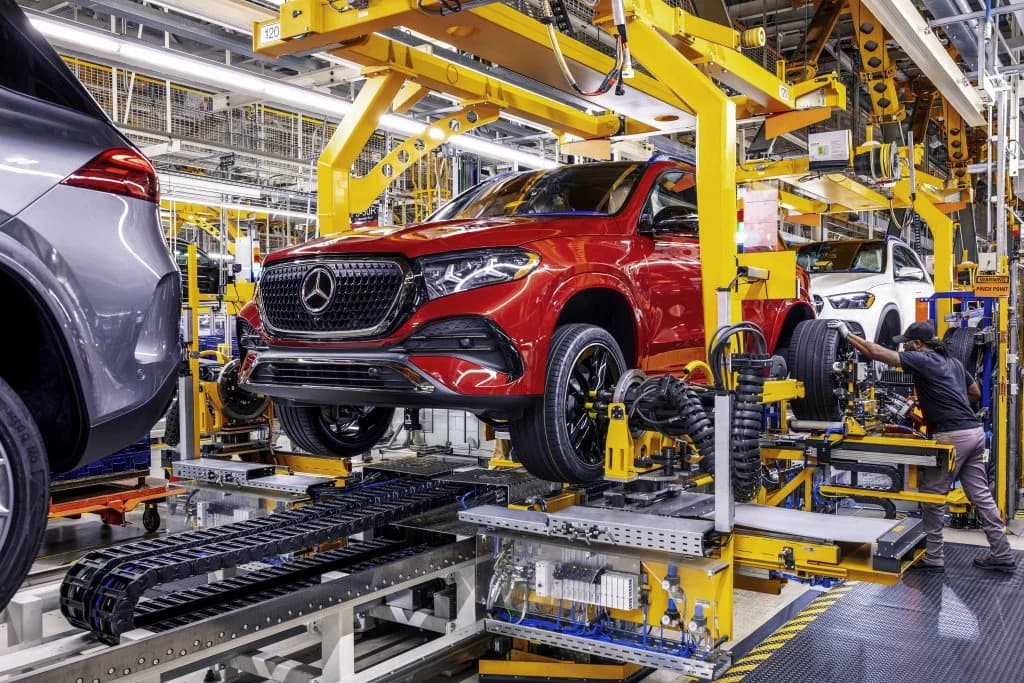
On 31 March 2026, Mercedes-Benz marked the five-millionth vehicle built at Tuscaloosa while unveiling the new GLE and GLS there. The official factory photograph accompanying this article comes from that announcement and shows SUV assembly, with a GLE in the foreground. It is not evidence that GLC production has already started in the United States.
A US factory serving overseas markets too
Mercedes-Benz U.S. International was established in 1995, with vehicle production beginning in 1997 with the M-Class. The operation has since become both a domestic manufacturing base and an export location. Mercedes-Benz says approximately 60% of the plant's output is exported, so its industrial role extends beyond supplying American customers.
The June 2026 plant description puts employment at about 5,800 and refers to roughly 200 US suppliers. These are dated figures for the existing operation. They should not be presented as a GLC staffing forecast, nor as evidence of job losses arising from the newly reported production schedule. The official materials examined do not provide such a calculation.
Mercedes-Benz has also announced US investment extending through 2030. That broader investment horizon is separate from the start date of an individual model. Sharing a year with the reported GLC timetable does not turn the investment programme into independent confirmation of a May production launch.
Why the tariff exposure lasts longer
The European Commission describes the EU–US trade framework as providing an all-inclusive 15% tariff ceiling for most covered European exports, including cars. US Customs and Border Protection explains how the measure applies to eligible EU-origin passenger vehicles and light trucks: where the ordinary tariff is below 15%, that rate and the additional Section 232 component together reach 15%.
That distinction prevents two misleading shortcuts. The rule is not simply another 15 percentage points stacked on top of every existing duty. Nor does a manufacturer's nationality alone establish the treatment of every vehicle it sells. Origin and customs classification matter, making the location where a vehicle is produced relevant to its import exposure.
If the localisation timetable moves back as reported, the period of supplying the US through imports would continue for longer. That is a direct industrial implication of the schedule change, but it does not establish an equivalent percentage increase in showroom prices. Customs value and retail price are different measures, and the examined sources do not contain a new GLC price list tied to the reported delay.
What the report does not settle
The material does not establish a GLC delivery delay for European buyers or a suspension of the model's European availability. It also does not provide a confirmed single explanation for the timetable change. A buyer with an existing order would need the seller's specification, availability and contractual delivery information rather than an inference from a future Alabama production date.
A further limitation is the distance to 2030: today's trade framework cannot prove which tariff rules will apply when the line eventually starts. A detailed Mercedes-Benz update identifying the generation, powertrains and production date would be the next official checkpoint. Until then, the 2027 commitment in the historical company report and May 2030 in the new sourcing-based report should retain their separate dates and attribution.
Official image published on 31 March 2026: SUV assembly at Tuscaloosa, with a GLE in the foreground; it does not show an operating GLC line. © Mercedes-Benz AG / Mercedes-Benz USA.
Sources
- Mercedes-Benz: first-half 2025 report and original combustion-engine GLC plan.
- Mercedes-Benz: 2026 financial strategy and next-generation GLC localisation.
- Mercedes-Benz: US plant profile, updated June 2026.
- Mercedes-Benz: five-millionth Tuscaloosa vehicle, 31 March 2026.
- European Commission: EU–US trade framework.
- CBP: combined tariff implementation for eligible EU-origin vehicles.