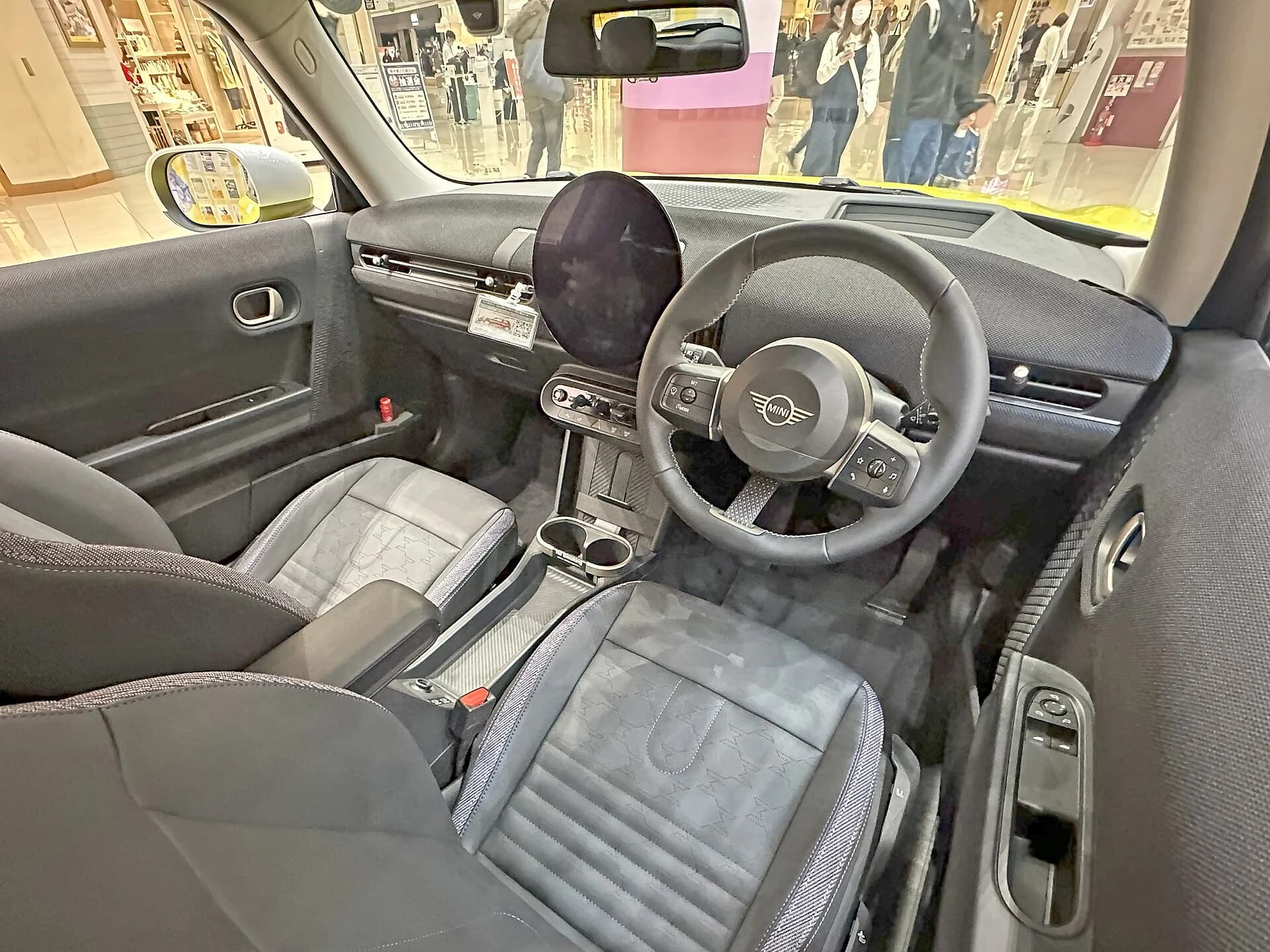
Reference image: MINI Cooper S Electric interior by Tokumeigakarinoaoshima, Wikimedia Commons, CC0.
MINI is not preparing to abandon the large circular display at the centre of its dashboard. Alexander Brockhoff, MINI Australia’s general manager, told Drive that the round screen is part of the brand’s history and should remain part of its character. The comment, reported by Motor1, describes a design commitment rather than a new model launch or a confirmed product timetable.
That distinction matters. MINI has not announced a replacement screen, a return to a particular set of buttons or a date for a cabin revision. What the interview does show is how the brand views the screen: as the digital continuation of the central instrument used by classic Mini cars.
A familiar circle with a different job
The original Mini arrived in 1959 with a compact layout conceived by Alec Issigonis. The central speedometer became one of the car’s most recognisable interior details. BMW Group says the modern MINI, launched in 2001 under its ownership, was designed to carry the original car’s character into a new era rather than reproduce it as a literal copy.
The location of the instrument changed over successive generations. Its role also expanded. A circular gauge that once displayed speed is now the visual anchor for navigation, media, telephone functions, vehicle settings and climate controls. The idea is familiar, but the information architecture is entirely digital.
MINI’s current design language, Charismatic Simplicity, reduces the dashboard to a small number of deliberately visible elements. The circular display is paired with a slim dashboard, a toggle bar and, depending on the specification, a head-up display. The result is recognisably MINI, but it also asks the driver to use the screen for tasks that were traditionally assigned to physical controls.
What the MINI Interaction Unit does
MINI introduced the new MINI Interaction Unit in 2023. The circular OLED panel measures 240 millimetres across, or roughly 9.4 inches. MINI describes it as the first fully usable round OLED display in a production car. It combines the instrument cluster and the on-board monitor, with touch and voice control available through MINI Operating System 9.
The upper part of the display can show speed and vehicle status. The lower portion provides access to navigation, media, telephone and climate functions. A home view presents widgets around the selected function, while a shortcut area allows frequently used commands to be stored for quicker access. The MINI Intelligent Personal Assistant adds voice interaction, activated by a steering-wheel control or the “Hey MINI” command.
The exact equipment depends on the vehicle and the market. MINI notes that digital services and functions vary by country, model and specification. An optional head-up display can place driving information in front of the driver, which is particularly relevant because the new dashboard no longer needs a conventional instrument binnacle behind the steering wheel.
The usability question
A round screen gives MINI a clear visual signature, but not every interface is naturally circular. MINI’s own navigation can use the entire display, while Apple CarPlay and Android Auto are built around rectangular layouts. Their projection therefore appears inside a rectangular window, leaving unused areas around it. That is not a mechanical defect, but it is a visible consequence of prioritising a distinctive shape over a universal screen format.
The reduction in physical controls creates another trade-off. The toggle bar retains functions such as the start control, parking brake, volume and Experience Mode selection. Climate settings, however, are handled through the digital interface or voice commands. A driver who prefers a button with a clear tactile position may find that slower than a dedicated switch, especially when the car is moving.
Brockhoff told Drive that customers appear more concerned about the lack of physical switches than about the circular screen itself. This is an attributed observation from a company executive, not a published customer survey. MINI has not announced a specific ergonomic response, so it would be premature to treat more buttons as a confirmed future feature.
Why MINI wants to keep it
MINI’s official design material links the OLED display directly to the classic central instrument. The company also uses Experience Modes to connect the screen with ambient lighting, projected patterns and sound. Timeless mode references older MINI graphics, while other modes provide different visual themes. The display is therefore part of a broader cabin concept, not only a replacement for a gauge cluster.
The circular unit also gives MINI a stable design element across petrol, hybrid and electric models. The screen’s physical shape can remain familiar while software, graphics and connected services are updated. MINI says its newer cars receive remote software upgrades several times a year for quality improvements, although the availability of individual functions depends on the market and equipment.
For now, the public message is continuity with room for refinement. MINI intends to keep the circle because it connects the current cars with a recognisable part of the brand’s history. Whether future updates add more physical controls, reshape the menus or improve smartphone integration remains open. The screen itself, according to the latest statement, is not going away.