Mitsubishi has not approved a new Lancer Evolution, but its leadership says the company should be able to build a car with the spirit of the famous performance model again. The comments come as Mitsubishi brings back the Pajero name and focuses its product strategy on SUVs, electrified vehicles and off-road capability.
Motor1’s report follows comments attributed to Mitsubishi president and chief operating officer Keisuke Kishiura. Japanese media quoted him describing the Lancer Evolution, Galant and Diamante as important treasures for Mitsubishi Motors. He also said there are currently no specific plans to reintroduce those models, while expressing the ambition to make Mitsubishi a company capable of creating such a car again.
That is an ambition about brand identity, not a product announcement. Mitsubishi has not named an SUV Evolution, published a powertrain specification, confirmed a platform or given a launch date. A future performance SUV could use electrification, but that is an interpretation of the direction rather than a confirmed programme.
What the Evo spirit could mean
The Lancer Evolution was more than a quick sedan. Its identity came from the combination of a turbocharged engine, all-wheel drive, suspension development and rally experience in a road car. Mitsubishi’s competition history also includes the Pajero’s Dakar programme. In that context, “Evo spirit” can refer to performance, control and engineering character without requiring the next product to be a petrol-powered four-door saloon.
Mitsubishi has not said that an SUV called Evolution is in development. There is no public information about horsepower, battery capacity, transmission, price or market availability. The Motor1 story reasonably raises the possibility that an SUV could carry the philosophy forward, but Mitsubishi’s official releases stop at a broader commitment to distinctive products and stronger brand identity.
Why the new Pajero matters
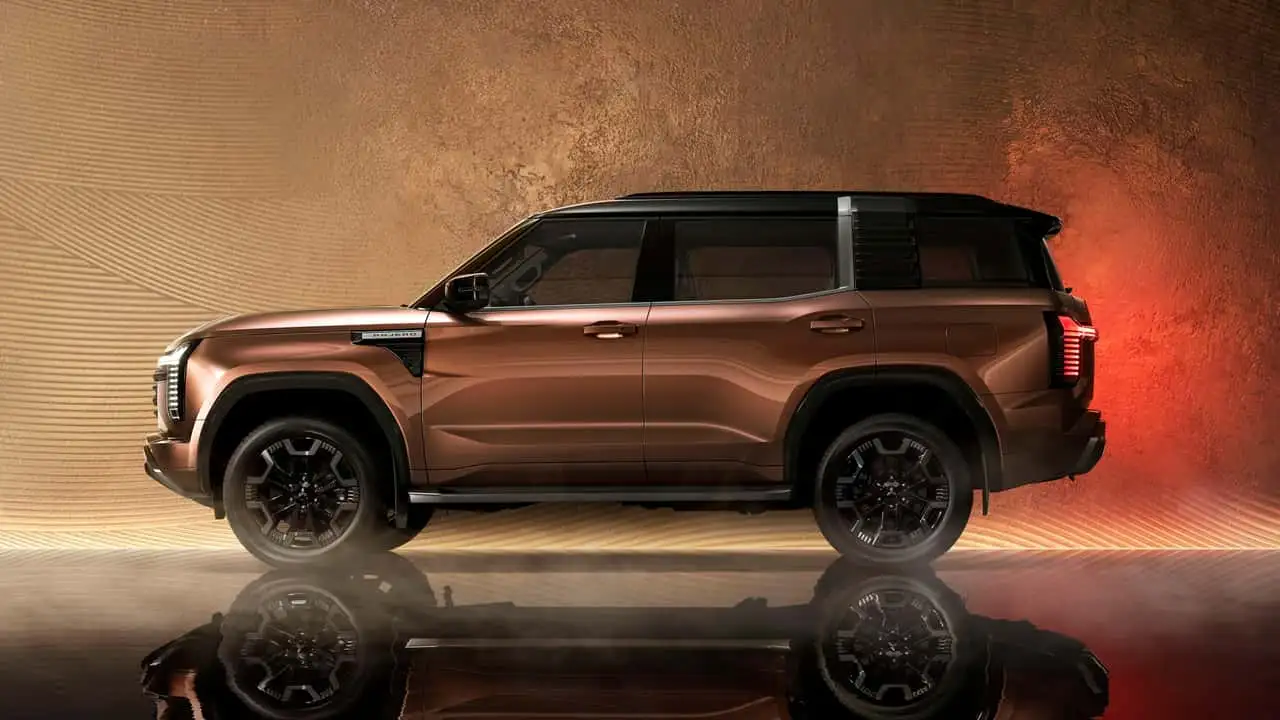
Mitsubishi unveiled the redesigned Pajero in September 2026 as a new flagship model. Production is based in Thailand. The first markets are Thailand, Japan and Australia during fiscal 2026, followed by a planned expansion to about 100 countries from fiscal 2027, including markets in ASEAN, Latin America and the Middle East.
The Pajero is not a Lancer Evolution replacement. It uses a robust ladder frame related to the Triton pickup and is designed to combine family comfort with serious off-road use. The vehicle has Super Select 4WD-II with 2H, 4H, 4HLc and 4LLc modes, as well as Super-All Wheel Control, which coordinates braking, traction and torque distribution.
The announced powertrain is a 2.4-litre clean-diesel engine with a single variable-geometry turbocharger and up to 480 Nm of torque, depending on specification. It is paired with a newly developed eight-speed automatic transmission. Seven drive modes cover Normal, Eco, Gravel, Snow, Mud, Sand and Rock. These are the specifications of a cross-country flagship SUV, not evidence of a sporty Evolution variant.
Rally heritage in a different type of vehicle
Mitsubishi says the Pajero won the Dakar Rally 12 times, including seven consecutive victories, and that production across four generations exceeded 3.29 million vehicles. The company uses this heritage to explain the new SUV’s frame, four-wheel-drive controls and durability focus.
A ladder-frame SUV and a tarmac-focused performance car solve different problems. The Pajero needs ground clearance, suspension articulation, underbody protection and predictable low-speed traction. A future Evo-inspired SUV would have to combine those priorities with sharper steering, stronger acceleration and road handling without losing the usefulness expected of an SUV.
That balance is technically possible, but no Mitsubishi release says that such a vehicle has entered development. The new Pajero establishes a foundation for the brand’s adventure image; it does not automatically become an Evo successor.
Mitsubishi’s wider product plan
Mitsubishi’s mid- to long-term vision calls for 13 new models between fiscal 2026 and fiscal 2031, including five HEVs and five PHEVs. The plan covers SUVs, pickups and ASEAN-focused products. Mitsubishi says the all-new Pajero will be developed into a series, making it the first model to embody the company’s new brand-led direction.
The company is also pursuing battery-electric vehicles. The Eclipse Sportback EV is supplied by Nissan on an OEM basis for the United States and Canada. Mitsubishi’s concept-car programme includes electrified SUVs such as the Elevance. These vehicles show that the company is combining off-road identity with different powertrains, but none has been identified as a new Evolution.
For Mitsubishi fans, the important point is that the leadership has not dismissed performance as part of the brand’s future. The wording still matters. “We want to be able to create such a car again” is different from “we are developing a new Evolution”. The former describes a desired capability; the latter would require an approved project, a vehicle programme, engineering resources and a commercial plan.
What is known and what is not
Mitsubishi is rebuilding its identity around SUVs, four-wheel drive, rally heritage and electrification. The new Pajero is the clearest official expression of that strategy, and the company plans to expand the nameplate into a series. Mitsubishi’s president also regards the Lancer Evolution as an important reference point.
There is still no confirmed SUV Evolution, Lancer successor, production Ralliart model or electric sports car. There is no public price, power output, platform, European launch date or delivery schedule. For now, the Evo spirit is a statement about what Mitsubishi wants to be capable of building, not a model customers can order or reserve.