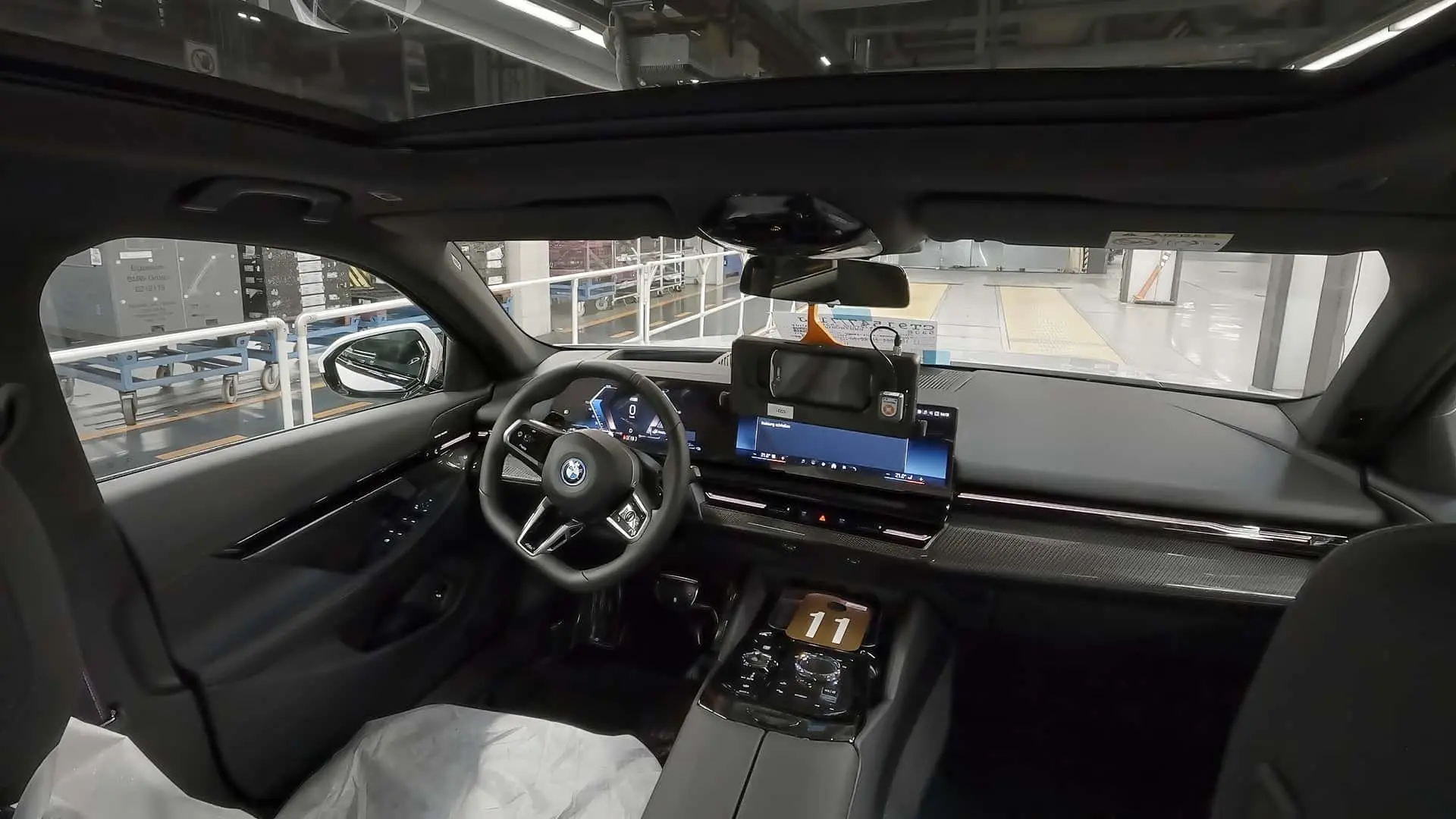
BMW Group says it has completed one million automated vehicle movements inside its production network. The company’s Automated Driving In-Plant system, known as AFW, moves new vehicles without a driver in defined production and logistics areas. The milestone is significant for factory automation, but it should not be read as a claim that BMW customer cars can drive themselves on public roads.
AFW is now operating at four BMW Group locations: Dingolfing, Leipzig and Regensburg in Germany, and MINI Plant Oxford in the United Kingdom. BMW says the network handles around 3,500 automated vehicle movements per day. Oxford alone recorded more than 53,000 such movements during the past year.
Factory autonomy is a different problem
The key distinction is the operating environment. A vehicle moving through a plant follows defined routes in a private, managed area. The plant can install sensors along those routes, map the operating zones and connect the movement system to manufacturing equipment. A car on a public road has to deal with an open environment, changing traffic rules, unpredictable road users and a much broader approval framework.
BMW’s own description of the earlier AFW pilot makes that difference clear. The vehicles do not need to use their own road-driving sensor suite for the plant operation. Instead, sensors installed around the route locate the vehicle and detect obstacles. A planning system then sends commands through the plant’s communications infrastructure.
The current system combines external sensors, cloud architecture and motion-planning software. LiDAR sensors continuously scan the environment, allowing the system to build a current picture of the area around the vehicle. BMW says the software can account for people, other vehicles, driverless transport vehicles, logistics traffic and temporary obstacles. That does not mean that every possible situation is solved everywhere; it means that the system is designed for the specific production zones in which it has been deployed.
BMW says its Dingolfing plant has the largest LiDAR infrastructure of this kind in Europe. In this context, the sensors are part of the factory rather than a consumer feature fitted to every car. That approach can make it easier to move different vehicle architectures through the same controlled space, provided the infrastructure, software and operating procedures have been validated for the site.
From pilot to a repeatable production tool
BMW began the AFW pilot at Dingolfing in 2022. The project was developed with Swiss technology company Embotech, whose software covers perception, prediction and motion planning for industrial environments. Embotech also describes a separate safety architecture that defines the system’s safety boundary. The company says that architecture has been independently certified by TÜV SÜD.
The first million movements did not arrive at a constant rate. Embotech says the initial 500,000 movements took 15 months, while the next 500,000 took seven months. That comparison suggests that the deployment became faster as the teams accumulated operational experience, although it does not prove that the same rate can be repeated at every future site.
The four current locations use the technology in different production and logistics situations. At Oxford, BMW says the system is connected directly to existing control systems. Automated movements can position vehicles next to lifting equipment for defined work steps, allowing the transport sequence and the plant equipment to exchange information through a cloud-based setup.
BMW identifies Spartanburg in the United States as the next plant expected to receive the system within roughly a year. The company’s wider iFACTORY strategy links factory planning with efficiency, digitalisation, data use and autonomous transport. The next test for AFW will therefore be less about proving that one route can work and more about adapting the method to different buildings, processes, vehicle mixes and safety procedures.
What the system may change inside a plant
Vehicle transport between production stations is repetitive and time-sensitive. A completed body or finished vehicle may have to move to inspection, a logistics zone, a lifting device or a temporary holding area. If the route is shared with people and other equipment, every interruption can affect the sequence around it.
BMW and Embotech list smoother vehicle flow, more flexible operations, continuous availability and fewer transport damages among the potential benefits. Those are manufacturer and technology-partner claims, not an independent productivity study. The milestone does show that the system has been used at a scale beyond a short demonstration: it has handled a million recorded movements across multiple plants.
Automation also changes the type of work required to keep a production system running. The factory still needs people to monitor the operation, maintain the sensors, handle exceptions, recover a vehicle after a stop and update the digital map when the physical environment changes. A driverless movement therefore does not mean a people-free process. It shifts part of the work from steering individual vehicles to supervising an integrated system.
The infrastructure itself is another constraint. A plant must install sensors, provide reliable communications, define safe zones and connect the automated system with existing production controls. The method can be scalable, but it is not a software-only upgrade that can be switched on in every factory without preparation.
A milestone with a clear limit
The one-million figure is best understood as an industrial deployment milestone. It indicates that BMW has moved from a 2022 pilot toward repeated use at four sites. It does not provide a new autonomy rating for BMW models and it does not change the legal status of driver assistance on public roads.
For car buyers, the practical connection is indirect. Factory automation can influence how manufacturers organise production, but the press material does not quantify a lower vehicle price, a specific reduction in assembly time or a change to a model’s equipment. Those outcomes should not be inferred from the movement count alone.
The next phase will reveal whether the approach remains reliable as it reaches more plants and more use cases. For now, BMW’s evidence is concrete: four sites, approximately 3,500 movements per day, more than 53,000 movements at Oxford in one year, and one million movements since the programme began.