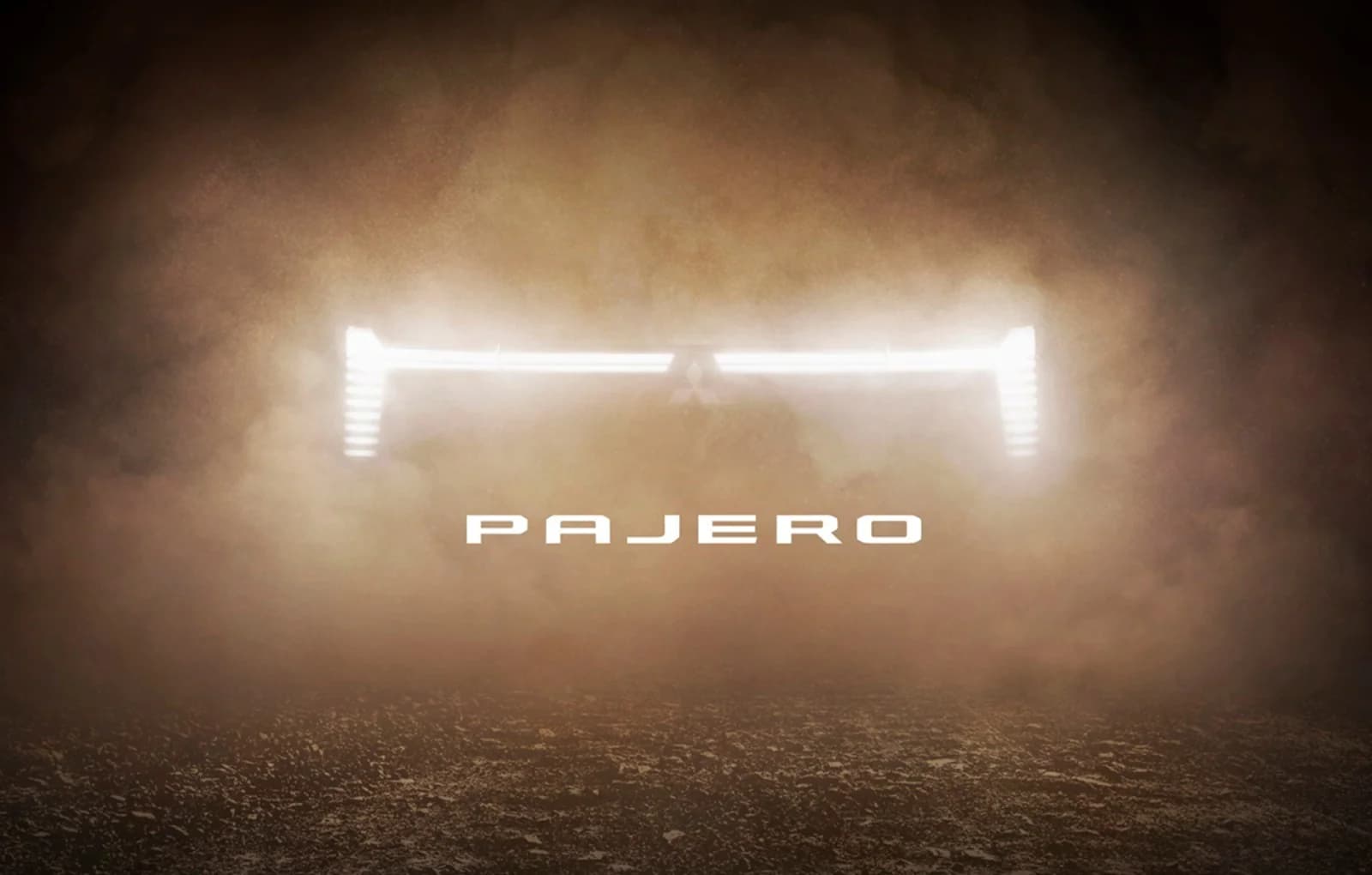
The new Pajero will keep its focus on difficult terrain and will become the flagship of the Mitsubishi range. Photo: Mitsubishi Motors
Mitsubishi Pajero returns after five years. The new 4x4 will be unveiled on 2 September
Mitsubishi will present the new-generation Pajero on 2 September 2026, bringing back one of the best-known names in its history. The manufacturer confirms it will not be merely a family SUV with a rugged look, but an off-road vehicle built on a separate chassis derived from the Triton pick-up.
The model will return globally after a five-year absence and will occupy the flagship position in the Mitsubishi range. The name differs by market: Pajero is the main designation, and Montero will be used in certain regions. A possible return of the Shogun name in the United Kingdom has not been officially confirmed.
Availability in Romania and the rest of continental Europe also remains unannounced. The September premiere should clarify markets, powertrains and the commercial timetable.
Separate chassis, not an urban SUV platform
Mitsubishi has confirmed that the new Pajero uses as its basis the ladder frame of the current Triton, a model also sold as the L200. The cabin, front suspension and rear suspension are, however, developed specifically for the Pajero.
That architecture places it in the category of genuine off-road models, alongside the Toyota Land Cruiser and Ford Everest, not in the segment of SUVs built on passenger-car platforms. A separate chassis is suited to heavy loads, towing and difficult roads, but it can add mass and a less agile behaviour on tarmac.
Mitsubishi says the development of its own suspensions aims to combine off-road toughness with a level of comfort worthy of a flagship model. How well that compromise has been achieved can be assessed only after final specifications and the first independent tests appear.
The S-AWC system will control all-wheel drive
Another confirmed element is Super All-Wheel Control, abbreviated S-AWC. Mitsubishi’s system coordinates all-wheel drive, braking and torque distribution to control the car’s behaviour on surfaces with different grip.
The manufacturer has not yet published all the technical details of the version fitted to the Pajero. Teaser materials do, however, show that torque distribution between the left and right wheels will be visible on the central screen dedicated to off-road driving.
The Pajero will receive a digital panel inspired by the three auxiliary gauges of earlier generations. It will display:
- altitude and direction of travel;
- outside temperature;
- the body’s longitudinal and lateral inclination angles;
- torque distribution between the left and right sides.
The equipment has a practical function on slopes, narrow trails and uneven ground, but it is also a direct reference to the cabin of older Pajero models.
Powertrains have not yet been announced
Mitsubishi has not confirmed the engine, power, transmission or consumption of the new generation. The technical link with the Triton makes it possible to use existing components, but that is not enough to claim that the Pajero will take over the pick-up’s diesel engine without changes.
No hybrid or plug-in hybrid version has been announced officially. Mitsubishi’s experience with the Outlander PHEV makes electrification of the range plausible in the longer term, but any configuration attributed now to the new Pajero remains speculation.
Those unknowns matter for Europe, where the mass, emissions and price of a body-on-frame SUV can limit the offer. A powertrain available in Asia or Australia is not automatically suited to European rules and commercial strategy.
The Pajero returns with a history that began in 1982
The first Mitsubishi Pajero was launched in 1982. Across four generations, the manufacturer sold more than 3.25 million examples in more than 170 countries and regions.
The model’s reputation was also built in the Dakar Rally. The Pajero scored 12 victories, including seven consecutive ones, a record Mitsubishi still uses today to define the identity of the new model.
Production of the previous generation ended first in Japan, in 2019, and withdrawal from the last export markets took place in 2021. Pajero Sport, also based on the Triton pick-up, continued to be sold separately and should not be confused with the flagship model now returning.
Will the new Pajero reach Romania?
For now, the correct answer is that there is no confirmation. Mitsubishi has spoken of a global return, but it has not published the list of countries where it will be sold, nor announced a European version.
The Romanian market could suit an SUV capable of towing and running on difficult roads, but price, powertrain and emissions rules will matter more than the fame of the name. The current local importer has not communicated a launch timetable.
The 2 September premiere will show the complete design and should provide the first answers on propulsion. Until then, what is certain is the Triton-derived ladder frame, the specially developed suspensions, the S-AWC system and the Pajero’s positioning as Mitsubishi’s new flagship.