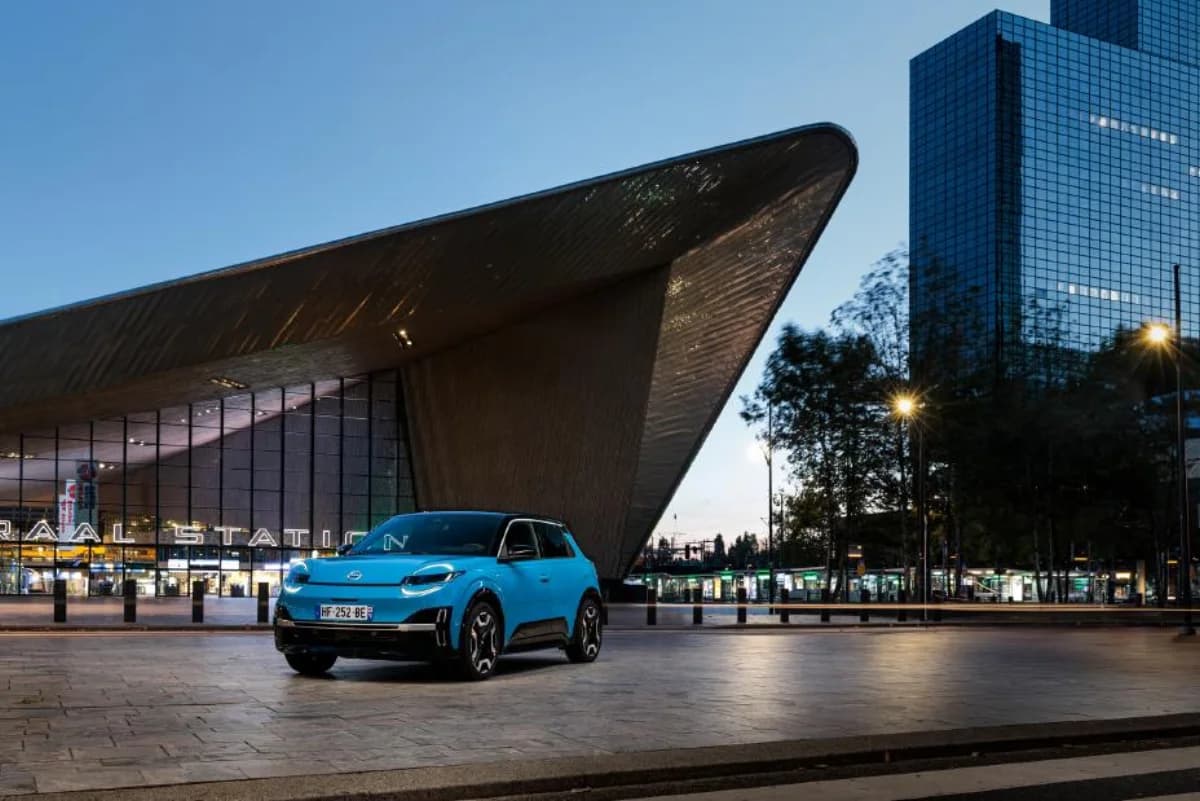
Photo: Nissan Europe. Official press image issued for the electric Micra's first road drive; used editorially.
The 52 kWh Nissan Micra appears in Green NCAP's database with five stars and a 94% sustainability rating. That is a strong official result, but it comes with an important qualification: Green NCAP did not physically test a Micra. It transferred the result from the technically related Renault 5 E-Tech 150 HP Iconic Five under its vehicle-family methodology.
That distinction also matters for a 12.6 kWh/100 km figure repeated in coverage of the result. Green NCAP's Micra entry lists declared consumption as unavailable, and 12.6 kWh/100 km is not a Green NCAP measurement. The tested Renault 5 recorded 15 kWh/100 km in the legal WLTP test and in Green NCAP's warm laboratory cycle, with higher figures on the motorway and in cold weather.
Why the Renault result can cover the Micra
Green NCAP permits a rating to cover another model when the vehicles share the technical characteristics that affect the assessment. For the Micra, validity is limited to the 52 kWh front-wheel-drive automatic with the same charging specification and cabin-heating concept as the tested Renault 5.
The common hardware includes a 52 kWh usable, 55 kWh gross battery, a 110 kW motor producing 245 Nm, and a thermal system combining waste heat, a PTC heater and a heat pump. Green NCAP also transfers its separate Driving Experience judgement when equipment is comparable and the onboard consumption display is expected to be equally accurate.
The five-star Micra result is therefore legitimate, rather than an informal comparison made by a publisher. However, it should be described as an inherited rating. Two separately tested cars would provide stronger model-specific evidence than one set of results applied across a technical family.
What the 94% sustainability rating contains
The assessment gives the Micra, by transfer, 9.1 out of 10 for Clean Air, 9.3 for Energy Efficiency and 10 for Greenhouse Gases. Under Green NCAP's current protocol, those scores look beyond tailpipe emissions. The life-cycle calculation includes raw materials, production, energy supply, vehicle use and end-of-life treatment.
For the tested Renault 5, Green NCAP calculated a total life-cycle climate impact of 105.3 g CO2-equivalent per kilometre, below the organisation's lower scoring threshold. Compact dimensions, moderate battery size, European production and an efficient drivetrain all helped. The Clean Air score was held back by non-exhaust emissions: tyre wear received 2.9 points out of six, while brake wear achieved 5.1 out of six thanks to extensive regenerative braking.
These are sustainability stars, not safety stars. Crash protection and driver-assistance safety are assessed separately by Euro NCAP. Green NCAP also presents consumption, range, winter performance and charging under Driving Experience, outside the headline percentage.
The measured consumption is not 12.6 kWh/100 km
The Renault 5 used 15 kWh/100 km in both the legal WLTP test and Green NCAP's warm-weather laboratory test. Energy demand rose to 24.8 kWh/100 km in the highway cycle. At -7°C, the cold-start result was 32.3 kWh/100 km; once the car was warm, the figure fell to 23.3 kWh/100 km.
Green NCAP's estimated real-world values give more useful context. In warm conditions it expects 13.4 kWh/100 km in urban driving, 15.8 on rural roads, 19.5 on motorways and 16.1 on a mixed route. The cold-winter mixed estimate is 27.8 kWh/100 km.
The 12.6 kWh/100 km number can be approximated by dividing the Micra's 52 kWh usable capacity by Nissan's 416 km WLTP range. That arithmetic is not an official plug-to-wheel consumption figure and does not reproduce the regulated test. Charging losses, battery buffers and test procedure prevent a simple capacity-to-range division from replacing measured consumption.
Warm- and cold-weather range
From the Renault 5 test transferred to the Micra family, Green NCAP estimates 439 km of warm-weather urban range, 372 km on rural roads, 302 km on the motorway and 366 km in mixed use. Its cold-weather estimates fall to 184 km urban, 254 km rural, 213 km motorway and 212 km mixed.
The dramatic urban winter penalty reflects repeated cabin heating on short journeys. Preconditioning while still plugged in can add an estimated 132 km in the urban scenario and 71 km in mixed use compared with an unprepared cold start. Green NCAP labels winter performance “good”, while consumption and range, and charging capability, are each rated “adequate”.
Home-charging efficiency for the Renault was 89% at up to 11 kW. That helps explain why the consumption displayed by a car is not the same as energy billed at the meter: conversion, battery conditioning and charging produce losses.
What Nissan offers in the new Micra
The sixth-generation Micra is electric-only in Europe. Nissan offers 40 kWh and 52 kWh batteries with claimed WLTP ranges of up to 317 km and 416 km respectively. DC charging reaches 100 kW on the larger version, and both support Vehicle-to-Load for external electrical devices.
The car uses the AmpR Small platform shared with the Renault 5 but receives Nissan-specific exterior design developed in London. Nissan quotes a 2.54-metre wheelbase, 326 litres of boot space and towing capacity of up to 500 kg. Two 10.1-inch displays and Google built-in provide the main cabin interface.
For buyers, the Green NCAP result supports the conclusion that the 52 kWh Micra belongs to an efficient technical family. It does not establish 12.6 kWh/100 km as a universal or Green NCAP-tested consumption figure. Temperature, speed, route, preconditioning and charging losses all matter, and the laboratory data show a much broader range than the headline number.