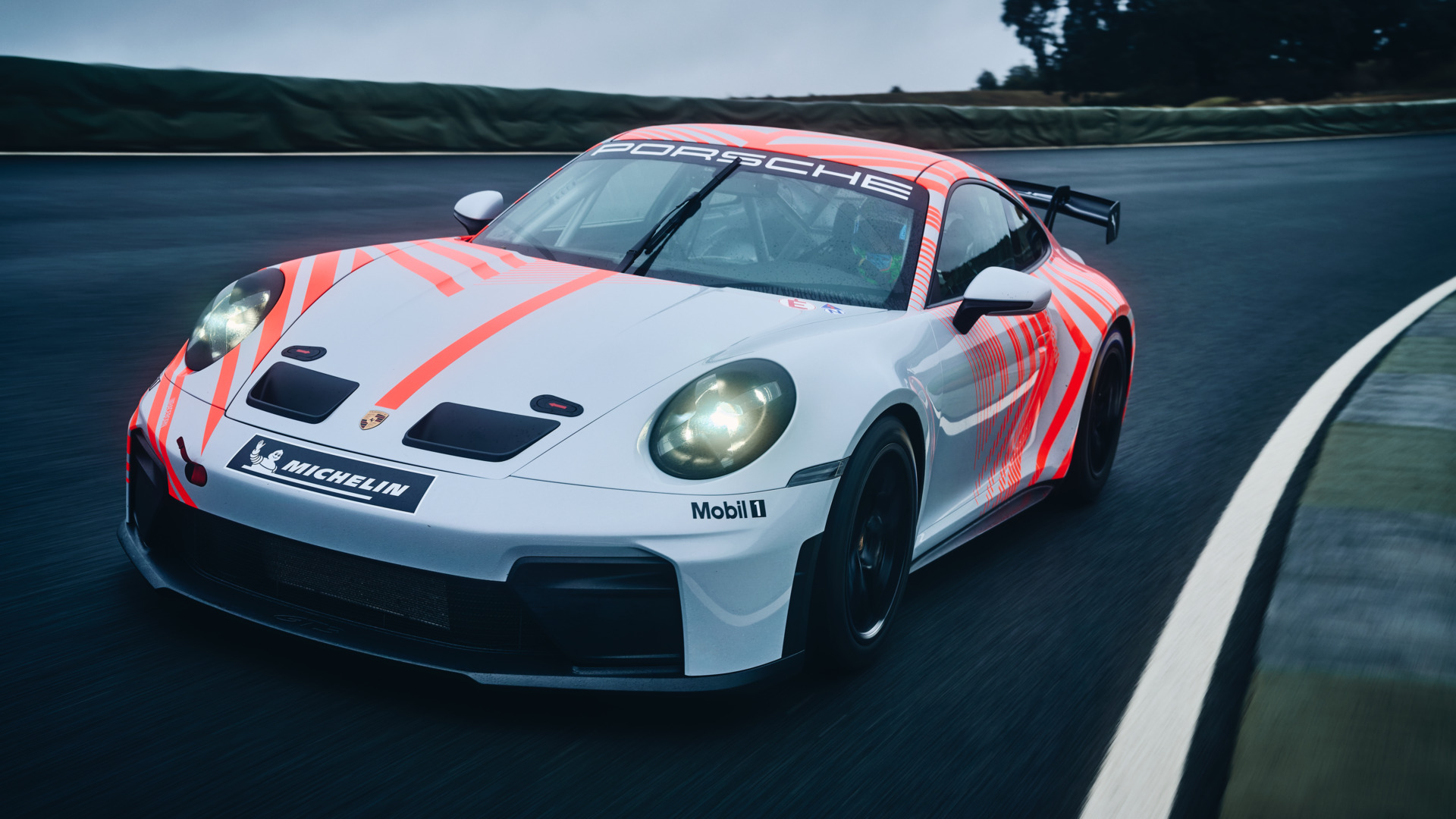
Porsche has presented the 911 Challenge, the new entry model in its customer racing range. The car starts from €208,800 excluding VAT, has a naturally aspirated 4.0-litre boxer engine and can be entered, from the 2027 season, in several one-make competitions organised internationally.
The term “entry model” must be seen in the context of Porsche Motorsport. The 911 Challenge is cheaper to buy and, according to the manufacturer, was designed to have lower running and parts costs than the 911 GT4 R and 911 Cup. Porsche has not, however, published an estimated annual budget for competing in a championship, and the announced price does not include the VAT specific to each country.
4.0-litre engine, 515 hp and PDK gearbox
The six-cylinder opposed engine comes largely from the production 911 GT3. In this configuration it develops 379 kW (515 hp) at 8,500 rpm, and the rev limit is 9,000 rpm. The exhaust has a catalytic converter but does not use a particulate filter.
Power reaches the rear wheels through a seven-speed PDK transmission. The driver can leave the gearbox in automatic mode or change manually from the steering-wheel paddles. The choice of a transmission close to that of the road model distinguishes the 911 Challenge from the 911 Cup, which uses a six-speed sequential gearbox.
The technical data published by Porsche indicate a mass of about 1,450 kg. For comparison within the competition range, the new 911 Cup has about 1,288 kg and 520 hp, but is a more specialised car intended for championships such as the Porsche Mobil 1 Supercup and the Carrera Cup series.
Race components, but also adjustable electronic systems
The 911 Challenge keeps the dimensions and main body elements of the 911 GT3, but the chassis receives components developed for the circuit. The dampers have a motorsport-specific setting, the anti-roll bar can be adjusted in three positions, and slick tyres are mounted on 18-inch wheels with five-stud fastening.
The steel brake discs have a diameter of 380 mm at both front and rear. This solution is also used by the 911 GT4 R and 911 Cup. Standard equipment also includes a three-jack pneumatic system, useful for rapid wheel changes in the pits, and a rear wing with four adjustment positions.
For drivers at the start of their careers, Porsche has kept several electronic systems that can be adjusted: ABS, traction control, stability control and Porsche Torque Vectoring Plus. The steering wheel comes from the 911 GT3 RS, but has extra controls for competition use. The car also has air conditioning, relevant equipment in races run at high temperatures.
The cabin is prepared for competition
Sound-absorbing materials, carpet and the road car’s trim have been removed. In their place, Porsche fits a welded roll cage, an adjustable racing seat with a six-point harness and a fire-extinguishing system.
The FIA FT3-homologated safety tank has a capacity of 110 litres. The front bonnet opens with quick-release fasteners, and an FIA-certified rain light is fitted at the rear. The 911 Challenge is not homologated for use on public roads.
Where the 911 Challenge sits in the Porsche Motorsport range
The new model takes the role previously occupied by the Cayman GT4 Clubsport and, more recently, the 718 Cayman GT4 RS Clubsport. It will compete mainly in the Porsche Challenge and Trophy series, where the cars are close in specification.
Above it sit the 911 GT4 R, built for the international GT4 category, then the 911 Cup, used in higher-level one-make championships. The 911 GT3 R remains the model intended for GT3 races organised under FIA regulations.
Porsche says the 911 Challenge will be able to take part in numerous one-make series from the 2027 season. The manufacturer has not yet announced a dedicated competition in Romania or a local price including taxes. For commercial enquiries in Europe, Porsche Motorsport indicates the address motorsport@porsche.de.
Image: Porsche AG, via Porsche Newsroom.