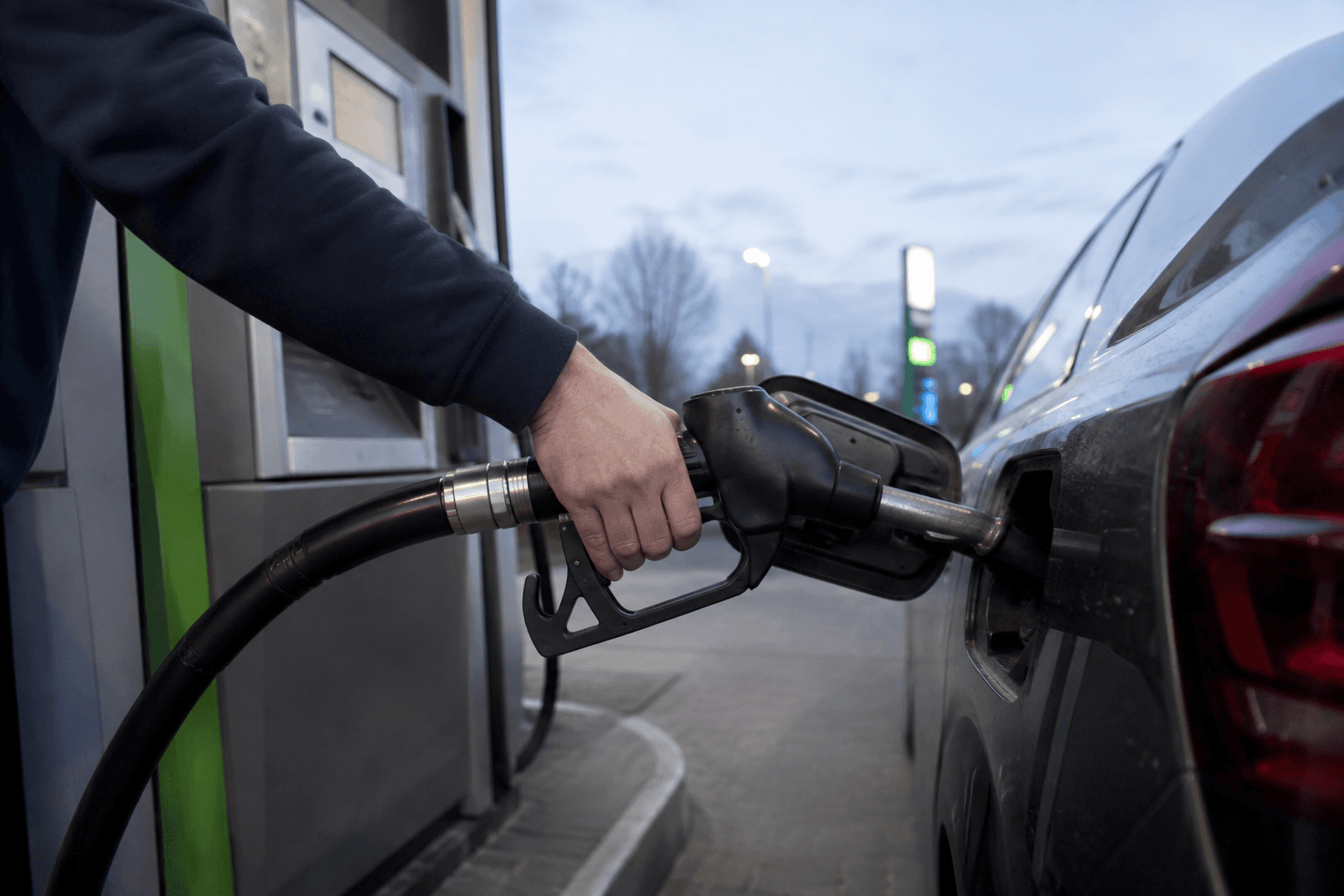
Prices differ by city, network and station. Illustrative image generated with the help of artificial intelligence.
Petrol hits a new record, and diesel again exceeds 10 lei per litre
Fuel prices rose again at the beginning of September 2026. Standard petrol reached as high as 9.79 lei per litre on Saturday, 5 September, and the national average indicated by compiled data was about 9.69 lei per litre. For standard diesel, the average rose to about 10.19 lei per litre.
The diesel increase comes even though the state is applying a 25% cut in excise duty from 1 to 15 September. The measure initially produced a price fall, but the rise in international petroleum-product quotations absorbed the fiscal advantage at many stations within a few days.
The figures are a snapshot of the market on the morning of 5 September, not fixed tariffs for the whole country. The price can differ even between two stations of the same network.
How much petrol and diesel cost on 5 September
At the monitored stations in western Bucharest, standard petrol was displayed between 9.59 and 9.77 lei per litre. Rompetrol had the lowest price in the sample, and OMV the highest.
| Network | Standard petrol | Standard diesel |
|---|---|---|
| Petrom | 9.73 lei/l | 10.19 lei/l |
| OMV | 9.77 lei/l | 10.25 lei/l |
| MOL | 9.70 lei/l | 10.16 lei/l |
| Rompetrol | 9.59 lei/l | 10.16 lei/l |
| Lukoil | 9.67 lei/l | 10.23 lei/l |
| SOCAR | 9.69 lei/l | 10.14 lei/l |
The table is not a national price list, nor the tariff of every station in each network. These are values reported for stations watched at the time of the check. For a specific route, drivers can consult Monitorul Prețurilor and select the locality, fuel type and search radius.
How much a 50-litre fill-up costs now
At the average of 9.69 lei per litre, a 50-litre fill-up of petrol costs 484.50 lei. The same quantity of diesel, calculated at the average of 10.19 lei per litre, comes to 509.50 lei.
The difference between the two fill-ups is 25 lei. The real cost of a journey also depends on consumption: a diesel car may use fewer litres than a petrol one, but that saving is not identical for all models and all routes.
For example, for 1,000 km driven:
- a petrol car that uses 7 l/100 km would consume fuel worth about 678 lei;
- a diesel car that uses 6 l/100 km would consume fuel worth about 611 lei.
The calculation uses the averages of 9.69 lei/litre and 10.19 lei/litre and does not include differences between stations or premium fuels.
Why diesel rose despite the excise cut
The Ministry of Finance increased the temporary reduction of excise duty on standard diesel from 20% to 25%, starting on 1 September. The reduction is 701.07 lei per 1,000 litres, which brings the effective excise level down to 2,103.22 lei per 1,000 litres in the first half of the month.
When the measure entered force, some networks cut the diesel price by about 17 bani per litre. By 5 September, prices had risen again. At Petrom, diesel was 10.14 lei/litre on 31 August and 10.19 lei/litre on 5 September. At OMV, the comparison was between 10.20 and 10.25 lei/litre.
Excise duty is only one component of the final price. The quotation of the refined petroleum product, the exchange rate, transport, stocks, commercial margins and VAT also matter. A tax cut can be cancelled if the base product rises quickly enough.
In the preceding days, the Platts Med quotation for diesel had passed 1,400 dollars per tonne, about 140 dollars above the level at the end of August, according to data cited by economic publications. For petrol, the reported increase was about 60 dollars per tonne.
The excise cut is reassessed every two weeks
The mechanism introduced by Law no. 162/2026 allows the excise reduction to be adjusted according to the evolution of quotations and the average pump price. The level is analysed for each half-month.
For 1–15 September, the reduction is 25%. It cannot be assumed that the same percentage will remain valid after 15 September; the Ministry of Finance must announce the level applicable to the next period.
The scheme for hauliers is separate from the reduction seen by all customers at the pump. The Ministry of Finance has established that eligible hauliers can receive in this period an additional reimbursement of 43 bani per litre, so that the two forms of support respect the European ceiling.
Petrol does not benefit from the current mechanism
The temporary reduction applies to standard diesel, not petrol. The rise in petrol to 9.79 lei per litre is therefore not offset by the same fiscal mechanism.
A maximum observed at one station does not mean that every driver pays that tariff. On the same day, the indicated national minimum for standard petrol was about 9.48 lei per litre, a difference of 31 bani from the maximum. On a 50-litre fill-up, the choice of station could change the bill by about 15.50 lei.
For diesel, crossing the 10 lei threshold was already widespread at the large networks. Checking the price before filling up can reduce the one-off cost, but it does not eliminate the effect of the general increase on the monthly budget.