
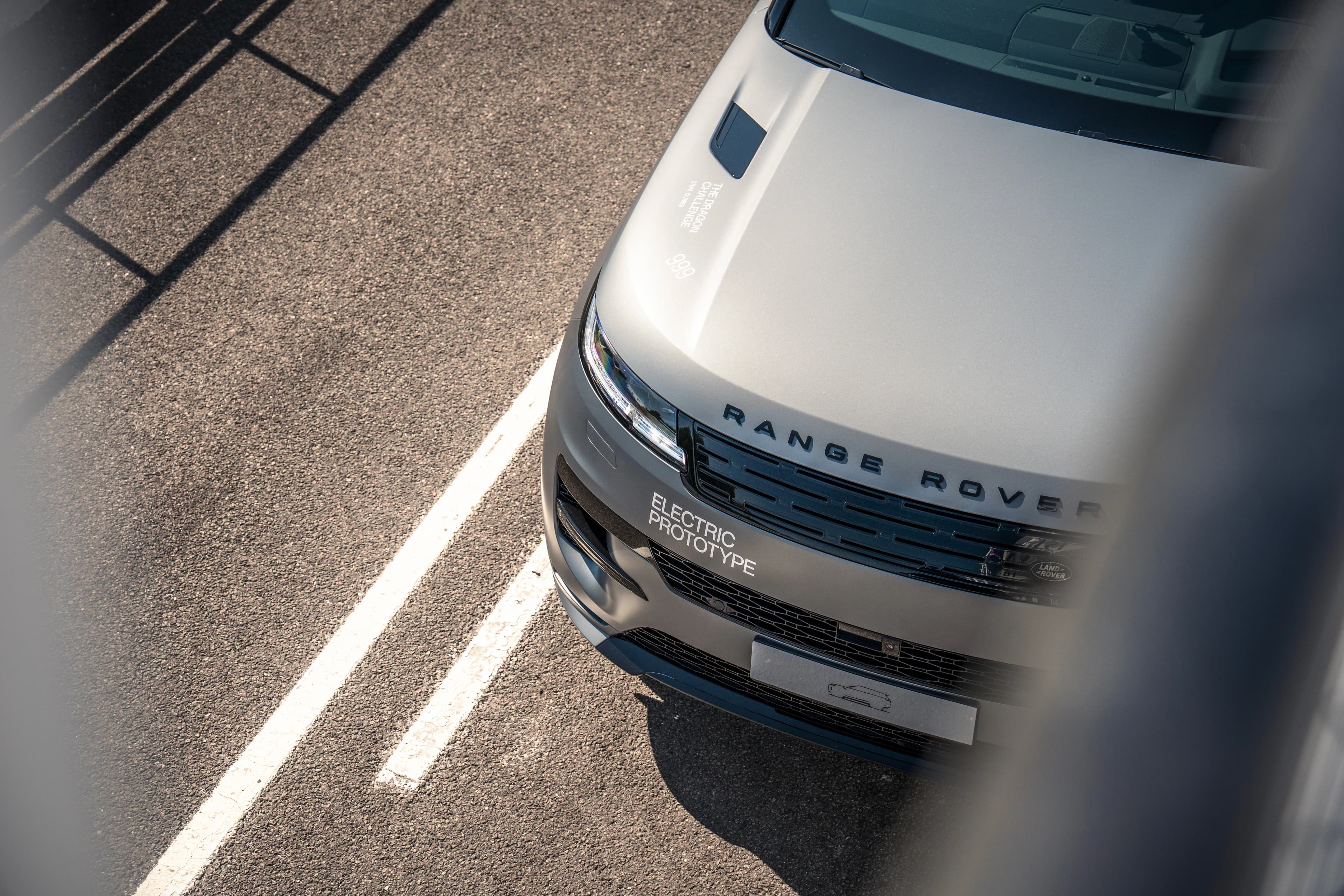
The Range Rover Sport Electric brings battery power to Land Rover’s sportier luxury SUV without changing the basic visual language. It combines two electric motors, 543 horsepower, 850 Nm of torque and a 118.5-kWh battery. Land Rover quotes up to 609 kilometres of WLTP range, a ten-minute charging gain of around 220 km and a 10-to-80-percent DC charge in approximately 22 minutes.
Familiar shape, different hardware
The electric Sport is deliberately easy to identify as a Range Rover Sport. The body keeps the muscular stance, high driving position and short visual overhangs of the combustion and plug-in-hybrid models. The main exterior changes are functional: a closed grille, revised airflow management and the absence of exhaust outlets.
That approach is consistent with Range Rover’s broader electrification strategy. The brand is not presenting the EV as a separate design experiment. Instead, it wants buyers to choose the powertrain that suits them while retaining the same luxury identity. The electric version therefore has to work as a quiet urban vehicle, a long-distance SUV and a capable machine on rough ground.
Twin motors and immediate torque
Two electric motors provide all-wheel drive, with one motor assigned to each axle. Their combined output is 543 hp and maximum torque reaches 850 Nm. Land Rover positions that torque figure above every previous Range Rover model, including the high-performance Sport SV with its twin-turbocharged V8.
The claimed 0–96 km/h time is 4.3 seconds. That is serious acceleration for a large luxury SUV, but it is not the only reason the electric drivetrain matters. Instant torque can make the vehicle feel more effortless in everyday driving, particularly when pulling away from a junction, joining a faster road or climbing with passengers and luggage.
Land Rover also says the electric powertrain ramps torque 50 percent faster than the system in the larger Range Rover Electric. In practice, the benefit depends on software calibration, tyre grip and the selected drive mode. The important point is that the Sport has been tuned to feel responsive, not merely powerful on a specification sheet.
A large battery and an 800-volt system
The 118.5-kWh lithium-ion battery sits beneath the floor. An 800-volt electrical architecture supports high-power DC charging. Land Rover quotes approximately 220 km of additional WLTP range after ten minutes when the vehicle is connected to a sufficiently powerful charger. A 10-to-80-percent session takes about 22 minutes.
The maximum range figure of 609 km is measured on the WLTP cycle. It should not be read as a promise of the same distance on every motorway trip. Cold weather, high speed, a full cabin, roof equipment, wheel choice and heating or air conditioning can all reduce real-world range. Even so, the figure is significant for an all-wheel-drive luxury SUV with substantial battery mass.
Charging performance may be more important than the headline range for many owners. A short stop during a long journey could add enough energy for the next section, provided the car and the charging station can reach the necessary power. The final experience will depend on the local network, battery temperature and the charger’s own limits.
Off-road ability remains part of the brief
Land Rover tested the Sport Electric in Carrara’s marble quarries in Italy. The route included gradients of up to 45 degrees and a mixture of polished marble and deep marble dust. The company also quotes a wading depth of up to 900 mm and the ability to climb 45-degree inclines.
Those numbers matter because the model is not being sold merely as an electric performance crossover. The battery pack changes the weight distribution and requires protection, cooling and careful sealing, while the electric motors make precise low-speed control possible. A low centre of gravity can help stability, but it does not remove the challenges associated with a heavy vehicle on loose surfaces.
The body is said to be 61 percent stiffer than the plug-in-hybrid version, while the centre of gravity is 73 mm lower. These are manufacturer claims for the presented vehicle. Independent tests will still be needed to judge ride comfort, tyre performance and energy consumption on real trails.
A designed sound and a familiar cabin
The Sport Electric also gets a bespoke sound. Engineers created an audio character linked to the drive modes, giving the driver an audible sense of acceleration without pretending that the vehicle has a combustion engine. The effect is subjective, and it can be adjusted or disabled depending on the final equipment specification.
Inside, the concept is evolutionary. The cabin remains focused on high-quality materials, quietness and a commanding view. The electric system adds information about charge level, energy use and charging status, but Land Rover has not yet published every market-specific equipment list. Buyers should therefore wait for local configurators before assuming that a feature shown in press material will be standard everywhere.
Production, price and what is not confirmed
Production is planned at JLR’s Solihull plant in the United Kingdom, on the same lines as combustion-powered and plug-in-hybrid Range Rover Sport models. The company has not announced a Romanian price in the material used for this report. European pricing, final kerb weight, detailed consumption data and local delivery timing remain market-dependent or unconfirmed.
The Range Rover Sport Electric is consequently a careful evolution rather than a clean-sheet departure. It keeps the familiar body and off-road mission, then adds fast response, high torque and rapid charging. Whether it becomes a practical daily choice will depend on the final price and the owner’s access to reliable high-power charging. The headline specifications are strong, but the real test will be whether the electric Sport can preserve the relaxed, all-terrain character that defines the nameplate.


