Image: Stellantis Media / Leapmotor. Official image from the Paris Motor Show release covering the B10’s Zaragoza production.
Stellantis plans to fill European factories with its own models and Chinese partners’ vehicles
Stellantis is trying to address pressure on its European manufacturing network by combining new products from its own brands with vehicles produced for Chinese partners. Automotive News reported from the Paris Motor Show that CEO Antonio Filosa said Stellantis would use underused European factories rather than close plants, with support from Chinese partners and a pipeline of new group models.
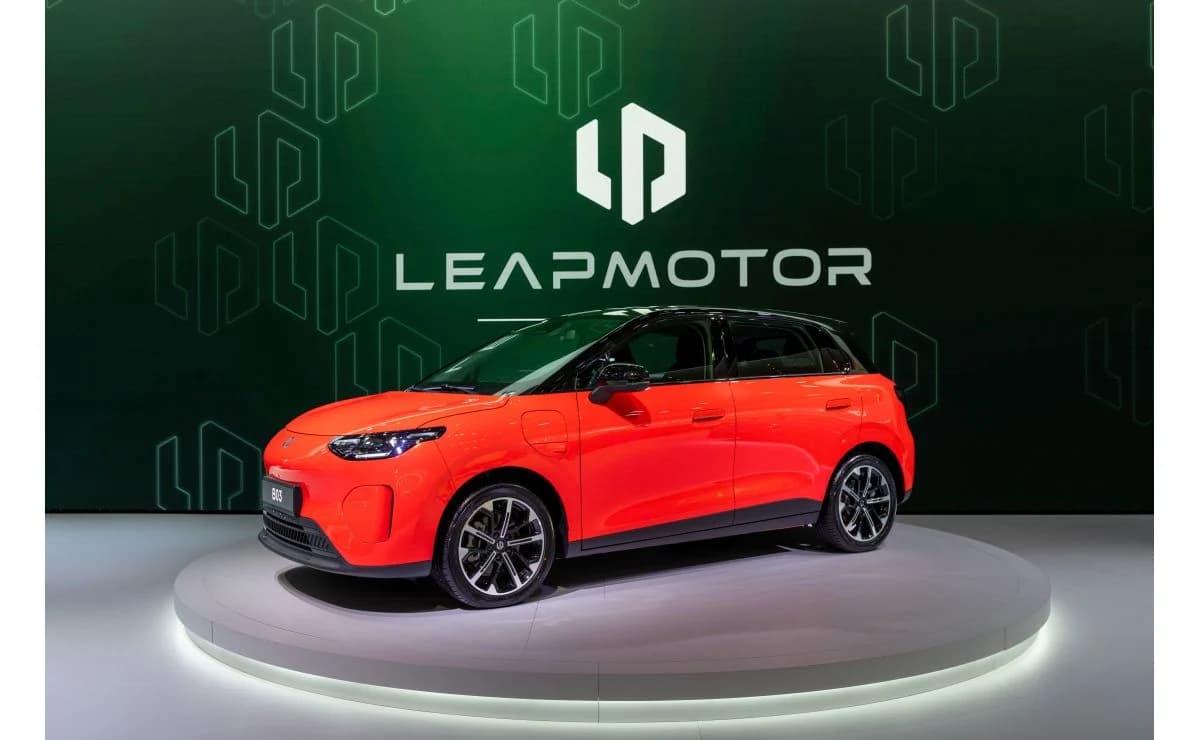
The most concrete example is the European production of the Leapmotor B10 electric SUV. Stellantis and Leapmotor confirmed on 12 October that B10 production had officially started at Zaragoza in Spain, Leapmotor’s first European manufacturing facility. The project shows how a European industrial footprint can be used to localise a Chinese brand’s products, but it also illustrates the different levels of certainty involved in Stellantis’ wider factory plans.
Zaragoza moves from proposal to production
The Figueruelas plant near Zaragoza is a Stellantis facility with a long Opel history. In their 8 May announcement, Stellantis and Leapmotor said they were assessing a new line for an all-new electric Opel C-SUV and that Leapmotor could bring B10 production to the site potentially from 2026. The release also noted that the plant produces the Peugeot 208 and Lancia Ypsilon.
The October Paris release confirms a higher level of certainty for the B10: production has started. Leapmotor describes Zaragoza as its first European manufacturing facility and says the vehicles are being built for European customers. That local-for-local approach can reduce the distance between production and customers and may simplify the company’s European industrial footprint. The release does not publish an annual production volume or a country-by-country allocation.
The Opel C-SUV remains at an earlier stage. Stellantis’ May wording referred to an assessment of an additional line, with a possible production start in 2028. It did not announce a commercial name, a confirmed annual capacity or a retail launch date. Treating that project as equivalent to the B10’s confirmed production would overstate the evidence.
Why the Leapmotor partnership matters
Stellantis acquired approximately 21% of Leapmotor in October 2023. The companies also created Leapmotor International, a joint venture owned 51% by Stellantis and 49% by Leapmotor, with rights to sell and manufacture Leapmotor products outside Greater China.
The arrangement combines different assets. Leapmotor brings electric products and technology, while Stellantis brings distribution, service operations, knowledge of European markets and industrial capacity. In May, the companies said Leapmotor International had grown to more than 850 sales and service locations in the region and had shipped more than 40,000 vehicles in Europe during 2025. Those are company-reported figures, not an independent market-share calculation.
For Stellantis, building a Leapmotor model in a European factory can help use available capacity while its own brands prepare new products. For Leapmotor, European production brings manufacturing closer to its customers. The open question is how much of the vehicle’s total value will be created in Europe. The releases do not provide a full local-content breakdown for the B10, so the existence of Spanish assembly should not be treated as proof that the entire supply chain is European.
Madrid and the Made-in-Europe question
The Villaverde plant in Madrid is also part of the proposed expansion. Stellantis and Leapmotor said they intend to allocate future Leapmotor products for European and global markets to the site, with several nameplates manufactured in line with Made-in-Europe requirements. The potential timing starts in the first half of 2028, and ownership of the plant is under discussion for a possible transfer to Leapmotor International’s Spanish subsidiary.
The wording matters. “Intend”, “potential” and “under discussion” do not mean that the transfer or production programme has already been completed. The companies also state that the initiatives remain subject to definitive agreements and customary approvals. For workers, suppliers and local authorities, the difference between an announced intention and a final production decision is substantial.
Mulhouse and Peugeot’s future models
Stellantis is not relying only on Chinese partners to use European capacity. In France, the company announced an investment of more than €1 billion at Mulhouse for three new Peugeot C-segment models, combining electric and hybrid powertrains on the STLA One platform. Production is scheduled to start in 2029.
Stellantis says the Mulhouse plant employs about 4,500 people and that the project will improve capacity utilisation and provide long-term visibility. The C segment represents approximately 30% of European car sales, according to the company’s release. That helps explain why compact cars and medium-sized SUVs matter to plant planning, but it does not guarantee the commercial volume of any future Peugeot model.
In Italy, Stellantis announced a separate small and affordable electric E-Car project for Pomigliano d’Arco, with production planned from 2028. The company has not yet published a final retail name, price or complete technical specification. It is another example of a strategic direction rather than a finished product launch.
Factories can be repurposed, not only filled with cars
Poissy in France illustrates another route. Stellantis announced a transformation of the historic site around four new industrial activities, including vehicle preparation and conversion, 3D printing for small series and circular-economy work. The company plans to invest more than €100 million and says the project is intended to maintain 1,000 production jobs in 2030.
That case shows why “using capacity” does not always mean making more cars on the same line. Some plants may receive new vehicles, others may combine several products, and others may move towards components, refurbishment or industrial services. For local communities, employment, skills and the investment timetable can matter more than the brand assembled at a particular moment.
What the strategy means for European buyers
The production of B10 in Zaragoza could make Leapmotor’s European supply chain less dependent on shipping finished vehicles from China. Stellantis and Leapmotor have not, however, announced when Spain-built vehicles will reach Romanian dealers or whether every European-market version will be made in Zaragoza.
Buyers should therefore separate factory origin from the full ownership question. Battery warranty, software support, spare parts, service responsibilities, charging capability and the final local price remain important. A vehicle assembled in Europe can still use components and technology from multiple regions.
Stellantis is trying to combine three goals: keeping European industrial activity, using the products and cost structure of Chinese partners, and continuing to launch its own electric and hybrid models. Zaragoza, Madrid, Mulhouse, Pomigliano and Poissy point to different solutions. One project is already in production, some have announced investment and others remain under evaluation.
Sources
- Stellantis Media — Leapmotor at the 2026 Paris Motor Show and B10 production in Zaragoza, 12 October 2026
- Stellantis Media — expanded Stellantis–Leapmotor partnership, 8 May 2026
- Stellantis Media — more than €1 billion investment at Mulhouse, 2 June 2026
- Stellantis Media — E-Car project at Pomigliano d’Arco, 19 May 2026
- Stellantis Media — transformation of the Poissy site, 16 April 2026