Subaru is testing an electric prototype built around its own hardware rather than the Toyota-linked architecture used by its first battery-electric models. The running test mule uses two motors, all-wheel drive and a combined output of about 510 hp. Subaru has not shown a production car or confirmed a name, price, body style or launch date for the vehicle that could eventually use this technology.
The prototype was demonstrated at Subaru's research and proving facilities in Japan and wears a modified Outback body. That body is a development tool, not a production preview. The practical reading is that Subaru is validating a new electric platform under familiar sheet metal while it decides what the eventual vehicle should be.
The reported hardware
The front e-axle is rated at 150 kW and the rear unit at 230 kW. Together they produce the roughly 510-hp figure reported after the technical briefing. The two motors give Subaru independent control of the front and rear axles, a layout that suits the company's long-standing focus on symmetrical all-wheel drive.
Reports also put the prototype's 0–100 km/h acceleration at under four seconds. This is a development-vehicle result, not a certified specification for a customer car. Subaru has not published the test mass, tyres, battery state of charge, surface, temperature or repeatability of the run. Those details matter when a prototype number is compared with a homologated production figure.
The important distinction is therefore between capability and commitment. The prototype shows that Subaru is engineering a high-output AWD system. It does not confirm a 510-hp STI, WRX or Outback, and it does not mean that every future Subaru EV will use this output level.
Weight and battery targets
Subaru says the dedicated platform is approximately 100 kg lighter than the architecture used by its current electric models. The battery reportedly contains around 4,000 cylindrical cells and is about 25 per cent lighter than the company's previous pack. Subaru has also described an energy-density target roughly 20 per cent above an industry average, although it has not defined the reference average in the public material available so far.
No battery capacity has been released. Charging power, charging time, usable energy, cell chemistry and real-world range are also unknown. Those omissions prevent a meaningful road-trip comparison with Solterra, Trailseeker or competing EVs. A lighter pack can help efficiency, but the final result still depends on the vehicle's size, aerodynamics, tyres, thermal management and software.
The cylindrical-cell count is not a range figure. It tells us something about the pack architecture, but not how much energy the pack stores. Cell format, voltage, chemistry, connection layout and cooling all influence the finished battery. Subaru may change these details before production, particularly if the platform is adapted to more than one vehicle.
A more integrated electronic architecture
Subaru is also developing an integrated control unit intended to coordinate the motors, battery, chassis functions, driver assistance and other software systems. The aim is to reduce the number of separate electronic modules and create a system that can support over-the-air updates.
That approach could allow Subaru to refine torque distribution or introduce software functions after a vehicle has been delivered. It also creates new requirements for cybersecurity, functional safety, diagnostics and long-term support. The company has not yet explained which customer-facing functions will be updateable, whether updates will be free or optional, or how long the platform will be supported.
In March 2026, Subaru announced a collaboration with Infineon on a microcontroller for an integrated ECU covering advanced driver assistance and vehicle-motion control in future Subaru vehicles. The announcement does not identify the 510-hp prototype as a direct application, but it fits the same move toward a centralised electronic architecture.
How this differs from the Toyota partnership
Subaru's first global BEV, the Solterra, was developed with Toyota on the e-Subaru Global Platform. The company has also confirmed that the Trailseeker is jointly developed with Toyota, with production beginning at Subaru's Gunma Yajima plant in February 2026. Subaru's own management policy described joint development, production and supply as a way to share investment and preserve flexibility while demand and technology were still difficult to forecast.
The new prototype represents a different stage of the strategy. Subaru wants to develop more of the electric powertrain, battery and software itself, while retaining the AWD behaviour that customers associate with the brand. Press reports say some of the technology could reach production vehicles from 2029, but Subaru has not announced a model programme or a production schedule that customers can order against.
The timeline should therefore be treated as an engineering horizon. It is not a launch promise for Europe, Romania or any other market. A future production vehicle would still need final design approval, crash development, calibration, regulatory certification, manufacturing decisions and market-specific equipment.
What remains unknown
The prototype does not establish whether Subaru is developing a sports wagon, a high-performance crossover, a family SUV or several vehicles on the same platform. Subaru has not disclosed wheelbase, dimensions, boot volume, ground clearance, towing capacity, interior layout or driver-assistance specification. It has also not said whether the final battery will retain the reported cylindrical-cell arrangement.
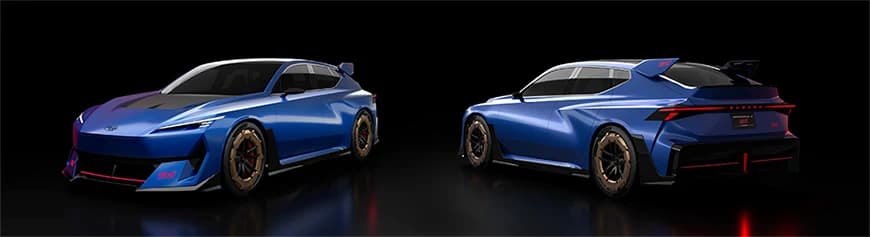
The official Performance-E STI concept shown at the 2025 Japan Mobility Show illustrates Subaru's electric performance design direction, but it is a concept and not the same vehicle as the test mule. The local image used here comes from Subaru's official release and should be read as context, not as a photograph of the 2026 prototype.
For now, the defensible conclusion is limited but clear: Subaru is building the technical capability for a more independent EV programme. The 510-hp prototype demonstrates dual-motor AWD and a lighter, more integrated approach. It does not yet tell us what customers will buy, how far it will travel, how quickly it will charge or when it will arrive.