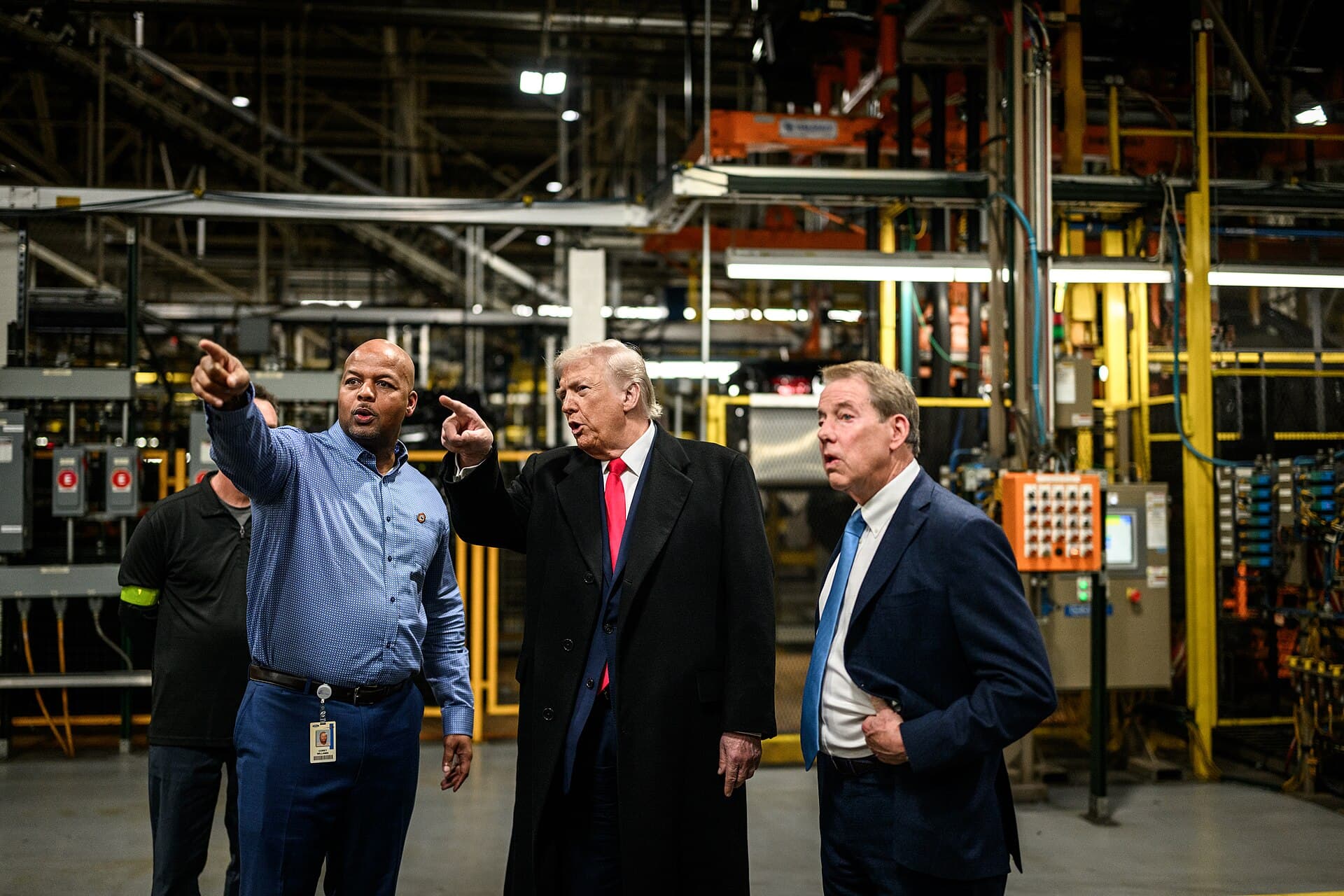
Photo: Daniel Torok / The White House. Donald Trump, Bill Ford Jr. and Corey Williams at the Ford River Rouge plant in Dearborn, Michigan, on 13 January 2026.
US President Donald Trump says he would accept Chinese carmakers entering the United States, with one important condition: the cars would have to be produced locally, and the plants would have to hire American workers. The statement indicates a possible path of access for companies such as BYD or Geely, but it does not amount to a change in legislation or the approval of a concrete investment.
“If China wanted to come and open a factory here for its cars, I would agree,” Trump said on The Ingraham Angle, broadcast by Fox News on 11 September. The president invoked the example of Japanese manufacturers that have long produced in the US and insisted on local jobs.
Trump specified, in the same interview, that he does not want Chinese manufacturers to build cars in Mexico in order to export them afterwards to the United States. The message is compatible with his industrial policy: access to the American market would be tied to production and hiring on US territory.
The statement does not open the American market immediately
At present, an electric car imported from China is subject in the US to an additional 100% tariff, introduced in 2024 through the Section 301 trade measures. The tax has made high-volume sales of Chinese electrics on the American market practically unviable.
Building a plant in the US would avoid the tariff applied to imported cars, but it would not automatically solve every obstacle. The Department of Commerce has adopted separate rules for connected vehicles, motivated by risks concerning access to data, remote control and critical infrastructure.
Starting with the 2027 model year, manufacturers under the ownership, control or jurisdiction of China or Russia cannot sell connected vehicles in the US that fall under the rule. Certain software programmes originating from these countries are also restricted. Limitations on connectivity hardware components apply later, mainly from the 2030 model year.
The regulation includes authorisation and compliance procedures, but simply assembling the car in an American state does not remove the criteria related to company ownership, software and the supply chain. That is why a possible BYD, Geely or Chery plant would need a structure accepted by federal authorities and a technical architecture adapted to American requirements.
A possible formula: a partnership controlled by an American company
Ford and representatives of the Trump administration previously discussed, at a preliminary level, a formula under which Chinese manufacturers could produce in America together with local groups. The variant reported in February assumed a partnership in which the American company would retain control, and technology and profits would be shared.
There is, however, no public agreement, federal programme or list of approved manufacturers. Trump’s statement confirms neither a new plant nor the date on which a Chinese car brand could start sales in the US.
Such a partnership would have to meet several requirements at once: local production, jobs for Americans, control over the data generated by the car, the elimination of prohibited components and compliance with safety rules. Ordinary type approval for road use remains mandatory as well.
American manufacturers are asking for tougher barriers
The opening expressed by Trump contrasts with the position of a significant part of the American auto industry and of Congress. The Alliance for Automotive Innovation, an organisation that represents manufacturers such as General Motors, Ford, Toyota, Volkswagen, Hyundai, Honda and Stellantis, has called for the rapid adoption of a law that would block Chinese vehicles.
In the Senate, the Connected Vehicle Security Act of 2026 has been introduced, a bill that would extend and turn into law the restrictions on connected cars and components from China. The bill should not be confused with a measure already in force: it must be passed by Congress and signed into law to produce legal effects.
The tension is also visible in the position of the Department of Transportation. On 8 September, Secretary Sean Duffy asked Ford to reduce its ties with China and criticised both the licensing agreement with battery maker CATL and collaboration talks with Geely. In this context, turning the presidential statement into an applicable policy would require important clarifications inside the administration.
What the US would gain from local production
For the American administration, the advantage of a local plant would be job creation and attracting investment without reopening the market to cheap imports. Chinese manufacturers would bring experience in battery production, affordable electric vehicles and rapid model development.
For companies in China, American production would be a more realistic path than direct exports. Even so, labour costs, plant construction and local suppliers would reduce the price gap with brands already present in the US. The cars could not automatically be sold at the same prices as on the Chinese market.
There is also the question of time. Choosing a site, obtaining permits, building the factory and forming a dealer network usually take several years. Even if Washington quickly defined a legal path, the effect in showrooms would not be immediate.
What it means for Europe and Romania
The statement produces no direct change on the Romanian market. European regulations, customs duties and EU type approval are independent of United States policy, and Chinese brands continue their expansion here through imports and European production projects.
The signal from Washington is nevertheless relevant for the industry’s direction: large markets increasingly condition access on local production, software security and the origin of components. For Chinese manufacturers, a plant located close to customers may become more important than the cost advantage of exporting from China.
For now, the conclusion remains limited to Trump’s statement: the president is willing to accept Chinese plants that hire Americans. Imports of electric cars from China remain burdened by the 100% tariff, and the rules for connected vehicles continue to represent a separate barrier.
Sources: Reuters – Donald Trump’s statement on Chinese car production in the US, USTR – Section 301 tariffs on electric vehicles and batteries, Bureau of Industry and Security – connected vehicle rule, US Department of Transportation – position on Ford’s relations with Chinese firms, Motor1 – context of the statement and access to the American market