
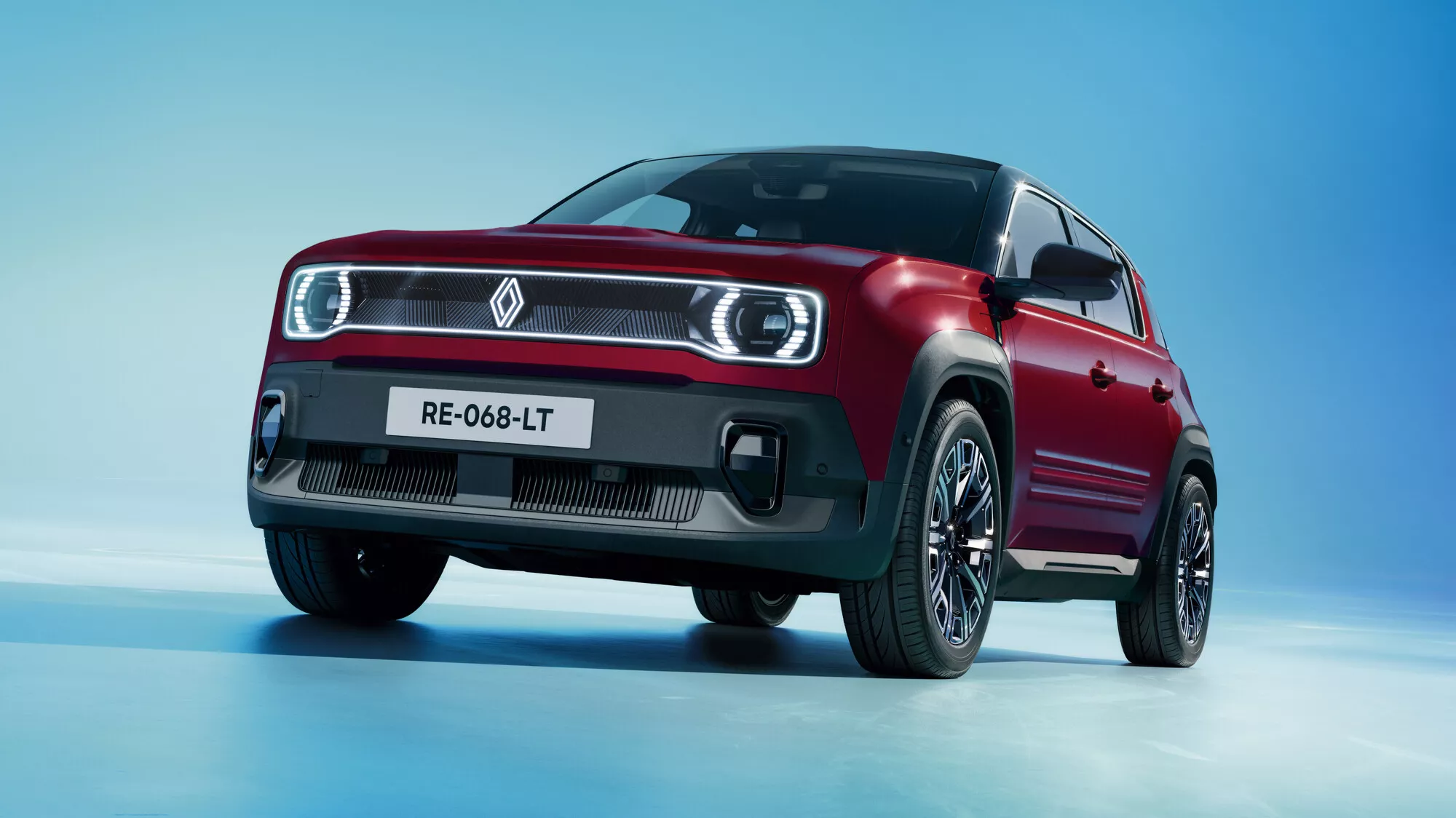
Renault is preparing a new entry point for the Renault 4 E-Tech electric range. Called Jogging, the trim is due to arrive by the end of 2026 with an 80 kW electric motor and a 37 kWh lithium-iron-phosphate battery. Renault quotes up to 305 km of WLTP range for this configuration.
The announcement was made in Renault’s 8 October 2026 press release for the Paris Motor Show. It confirms the technical package and the equipment list, but it does not give a Romanian price or a Romanian order date. Renault says that orders for the updated range will open from 12 or 13 October, depending on the version and market.
A smaller battery with LFP chemistry
The Jogging uses a 37 kWh battery, with 36.5 kWh available for driving. It is an LFP battery with a cell-to-pack architecture. Renault describes the pack as compact and lightweight for its size and weight, but the press material does not publish the battery mass or the vehicle’s kerb weight.
The motor produces 80 kW, or 110 hp, and comes from the same family as the unit used in the Twingo E-Tech electric. Renault quotes 10.2 seconds for 0–100 km/h. That figure places the Jogging below the 150 hp version of the Renault 4, but it is a clear specification rather than an estimate of real-world performance. Renault has not stated the top speed in the announcement.
The quoted range is a WLTP maximum. It should not be read as a fixed distance for every trip. Ambient temperature, motorway speed, wind, gradients, payload and cabin heating all affect consumption. Renault does not publish a separate WLTP consumption number for the Jogging in the press release, so the range figure is the main official efficiency reference currently available.
Charging figures
The entry trim includes a 6.6 kW AC onboard charger and an 80 kW DC charging system. Renault estimates a 10–80 per cent charge in three hours and 30 minutes from an AC socket or charging point. At a suitable DC fast charger, the same interval is quoted at 25 minutes.
Those are manufacturer figures under specified conditions. Actual charging time depends on the power available from the installation, battery temperature and the charging curve. The car will not necessarily hold 80 kW from 10 to 80 per cent. A new manual battery pre-conditioning function is available across the Renault 4 range, allowing the driver to prepare the battery from the central screen before a fast-charging stop.
Equipment for the entry trim
Jogging is designed as the simpler version of the range. The announced equipment includes manual air conditioning, Renault’s OpenR twin-screen layout, a 7-inch digital instrument cluster and a 10.1-inch multimedia display. Apple CarPlay and Android Auto can be used in full-screen mode.
The rear bench folds 60/40, and rear parking sensors are standard. The exterior uses 18-inch wheels with monotone steel covers. Renault also says that the updated range receives a new digital reversing camera. A high-definition 360-degree camera is available as an option on the Techno and Iconic trims, not on the entry-level Jogging according to the current press release.
The equipment list matters because the smaller battery is only one part of the positioning. Buyers choosing Jogging will also accept a shorter list of comfort features than customers selecting higher trims. Renault has not yet published the final market-specific equipment matrix for Romania, so local importers may confirm further details later.
More range for the existing versions
The Jogging announcement is part of a wider revision of the Renault 4 line-up. The 40 kWh urban-range battery, paired with the 90 kW, 120 hp motor and the Evolution trim, now reaches up to 310 km WLTP. Renault quotes 14.7 kWh/100 km for the combined cycle.
The 52 kWh comfort-range battery with the 110 kW, 150 hp motor reaches up to 415 km WLTP. It is listed with Evolution, Techno, Iconic and the Roland-Garros special edition. Official combined consumption for this configuration is 14.4 kWh/100 km.
The Plein Sud version keeps the 52 kWh battery and 110 kW motor but is rated at up to 400 km, with 14.9 kWh/100 km in the combined cycle. Its opening fabric roof changes the configuration compared with the closed-roof versions.
Renault attributes the range gains to aerodynamic changes, including lower body fairings and new wing mirrors. The figures therefore describe efficiency improvements rather than a larger battery in the existing 40 kWh and 52 kWh versions.
The manufacturer is also adding a predictive eco-driving assistant and an emergency stop assistant to the technology package. A new charging-end notification can appear in the My Renault app five minutes before the planned finish or before the requested state of charge is reached. These functions are separate from the battery capacity and should not be confused with a change to the WLTP test result.
Romanian availability remains open
Renault has not announced a Romanian price for the Jogging trim in the material used for this article. The French press release contains country-specific commercial information, but it cannot be treated as a Romanian price list. The same caution applies to order timing: the global announcement gives a market-dependent window, not a confirmed Romanian delivery schedule.
The Renault 4 E-Tech Jogging is therefore a confirmed future configuration, with a defined battery, motor, charging system and WLTP range. Its position in the Romanian range will depend on the local importer’s pricing, equipment and ordering calendar. Until those details are published, the most useful comparison is technical: 305 km WLTP from a 37 kWh LFP pack, with 80 kW DC charging and a 110 hp motor.


