
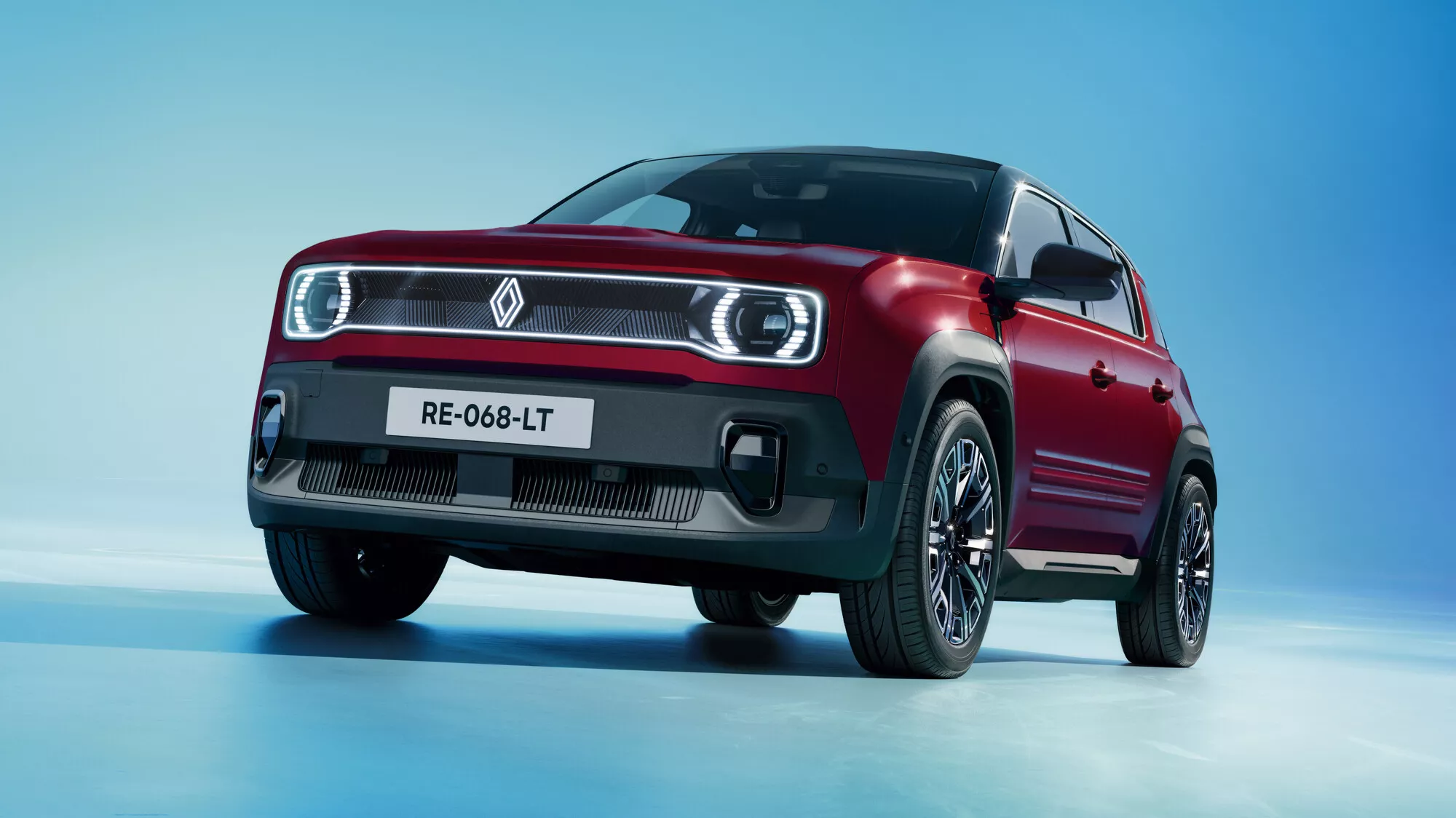
Renault has announced a new entry-level configuration for the Renault 4 E-Tech electric. The Jogging trim is scheduled to arrive by the end of 2026 with an 80 kW electric motor, a 37 kWh lithium-iron-phosphate battery and an official WLTP range of up to 305 km. The announcement was made in Renault’s 8 October 2026 media release for the Paris Motor Show.
The press release confirms the main hardware and the standard equipment, but it does not state a Romanian price. It also does not confirm when Romanian dealers will accept orders. Renault says that orders for the updated Renault 4 range open from 12 or 13 October, depending on the version and country, so the date should not be treated as a local delivery promise.
Battery and motor
The Jogging’s battery has 37 kWh of total capacity and 36.5 kWh available for use. Renault identifies it as an LFP pack and says it uses a cell-to-pack architecture. The company presents the layout as a compact and lightweight solution for the vehicle, but has not published the pack’s mass or the full vehicle kerb weight in this announcement.
Power comes from an 80 kW motor, equivalent to 110 hp. Renault says the unit belongs to the same motor family as the one used in the Twingo E-Tech electric. The quoted 0–100 km/h time is 10.2 seconds. That places Jogging below the 150 hp Renault 4 versions, although the specification is still suited to the role of an urban-focused entry trim. Renault has not released a top-speed figure with the announcement.
The maximum range is a WLTP result. It is an approval figure, not a fixed distance that every driver will achieve. Cold weather, motorway speeds, wind, gradients, payload and climate-control use can all change energy consumption. Renault has not listed a separate combined-cycle consumption figure for Jogging in the press release, so 305 km is currently the clearest official efficiency reference for the trim.
AC and DC charging
The standard charging equipment includes a 6.6 kW onboard charger for alternating current and an 80 kW system for DC fast charging. Renault estimates a 10–80 per cent AC charge in three hours and 30 minutes. The same state-of-charge interval is quoted at 25 minutes from a suitable DC fast charger.
The figures depend on the available installation, the battery temperature and the vehicle’s charging curve. A charger rated at 80 kW will not necessarily deliver that power continuously. Drivers will also be able to manually pre-condition the battery from the central display. Renault is adding this function across the Renault 4 E-Tech range, giving drivers a way to prepare the battery before a rapid-charging stop without relying on route planning.
What comes as standard
Jogging is positioned as the simpler version in the line-up. Its announced equipment includes manual air conditioning, Renault’s OpenR twin-screen system, a 7-inch digital instrument cluster and a 10.1-inch multimedia screen. Apple CarPlay and Android Auto are supported in full-screen mode.
The rear bench is split 60/40, and rear parking sensors are standard. The car uses 18-inch wheels with monotone steel covers. Renault also says that all Renault 4 E-Tech versions gain a new digital reversing camera. A high-definition 360-degree camera is listed as an option for the Techno and Iconic trims, not for Jogging.
This equipment strategy makes the trim’s role clear. It is not simply a more affordable battery option with the same specification as a high-grade Renault 4. Buyers get the core display, connectivity and parking equipment, while features associated with the more expensive versions remain outside the entry model. The final Romanian equipment list still needs confirmation from the local Renault organisation.
The rest of the range also improves
Renault’s announcement covers more than the new Jogging trim. The existing 40 kWh urban-range configuration, paired with the 90 kW, 120 hp motor and the Evolution trim, now reaches up to 310 km WLTP. Its official combined consumption is stated as 14.7 kWh/100 km.
The 52 kWh comfort-range battery, paired with the 110 kW, 150 hp motor, now reaches up to 415 km WLTP. Renault lists this combination with Evolution, Techno, Iconic and the Roland-Garros special edition. The quoted combined-cycle consumption is 14.4 kWh/100 km.
The Plein Sud version retains the 52 kWh battery and 110 kW motor but is rated at up to 400 km, with official consumption of 14.9 kWh/100 km. Its opening fabric roof is part of the reason it is listed separately from the closed-roof versions.
Renault says the range gains for the existing configurations come from aerodynamic work, including lower body fairings and new wing mirrors. The company is therefore describing an efficiency update rather than a capacity increase for the 40 kWh and 52 kWh batteries.
The wider update also includes a predictive eco-driving assistant, an emergency stop assistant and a charging-end notification in the My Renault app. Renault says the notification can arrive five minutes before the scheduled end of charging or before the vehicle reaches the requested charge level. These functions change the user experience, but they do not change the official battery capacities.
No Romanian price yet
Renault has not supplied a Romanian price, warranty detail or confirmed local ordering date in the global press material. Commercial information from another country cannot be used as a Romanian price list because incentives, taxes and equipment packages vary by market.
The technical position is clear: Jogging will be the Renault 4 E-Tech entry trim, with a 37 kWh LFP battery, an 80 kW motor, 80 kW DC charging and up to 305 km of WLTP range. Its actual place in the Romanian offer will depend on the importer’s pricing and specification. Until that information is released, the new version is best understood as a smaller-battery alternative to the 40 kWh and 52 kWh configurations already announced by Renault.


