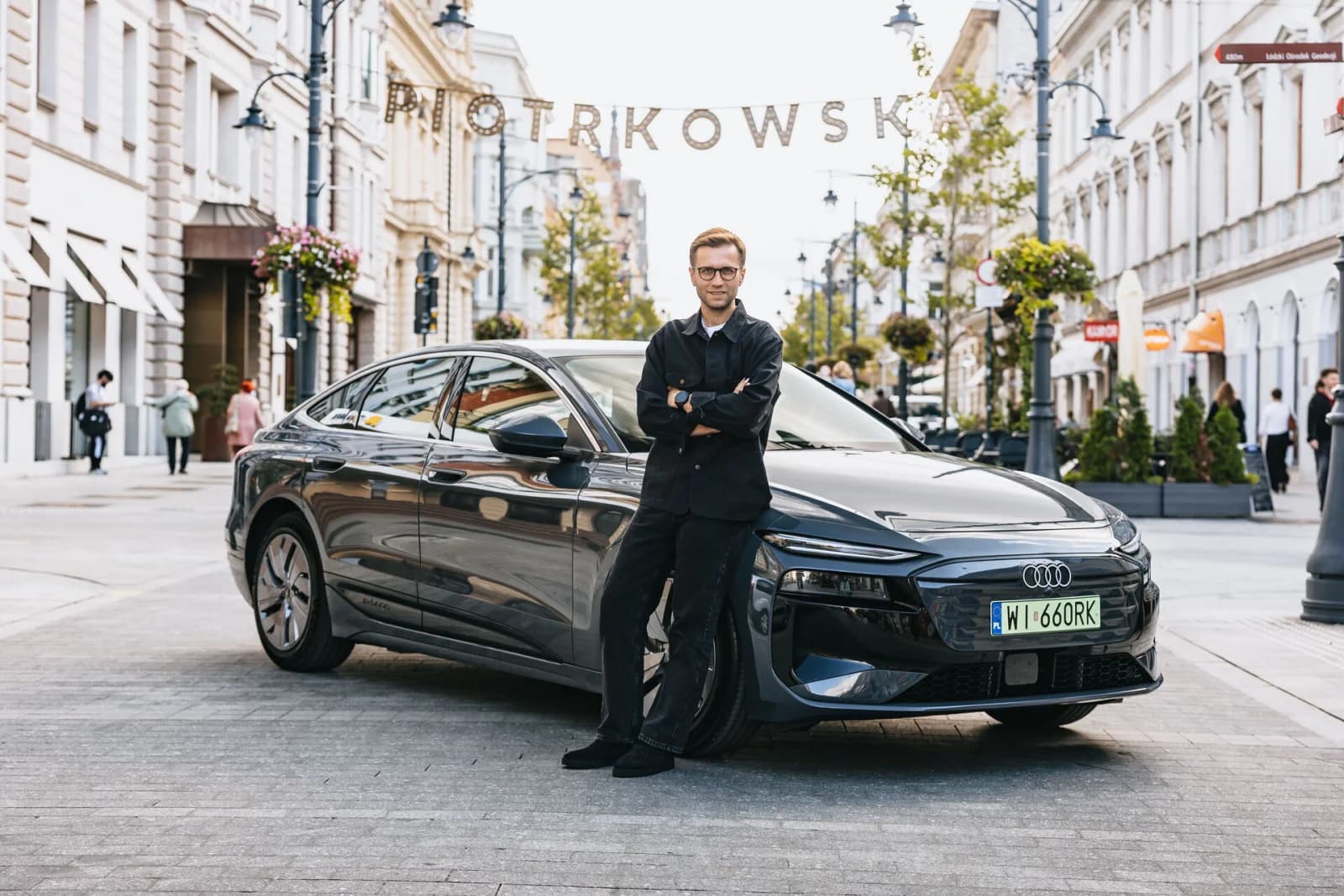
Photo: AUDI AG, image A264637. Official photograph released free of charge for editorial use.
Polish rally driver Mikołaj “Miko” Marczyk drove an Audi A6 Sportback e-tron performance for 1,338 km without recharging. Guinness World Records certified it as the longest journey by a series-production electric car on a single charge, according to Audi and project partner Volkswagen Financial Services.
The recorded average consumption was 7.09 kWh/100 km, less than half Audi's official combined figure of 15.8–13.6 kWh/100 km for this version. That does not turn 1,338 km into a realistic motorway range. The attempt lasted more than 45 hours and was designed around extreme energy conservation rather than normal journey speed.
From Zakopane to the Baltic and part-way back
Marczyk left an ORLEN Charge station in Zakopane at 1:55am on 11 September. The route ran through Kraków, Sandomierz, Puławy, Warsaw, Płock, Włocławek, Toruń and Grudziądz, then through the Tri-City area to Hel on the Baltic coast. He turned around and followed the same corridor south.
The run ended between Toruń and Ciechocinek after 1,338 km. Audi says it used open public roads in normal traffic, including many sections during rush hour. Average ambient temperature was 15°C, while the lowest recorded temperature was 7°C in Grudziądz at 5:30am.
Neither Audi nor Volkswagen Financial Services has published the average moving speed, complete elevation log, stopping time or exact tyre pressures. Dividing distance by the total elapsed time would produce an average below 30 km/h, but that calculation includes any stops and is not the car's driving speed. Without the full technical log, the result cannot be converted into a credible motorway-range estimate.
What the Guinness title covers
The category is the greatest distance travelled by a series-production battery-electric car on one charge. Volkswagen Financial Services says Guinness World Records adjudicator Anouk de Timary validated the attempt. The previous mark was 1,205 km, achieved in a Lucid Air Grand Touring by Ümit Sabancı, Kenneth Schofield and Fergal McGrath.
Marczyk improved that distance by 133 km. The definition matters: this was not a speed record, a WLTP certification run or a controlled comparison between competing cars. It rewarded maximum distance under an efficiency-focused strategy.
The driver has relevant form. In 2025, he drove a fourth-generation Škoda Superb diesel for 2,831 km on one tank at a reported 2.6 l/100 km, earning another Guinness title. Volkswagen Financial Services supported both the electric project and Marczyk in his role as a company ambassador.
Why the A6 e-tron performance suits the task
The rear-wheel-drive A6 Sportback e-tron performance uses a 270 kW motor, equivalent to 367 hp, and a 100 kWh gross battery with 94.9 kWh usable. Audi quotes 5.4 seconds from zero to 100 km/h and up to 777 km of WLTP range in the most favourable configuration.
The communicated figures are mathematically consistent. Dividing 94.9 kWh by 7.09 kWh/100 km gives about 1,339 km. That check does not prove the usable buffer is identical in every situation; temperature, speed, wind, elevation and the battery protection margin all affect available energy.
Aerodynamics provided a major advantage. The Sportback has a 0.21 drag coefficient, the lowest Audi has announced for a production model. Audi estimates aerodynamic drag accounts for roughly 40% of the car's energy consumption in the WLTP cycle. Drag rises quickly with speed, which is why a low-speed record run and an ordinary motorway journey produce such different results.
Regenerative braking power can reach 220 kW. Audi says regeneration can handle around 95% of braking events in normal use. During a range attempt, avoiding unnecessary acceleration remains better than recovering part of that energy later, because each conversion involves losses.
Tyres, terrain and driving technique
Marczyk said the car used efficiency-oriented Michelin tyres, although the published material does not specify their model, size or pressure. His advice included checking pressure, understanding the car's driving modes, anticipating traffic and avoiding unnecessary acceleration or abrupt braking.
Starting in Zakopane gave the first part of the run a favourable descent from the Polish mountains towards the Vistula valley. Volkswagen Financial Services explicitly says the team used the helpful terrain. The return from Hel means the full result was not produced by a continuous downhill route, but the precise elevation balance has not been released.
Audi does not report mechanical modifications, and the Guinness category requires a production car. Even so, several details needed to reproduce the result are missing: total test mass, climate-control settings, sector speeds, wind, traffic delays and the exact starting-charge procedure. Those limits are why the Guinness distance and the certified road-car range should remain separate numbers.
WLTP range and rapid charging remain the practical figures
WLTP's standardised procedure is designed to compare vehicles, not to predict every journey. Audi currently quotes up to 777 km for the A6 Sportback e-tron performance, depending on specification, and an official combined consumption range of 13.6–15.8 kWh/100 km. Wheels, options, temperature, route and driving style can all change the result.
For long-distance use, the PPE platform's 800-volt electrical system allows up to 270 kW DC charging. Under suitable conditions, Audi claims a 10–80% charge in 21 minutes and as much as 310 km of WLTP range added in ten minutes. Those short stops at normal road speeds are more representative of how an owner would travel than spending more than 45 hours avoiding a charger.
The record shows the outer edge of what this production powertrain can achieve when distance is the only priority. It does not replace the WLTP figure or promise buyers four-figure range. A realistic trip plan still needs consumption at the relevant speed and temperature, plus charging availability along the route.