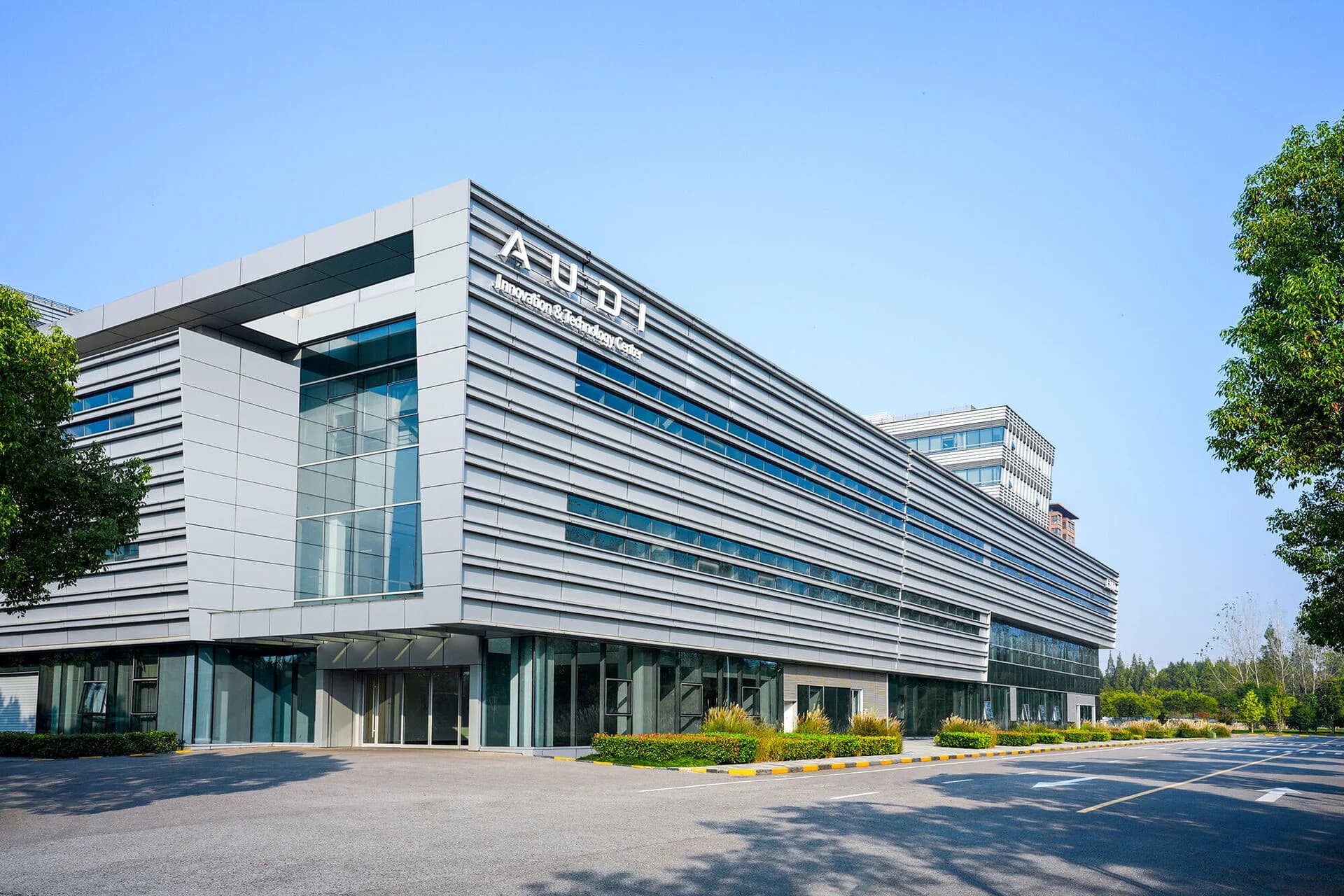
Audi and SAIC have opened the AUDI Innovation & Technology Center (AITC) in Shanghai, giving a local team responsibility for future vehicles from initial concept to production readiness. Audi says the operation will employ around 300 people and develop the next generation of the Advanced Digitized Platform used by the China-only AUDI brand.
This is not a European product announcement. AUDI, written in capitals and presented without Audi's four-ring badge, is a separate marque created with SAIC for China. The 5 November 2026 release contains no European launch, homologation or pricing information for its cars.
A full-vehicle development centre
AITC is intended to cover complete vehicle engineering rather than a narrow software function. Its brief includes vehicle concepts, production development, digital architecture, over-the-air updates, advanced driver-assistance systems and an AI-centred cabin experience.
Audi lists multimodal interaction, agent-like software functions and personalised in-car services among the research areas. It also says the centre is exploring early integration of AI models with a major Chinese AI and cloud platform. The supplier is not identified, and Audi does not specify which functions have passed validation for production. These statements therefore describe a development programme, not equipment promised for a named vehicle.
Matthias Pfister is general manager of AITC and Shan Yunwei is deputy general manager. Audi says the roughly 300-person workforce will mix local and international specialists. The company has not disclosed the investment, the ownership split of the entity or a departmental breakdown of those jobs.
The next Advanced Digitized Platform
The most concrete engineering task is the second generation of the Advanced Digitized Platform, or ADP. Audi and SAIC jointly developed the existing architecture for the first AUDI products. Their April 2026 cooperation agreement assigned four further vehicles to the next-generation platform.
An Audi China statement published in September added that the first model in this next group is scheduled from 2028. That is a planning marker, not a guaranteed delivery date. Battery capacities, range, performance, prices and the capability of future assistance systems remain unannounced.
ADP is described as an architecture for intelligent connected vehicles. The Shanghai centre is expected to bring software, electronics, chassis and whole-vehicle engineering into one programme near Chinese technology suppliers and the intended customers. Audi's stated objective is to shorten development cycles and avoid designing a global product first and adapting it to local digital services later.
E5 Sportback established the template
AUDI was introduced in 2024. Its first production car, the E5 Sportback, appeared in April 2025 and entered the Chinese market later that year. Audi's launch material described a four-door electric fastback with up to 579 kW, rear- or all-wheel drive and a maximum claimed range of 770 km under the applicable Chinese test basis.
Those figures belong to the E5 and cannot be applied to future AITC vehicles. They do, however, show how the first-generation platform combines an electric powertrain with a zonal electronic architecture and over-the-air updating. Audi said parallel work by teams in Germany and China reduced the E5's development time by 30 per cent. It did not publish the absolute timetable or the baseline used for that comparison, so the percentage remains a manufacturer claim.
The AUDI E7X, an electric SUV, followed in May 2026. Audi also refers to a third planned model that will complete the first product generation. The four vehicles announced for the next ADP generation are a separate programme. Their names, body styles and detailed launch sequence have not yet been published.
Why local engineering matters in China
Audi describes its Chinese business as a two-brand, two-partner strategy. The AUDI project with SAIC targets digitally focused premium customers with cars engineered around the Chinese technology ecosystem. Conventional four-ring Audi products continue through the company's other industrial and commercial arrangements.
The distinction is material because cloud providers, mapping, apps, voice services, data rules and customer expectations differ between China and Europe. A local team can design these elements into the electrical architecture early rather than attach them near the end of development. It can also work directly with regional suppliers.
That closer integration does not prove that the resulting systems will perform better, and the announcement gives no automation level. “Advanced driver assistance” should not be read as autonomous driving or permission for the driver to stop supervising the vehicle. Technical capability, regulatory approval and user responsibility must be assessed for each production model.
No confirmed route to Europe
AITC's opening has no immediate effect on Audi's European range. Neither the E5 Sportback nor E7X is announced for Europe in the cited material, and the next four ADP models are described as China-specific. There are no euro prices, European warranties, service arrangements or type-approval dates.
The work may still be relevant outside China as engineering knowledge, but Audi has not confirmed a transfer of these products or their software to four-ring cars. Treating that possibility as a launch plan would go beyond the evidence.
What is confirmed is narrower and useful: Audi and SAIC now have an operating Shanghai hub with around 300 staff, end-to-end vehicle responsibility and a mandate to build the second ADP generation. The first model from the resulting four-car family is planned from 2028 for China. Product specifications and any broader market role remain open.
Image: AUDI AG, press image A264955. Audi states that editorial use is permitted free of charge.