Rear-wheel steering changes the angle of the back wheels as well as the front ones. At low speed, steering the two axles in opposite directions can tighten a car's turning circle. At higher speed, steering them in the same direction can help control the car's lateral response. The important detail for buyers is that different systems use different angles, thresholds and hardware.
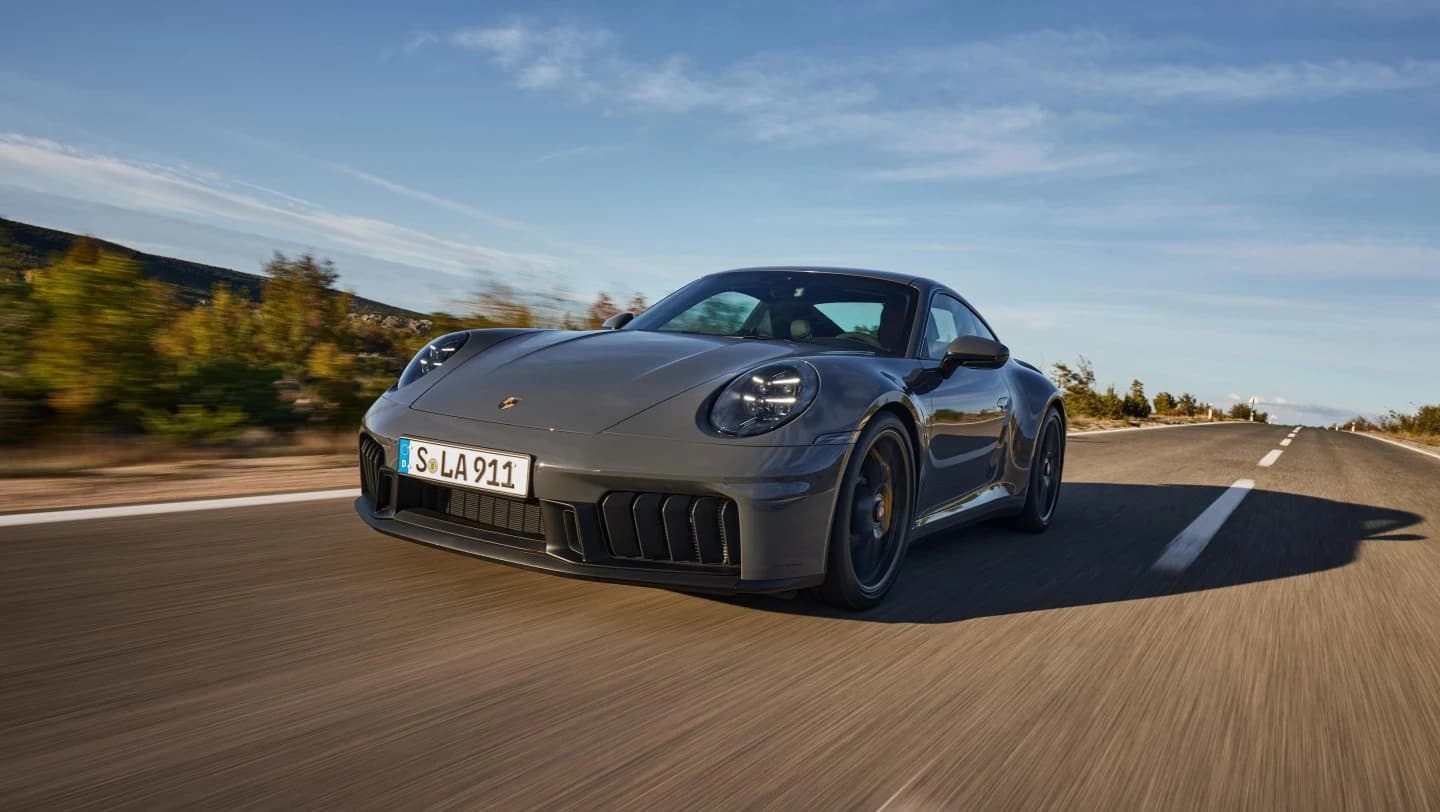
A Renault Austral, a Mercedes-Benz S-Class and a Porsche 911 Carrera GTS illustrate those differences. Their manufacturers describe the same broad objectives, but the specifications cannot be exchanged between models. Nor does four-wheel steering imply four-wheel drive: steering concerns where the tyres point, while the drivetrain determines how driving torque reaches them.
What the rear axle actually does
Modern active systems use an actuator to change the steering angle at the rear. Mercedes-Benz's September 2020 technical description of the S-Class explains that an electric motor drives a spindle mechanism through a belt. Its movement changes the rear-wheel angle according to road speed and the driver's steering input. The driver continues to use one steering wheel; the car coordinates the axles.
Renault's July 2022 explanation of 4CONTROL Advanced identifies an actuator on the Austral's rear axle. It receives information associated with the power steering, engine and electronic stability programme. This is a controlled steering function, rather than a claim that the rear wheels merely follow the front tyres around a corner. Equally, it is separate from a system that adjusts the suspension's damping or distributes torque between wheels.
The parking benefit has a measurable size
Imagine turning left in a confined car park. With opposite-direction steering, the front wheels point left and the rear wheels point right. This allows a tighter path than the same vehicle would otherwise describe. Calling it a virtually shorter wheelbase is an explanation of the steering effect: the distance between the axles does not physically change.
For the third-generation 4CONTROL Advanced system introduced on Austral, Renault quotes up to five degrees of opposite-direction rear steering and a kerb-to-kerb turning circle of 10.1 metres. The release compares that angle with 3.5 degrees for the previous generation. These are manufacturer's specifications for the system described in 2022, rather than measurements from a Carboratory road test or a guarantee about every Austral configuration.
The S-Class launch data offers a comparison within one vehicle configuration. Mercedes lists a 12.8-metre turning circle for the long-wheelbase V223 with 4MATIC and no rear steering. The listed figure becomes 11.9 metres with the 4.5-degree system and 10.9 metres with the 10-degree version. This makes the benefit concrete without comparing unrelated cars on different specifications.
A turning-circle figure still needs a definition. Renault explicitly describes a kerb-to-kerb diameter; that is not a radius, and it does not describe every part of the body passing a wall. Rear steering changes the path of the vehicle, but leaves its width, mirrors and door-opening requirements intact. A narrow garage can therefore remain unsuitable even if the car can turn into its entrance more easily.
Why the wheels turn together at speed
Same-direction steering serves a different purpose. Small rear-wheel inputs can help the back of the car develop lateral force sooner and control rotation as the driver changes direction. Porsche describes improved lane-change stability and an earlier build-up of lateral acceleration for its 911 Carrera GTS. Those are manufacturer explanations of the chassis response, not evidence of an unlimited increase in tyre grip.
There is no single speed at which every rear-steering car changes its strategy. Renault's Austral release describes up to one degree of same-direction rear steering at high speed or when taking corners above 50 km/h. The archived Mercedes S-Class technical document specifies a switch to same-direction steering above 60 km/h.
For the 911 Carrera GTS detailed in Porsche's 2024 press kit, the stated regions are opposite-direction steering below 50 km/h and same-direction steering above 80 km/h. Those numbers should be retained as two regions; choosing an invented changeover point in between would misrepresent the source. The press kit describes rear-axle steering as standard on those GTS models, with Porsche's newsroom specifications referring to the German market.
Honda reached the same goals mechanically
Rear steering predates today's electronic chassis controls. Honda introduced its steering-angle-sensing 4WS on the Prelude in 1987. A shaft mechanically connected the front and rear steering gearboxes. The system turned the rear wheels in the same direction for small steering-wheel inputs and in the opposite direction for larger inputs.
That distinction matters when explaining how four-wheel steering works. The Prelude system used steering angle to determine its response rather than directly selecting the rear-wheel direction from a road-speed threshold. Honda's reasoning was that lane changes generally involve small inputs, whereas parking and tight turns involve large ones. A general description based only on speed would leave out the defining feature of this historical application.
What to check on a car you might buy
The maximum angle alone is an incomplete comparison. In the 2020 S-Class documentation, Mercedes specified two optional versions, with 4.5 or 10 degrees of rear steering. For the 10-degree version, wheel size was restricted to a maximum of 255/40 R20 to provide space for the larger movement. Equipment and wheel compatibility therefore belong in the same conversation.
Ask for the actual equipment list and the specification for the car's model year and market. On a used example, have the rear steering mechanism and its control system checked by a workshop familiar with the model. Additional actuators and linkages create additional components to inspect, but the sources here do not establish a common failure rate or a universal repair bill. For a buyer whose daily problem is a difficult garage entrance, a careful manoeuvre in that space is more informative than assuming that every rear-steering system delivers the same result.
Photo: 2024 Porsche 911 Carrera GTS, © Porsche AG, Porsche Newsroom. Press image used for editorial reporting; it does not demonstrate a rear-steering angle.