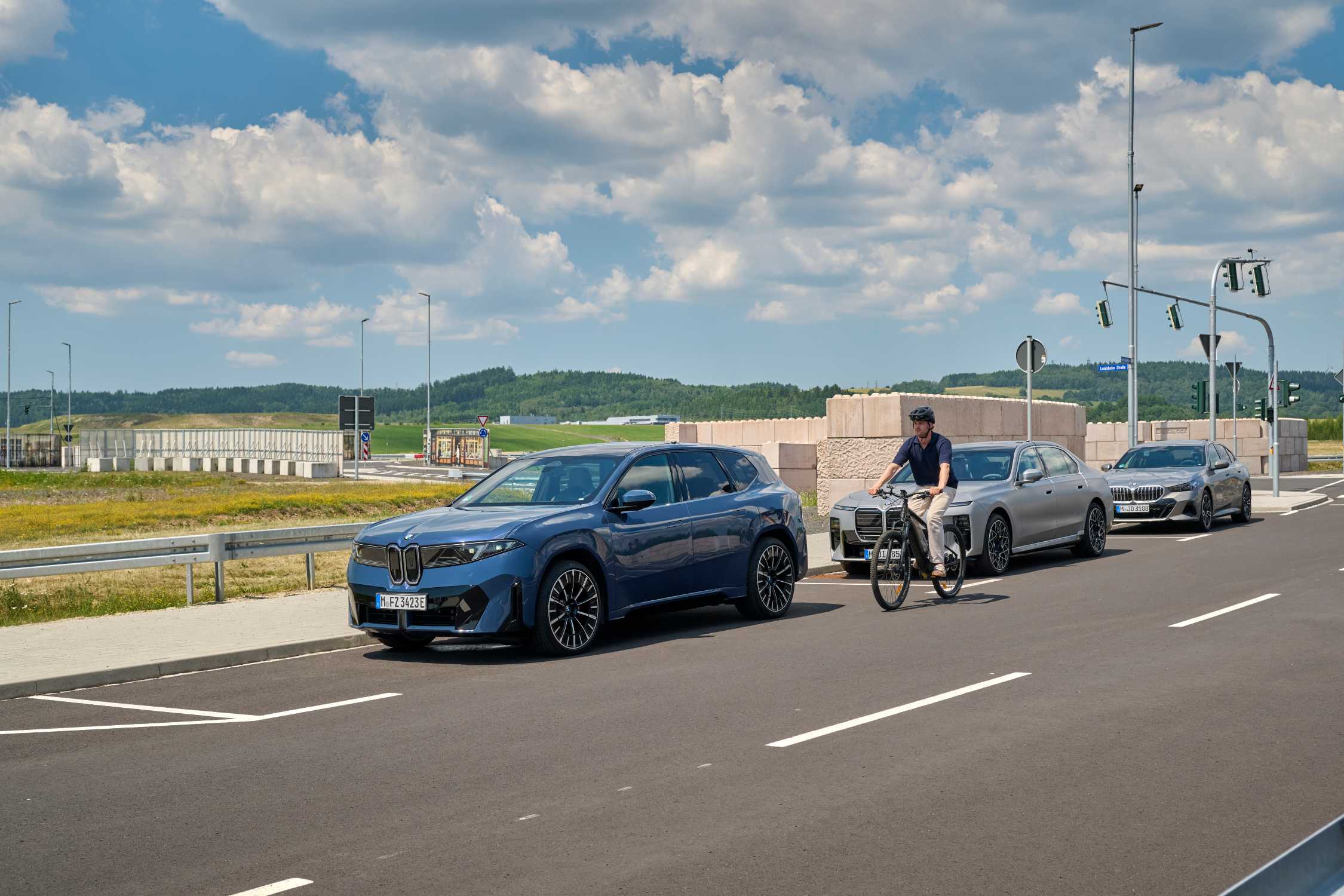
The new generation of BMW systems also tracks cyclists and other road users next to the car. Photo: BMW Group.
BMW expands standard safety systems: delayed door opening and braking during manoeuvres
BMW will offer more active-safety functions as standard on its next generation of models. The BMW iX3 is the first production car to use the technology, and the manufacturer says it will later reach the BMW i3, BMW X5 and BMW 7 Series.
The additions cover three common situations: driving in traffic, parking manoeuvres and opening the doors. One of the more important functions can actively delay a door opening when the side radars detect a cyclist, a vehicle or another road user approaching.
BMW has not yet published a complete table showing which function will be standard on every trim and in every country. Availability may depend on the model, market, type approval and configuration. The announcement describes the direction for new cars, not a confirmed update for every BMW already on the road.
The door does not open immediately if a cyclist is approaching
Exit-warning systems already exist on several models. They use visual and audible alerts when they detect a vehicle or cyclist coming from behind. BMW’s new version adds active delay of the door opening.
Side radars monitor the area next to the car after it stops. If the system estimates a risk of impact, the electronic lock postpones opening the door until the danger has passed. The aim is to reduce dooring accidents, in which a door opened suddenly enters a cyclist’s path.
The function is relevant in Romania as well, especially on streets where parking spaces sit against the traffic lane or a cycle path. It remains an aid. The driver and passengers still need to check the mirror and the blind spot before opening the door.
BMW cites German insurers’ data according to which Berlin recorded 392 dooring accidents in 2024, almost 8% of the city’s reported collisions involving cyclists. The figure describes Berlin and should not be extrapolated automatically to Romania.
The car can steer around an obstacle without leaving its lane
The new emergency steering intervention can guide the car around an obstacle while keeping it in its own lane, if the sensors detect enough space. BMW’s examples include a pedestrian stepping onto the carriageway between two vehicles, or a cyclist that is hard to see in poor light.
The system can also intervene when another car approaches dangerously from the side. A short steering correction moves the BMW away from the object without sending it into the adjacent lane.
Physical limits still apply. Grip, speed, distance, visibility and available space can make collision avoidance impossible. No assistance system guarantees that an accident will be prevented.
Improved emergency braking, including for animals
The emergency braking assistant gains support for an avoidance manoeuvre and can apply the brakes up to maximum deceleration in a possible frontal impact. BMW says the improved sensors allow the system to react in situations involving animals on the road as well.
That extension can be useful on national and county roads, where animals can appear suddenly after dark. Detection does not remove the obligation to match speed to visibility and road conditions.
The car can stop if the driver is no longer able to drive
The driver-attention assistant uses the cabin camera to identify a possible medical emergency. If the system judges that the person at the wheel can no longer drive, it can temporarily take control and bring the car to a controlled stop.
During the procedure the hazard lights and the automatic eCall emergency call are activated. The driver can interrupt the intervention. The function does not make a medical diagnosis; it reacts to cues observed by the monitoring system.
Extra protection when parking
BMW is also expanding low-speed interventions. Active Park Distance Control uses the ultrasonic sensors and surround-view cameras to brake if it detects an obstacle. In addition to protection when reversing, the new generation can stop the car if there is a risk of a side impact during the manoeuvre.
When reversing out of a space with limited visibility, the rear side radars watch crossing traffic. Automatic braking can intervene when a cyclist, pedestrian or another vehicle appears on the trajectory. The reversing camera and the overhead view on the display help the driver understand the situation, but they do not replace a direct check.
The system recognises accidental accelerator pressure
Another standard function monitors moving off to detect confusion between the accelerator and the brake. If there is an obstacle less than a metre away, speed is no more than 2 km/h, and the accelerator is pressed unusually quickly and hard, the car can brake in a controlled way to a stop.
The intervention works both when moving forward and in reverse. The typical situation is a manoeuvre in a car park, next to a wall, another car or a building’s shopfront.
Traffic warnings appear in the driver’s field of view
Road Priority Warning recognises red traffic lights, “Give way”, “Stop” and “No entry” signs. The new version adds warnings for pedestrian crossings and can display the information in BMW Panoramic Vision, at the base of the windscreen.
BMW Operating System X presents detected objects and the status of assistance functions on the central display, in Panoramic Vision or, optionally, on the 3D Head-Up Display. The aim is for the driver to distinguish easily what the car has observed and whether a function is intervening.
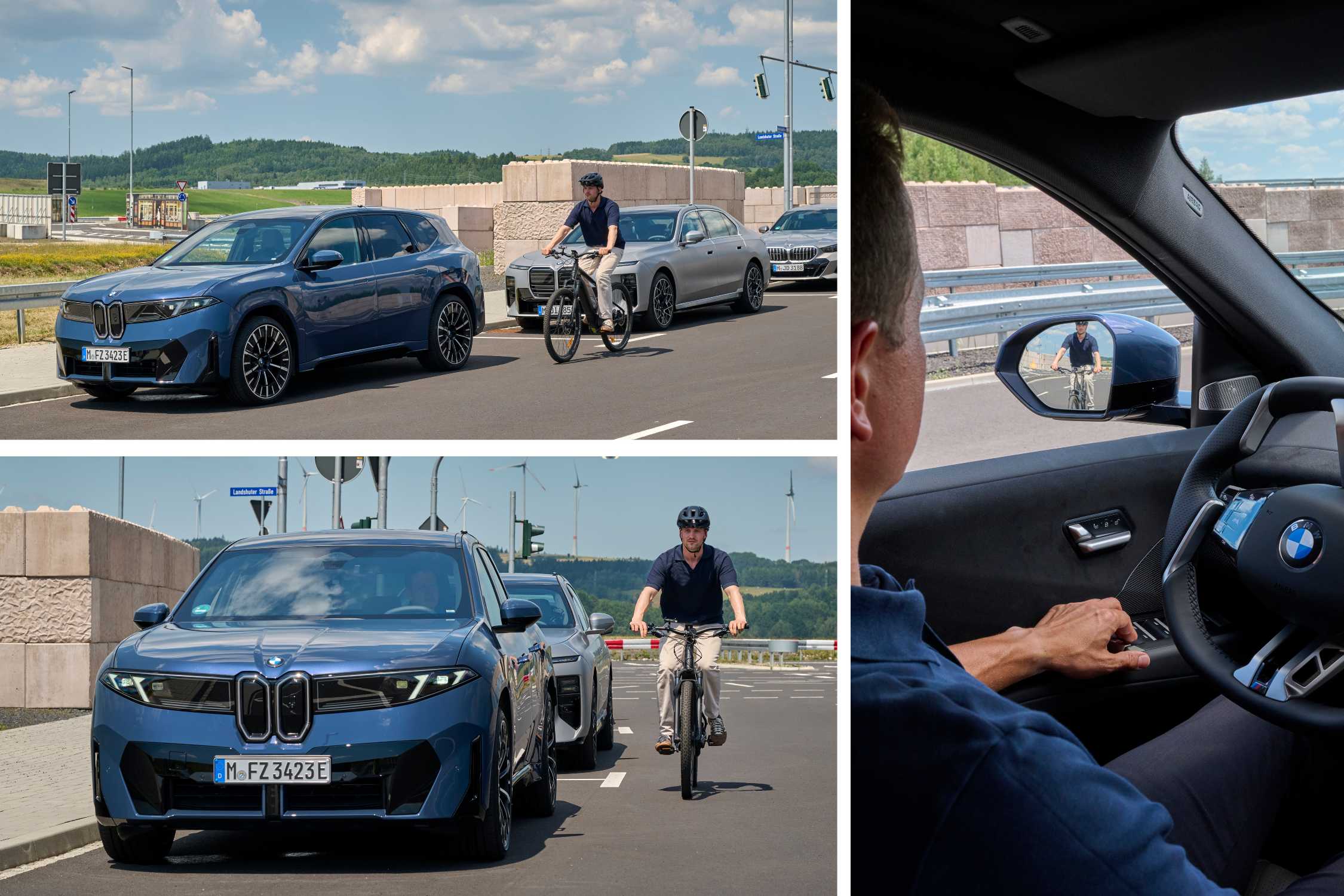
BMW tests the new functions in controlled scenarios that include cars, pedestrians and cyclists. Photo: BMW Group.
What BMW Symbiotic Drive means
BMW calls the new logic of collaboration between the human and the assistance systems Symbiotic Drive. The car analyses steering inputs, signalling and gaze direction to distinguish an intentional manoeuvre from an accidental deviation.
For example, the lane-keeping assistant can skip a correction if the driver signals, looks over the shoulder or steers deliberately, as long as the system does not anticipate an impact or leaving the carriageway. If the deviation appears involuntary or dangerous, it can warn and intervene on the steering.
The approach aims to reduce unnecessary interventions, one of the frequent criticisms of modern lane-keeping systems. Effectiveness will only be judged properly after production models are tested on real Romanian markings and roads.
A central computer with around 20 times more computing power
Safety, assisted driving and automatic parking functions are managed by a liquid-cooled central computer that BMW calls the “Superbrain of Automated Driving”. The manufacturer says it has around 20 times more computing power than the previous system.
The centralised architecture allows joint processing of data from cameras, radars and ultrasonic sensors. It can also support later software updates, but BMW does not promise in the current release that every function can be installed retrospectively on older cars.
The systems were developed and validated in part at BMW’s centre in Sokolov, Czechia. The proving ground covers about 600 hectares and 25 km of routes for urban traffic, motorway driving and parking manoeuvres.
Which models will get them
BMW indicates the following general order:
- BMW iX3 — the first Neue Klasse model equipped with the new generation;
- BMW i3 — the electric saloon built in Munich;
- BMW X5 — the new generation of the SUV;
- BMW 7 Series — the updated version of the limousine.
The manufacturer does not specify in the release an introduction date for each market, nor whether every listed function will be standard on every version. For an order in Romania, the equipment sheet and the dealer contract are the relevant documents.
Are the cars autonomous?
No. The systems described are active-safety and assistance functions. Even if some BMWs separately offer Highway Assistant with hands-off driving in approved conditions and countries, the driver must watch the road and be able to take control. Availability of these advanced functions differs by legislation and market.
The new door-opening warning, parking braking or emergency steering correction does not shift driving responsibility to the car. They are extra safety nets for situations in which the human reaction is late or visibility is poor.
What to check before ordering
- whether the functions are standard or part of an optional package;
- the exact list for the version and model year ordered;
- whether type-approval-dependent functions are active in Romania;
- which sensors and cameras are included;
- whether repairing a windscreen, bumper or mirror requires calibration;
- the conditions in which the systems can be temporarily deactivated;
- the costs of ConnectedDrive packages and of any services after the included period.
When collecting the car, ask the dealer to demonstrate the menus, warnings and limits of the functions. A safety system is useful only if the driver understands what it can do and when it cannot intervene.
Frequently asked questions
What does the new exit warning do?
Side radars detect approaching road users. If there is a risk of impact, the electronic lock can delay opening the door until the danger has passed.
Will the functions be standard on all current BMW models?
BMW announces their expansion with the Neue Klasse generation and names the iX3, i3, X5 and 7 Series. The company does not say that every current car will receive the same functions through an update.
Can the car brake if the driver presses the accelerator by mistake?
Yes, in the scenario described by BMW: an obstacle less than a metre away, speed of no more than 2 km/h and a sudden, hard press of the accelerator. The system can stop the car forwards or backwards.
Does the system prevent every accident?
No. Detection and intervention depend on visibility, grip, speed, sensor condition and available space. The driver remains responsible.