
BMW has shown the i3 M60 xDrive ahead of its planned 2027 launch. The car will be the M Performance version of the electric sedan built on the Neue Klasse architecture, sitting above the i3 40 xDrive and i3 50 xDrive in the new BMW 3 Series family.
The important figures are still missing. BMW has not announced the M60’s maximum output, torque, battery capacity, official range, acceleration time or price. It has confirmed two electric motors and all-wheel drive, while the official images reveal M-specific lighting, optional 21-inch aerodynamic wheels and a more assertive body treatment.
An M Performance model, not yet the electric M3
The i3 M60 xDrive is an M Performance model. In the combustion range, that role is filled by the BMW M350 xDrive, the six-cylinder petrol flagship of the new 3 Series. The M60 should therefore be understood as a faster, more focused version of the i3 rather than as the confirmed replacement for a full BMW M3.
That distinction matters because an M Performance car does not automatically use the same hardware or calibration as a full M model. BMW has not said whether the M60 will receive a larger battery, stronger motors, upgraded cooling, larger brakes or a different suspension layout. Those details will determine how far the car moves beyond the regular i3 50 xDrive.
Motor1 reports that the M60 uses a pair of electric motors for all-wheel drive and that BMW is keeping the output secret. The comparison point is the i3 50 xDrive, which BMW rates at 345 kW, or 469 hp, and 645 Nm. The M60 should sit above that version in the performance hierarchy, but no official power or acceleration figure exists yet.
BMW gives the exterior a more focused identity
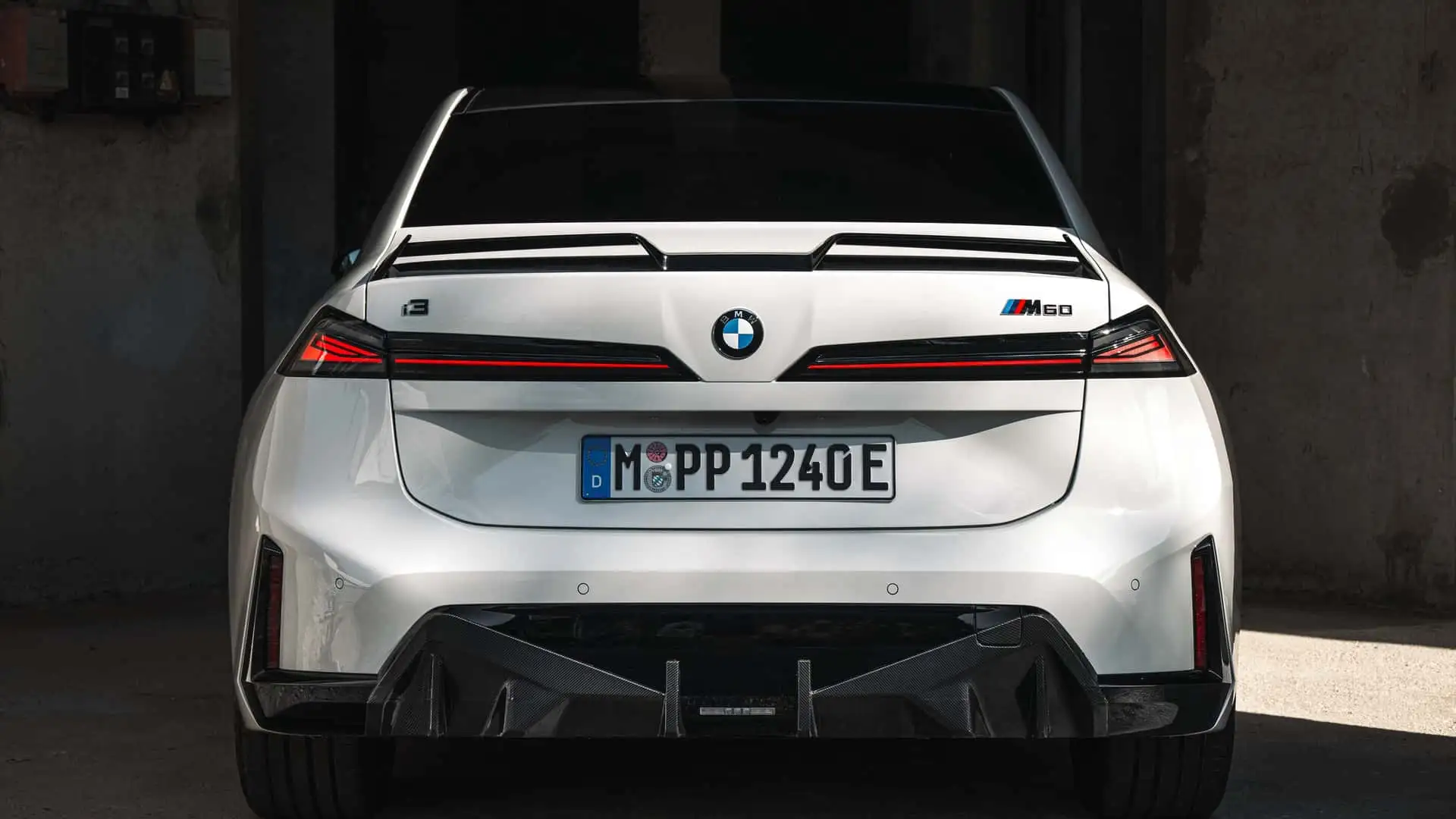
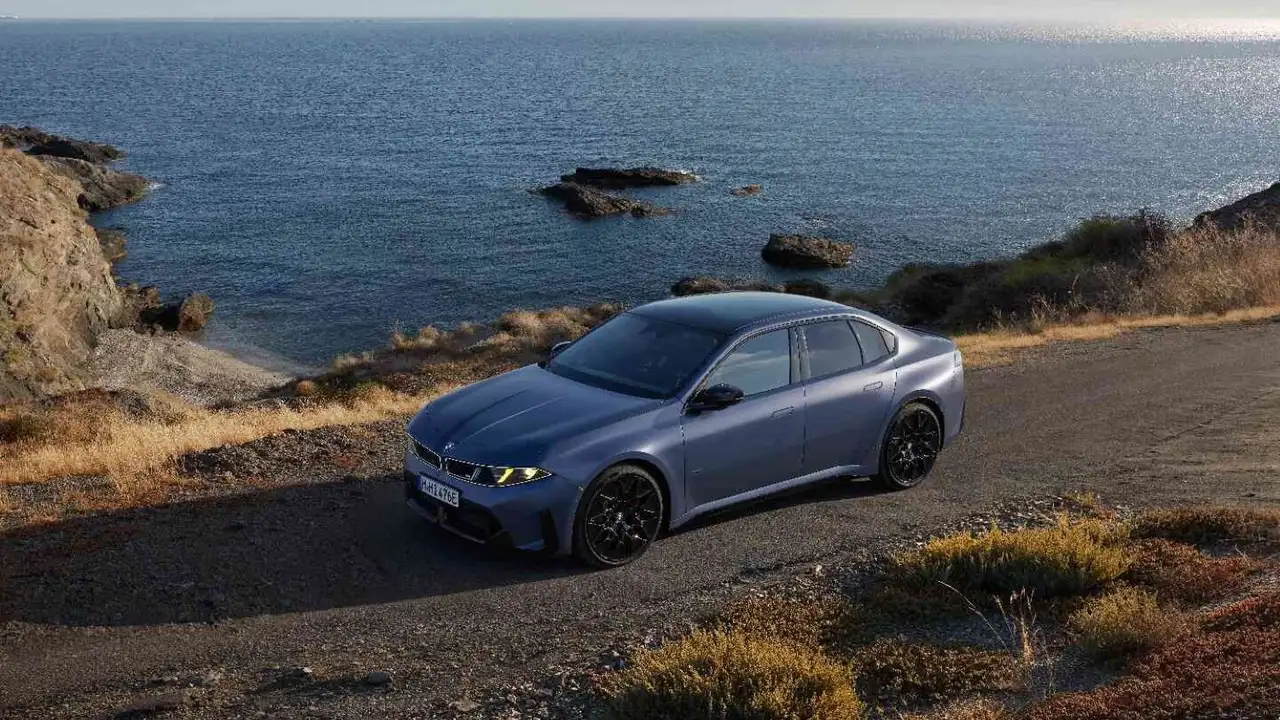
The published BMW photographs show a front end that looks more technical and aggressive than the standard i3. The Neue Klasse light signature remains, but the front graphic has sharper lines and a stronger visual connection to BMW’s performance models. M Yellow Lights identify the car as part of the M Performance family and add a feature that has become associated with BMW’s higher-performance variants.
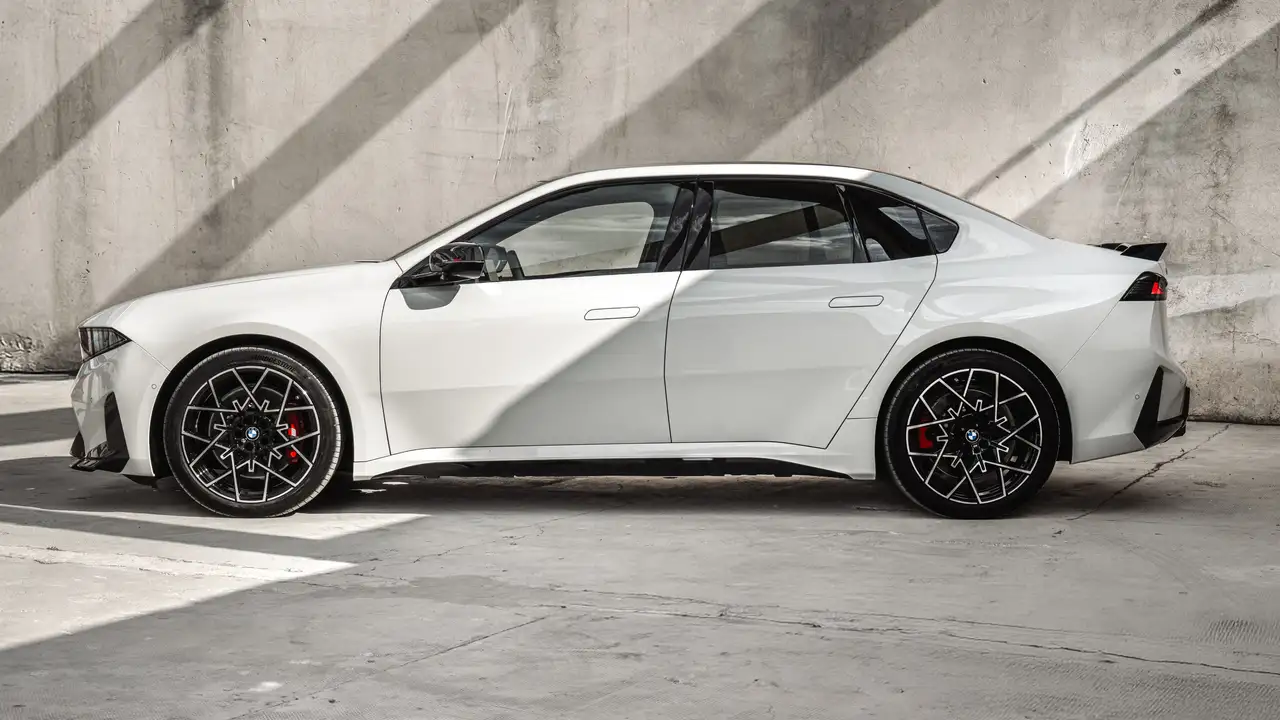
Optional 21-inch aerodynamic wheels are another visible distinction. Larger wheels can accommodate tyres with a sportier focus and change the car’s stance, but they also affect rolling resistance, comfort and range. BMW has not yet published the complete tyre sizes, vehicle mass or suspension differences between the M60 and the i3 50 xDrive.
The body remains a sedan from the electric 3 Series family. BMW uses one Neue Klasse design language across the combustion 3 Series and the i3, although the two architectures require differences in wheelbase, overhangs, tracks and underbody hardware. The M60 adds its own details without turning the car into an SUV or a two-door model.
BMW has also shown M Performance Parts for the car. Motor1 notes that carbon-fibre components and additional exterior pieces move the M60 towards the more aggressive look expected from the future electric M3. These accessories should not be confused with standard equipment. BMW has not published individual prices or confirmed the exact availability of every part in Europe.
What is confirmed about the hardware
The i3 M60 xDrive uses two electric motors, one at each axle, and all-wheel drive. That layout allows separate control of the front and rear axles and provides a suitable starting point for a performance model. BMW has not explained whether the M60 will add dedicated torque-vectoring modes, a different recuperation map or software functions designed specifically for track driving.
The launch i3 models use BMW’s sixth-generation eDrive technology, an 800-volt electrical system and high-voltage batteries with cylindrical cells. It is reasonable to expect the M60 to remain part of the same technical family, but BMW has not published a separate M60 data sheet confirming its battery size or charging rate.
The i3 50 xDrive provides the clearest official benchmark. It has a 108.7-kWh battery, 345 kW, 645 Nm, a 0–100 km/h time of 4.7 seconds and a maximum WLTP range of 912 km in BMW’s German-market information. Those figures belong to the 50 xDrive and cannot be transferred to the M60. A sharper, more powerful car with larger wheels may consume more energy and achieve a different certified range.
The i3 40 xDrive is the second reference point, with 275 kW, or 374 hp, an 82.8-kWh battery and a maximum WLTP range of 710 km. The M60’s performance position should put it above both launch variants, but the actual difference will only be clear once BMW publishes its homologation data.
Performance expectations remain unconfirmed
Motor1 expects the M60 to beat the i3 50 xDrive’s 4.7-second 0–100 km/h time and to exceed the regular car’s 200 km/h top-speed limit. Those are editorial expectations, not BMW specifications. The confirmed facts are the dual-motor layout, all-wheel drive, M Performance positioning and planned 2027 arrival.
The missing output figure may be deliberate. BMW needs the M60 to separate itself from the i3 50 xDrive while preserving space for the future electric M3. The company could use different software limits, battery hardware and cooling strategies to create clear gaps between the models without publishing every detail at the same time.
Range will be just as important as acceleration. Battery size, vehicle mass, wheel design and tyre choice directly influence energy consumption. A model tuned for repeated acceleration and higher cornering loads may have a lower certified range than the standard car. Without a WLTP value, there is no sound basis for predicting how much range the M60 will lose against the i3 50 xDrive.
A 2027 launch with no European price yet
BMW confirms 2027 as the year in which the i3 M60 xDrive will join the range, but it has not announced a precise month, opening date for orders or first markets. The regular i3 50 xDrive and the combustion 3 Series variants are scheduled to reach customers before the M Performance electric model. Timing can differ between Europe, the United States and other regions.
There is no Romanian or European price yet. BMW’s US material lists prices for the i3 50 xDrive and M350 xDrive, but those figures cannot be converted into a European M60 price. Equipment, taxes, certification, transport and local pricing policy will all affect the number.
BMW will build the electric i3 family at Plant Munich. BMW says the site will switch to producing only electric Neue Klasse models in 2027. The combustion 3 Series will be built at Dingolfing, creating a production split that mirrors the two technical branches of the new family.
How it differs from the future electric M3
Motor1 also mentions a future full electric M3, expected to use four motors and a more radical BMW M control strategy. BMW has not published a complete official specification for that car, so the i3 M60 and the electric M3 should be treated as separate projects.
The M60 is already confirmed with official images and a launch year. The electric M3 is a distinct model with a higher performance brief. For buyers, the M60 may become the step between the regular i3 and the full M3, but the price, power and range gap will only be clear after BMW releases the technical data.
The BMW i3 M60 xDrive is therefore the first M Performance version of the new electric 3 Series family. It has dual motors, all-wheel drive, M design details and a 2027 launch plan. The key unanswered questions—output, torque, battery, range, acceleration and price—remain with BMW.


