
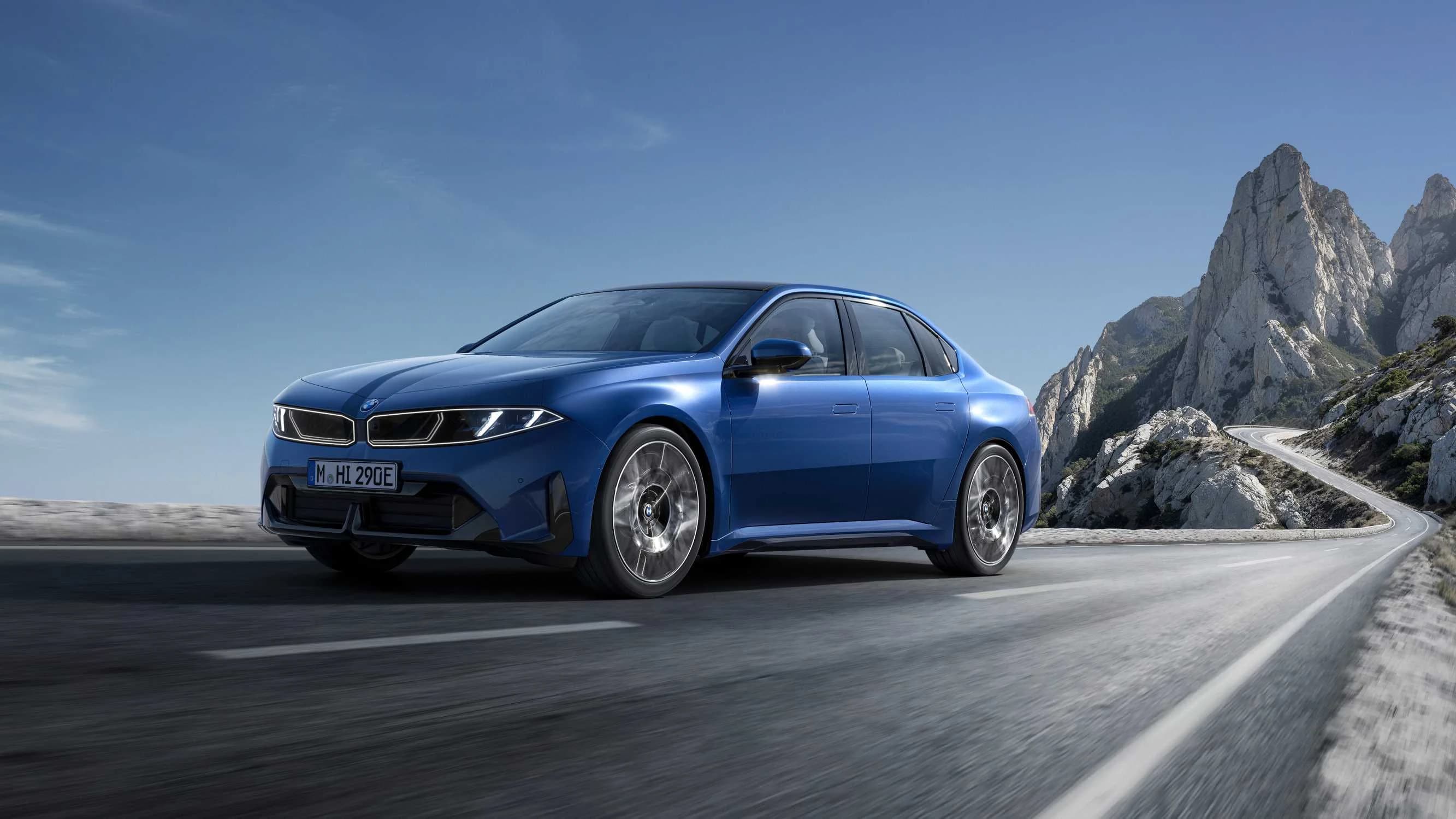
BMW has started series production at its new high-voltage battery plant in Irlbach-Straßkirchen, Bavaria. The site supplies batteries for Neue Klasse electric vehicles, including the new BMW i3 built in Munich. BMW says the investment is approximately €1 billion.
The factory opening coincides with the launch of the BMW i3 50 xDrive as the second Neue Klasse model after the iX3. For the First Edition, BMW quotes up to 906 kilometres of WLTP range. That is a certification-cycle figure, not a guaranteed distance in every journey. Actual range depends on configuration, tyres, weather, speed, auxiliary loads and battery condition.
A battery plant close to Munich
Irlbach-Straßkirchen is in Lower Bavaria, roughly 90 minutes from BMW Group Plant Munich. BMW presents the site as part of a Bavarian battery network covering research, production and recycling. Locating battery production close to German vehicle plants supports BMW’s “local for local” approach for the Neue Klasse programme.
The facility makes sixth-generation high-voltage batteries. BMW describes production with end-to-end inline quality checks, digital twins and systematic use of artificial intelligence. The company also says renewable energy is used for the production of anode and cathode materials and for cell manufacturing. BMW has not provided one single lifecycle-emissions figure for the entire battery process in the announcement, so the energy claim should not be read as a complete carbon assessment.
The plant does not build the finished car. It supplies battery packs to vehicle factories, where the pack is integrated with the body, electric drive and other systems. For the new i3, batteries come from Irlbach-Straßkirchen while final vehicle production takes place in Munich. This arrangement shows how BMW is building a regional network for an increasingly important electric-vehicle component.
The i3 is not made in one location
BMW states that the sixth-generation electric motor for the i3 is produced at BMW Plant Steyr in Austria. Steyr manufactures the rotor, stator, inverter and transmission of the integrated e-drive. The motor housing comes from BMW’s aluminium foundry at Plant Landshut in Germany.
Final assembly of the sedan takes place in Munich. BMW spent four years transforming the plant while production continued. The conversion added a new body shop, a new assembly hall with integrated logistics and a delivery hall for final inspection. BMW says series production of the i3 started in August 2026, with deliveries scheduled from autumn 2026.
From 2027, BMW Group Plant Munich is scheduled to produce fully electric vehicles exclusively. The decision makes the i3 part of a larger industrial transition at BMW’s home plant, rather than a standalone model launch. BMW says experience gained during the Munich production start will be shared with other plants in its global network.
How the i3 reaches 906 km WLTP
The quoted range comes from several technical changes working together. The i3 uses an 800-volt electrical architecture, new cylindrical cells and a cell-to-pack design. The cells are integrated directly into the high-voltage battery instead of using the same conventional modular structure between cells and pack. BMW says this improves pack-level energy density and helps reduce mass and cost.
The battery also uses a pack-to-open-body concept in which the battery casing helps close the vehicle floor structurally. BMW says the result is a flatter battery layout, improved integration and a body structure that benefits from increased torsional rigidity. These choices support the low-slung proportions and aerodynamic efficiency expected from an electric sedan.
The BMW i3 50 xDrive uses one electric motor on each axle. BMW quotes a combined system output of 345 kW, or 469 hp, and maximum torque of 645 Nm. BMW’s First Edition material lists up to 906 km of WLTP range, while other BMW documents show provisional values around 900 or 912 km depending on the configuration. Those numbers should not be merged into one universal specification.
WLTP is a standardised test cycle for comparing vehicles. It is not an instruction that a driver will always cover 906 km. BMW lists load, driving style, route, weather, heating or air conditioning, tyres and battery state of health among the variables that affect actual results.
400 kW charging and bidirectional energy
The 800-volt system enables DC charging at up to 400 kW, provided the charger and vehicle conditions support that level. BMW says the i3 50 xDrive can add energy corresponding to up to 423 or 400 km of WLTP range in ten minutes, depending on the document and version cited. The result is based on ISO 12906 in the WLTP cycle, not on a guaranteed real-world distance.
The car can also charge on AC at up to 22 kW, depending on equipment. BMW is adding bidirectional functions: Vehicle-to-Load can power external devices, Vehicle-to-Home can use the car as a household storage device, and Vehicle-to-Grid can exchange energy with the public grid where the hardware, supplier and regulations allow it.
These functions do not automatically work in every home. They require compatible charging equipment, software and grid conditions. In Romania and other European markets, practical V2H or V2G availability will depend on the wallbox, energy supplier, contract and local rules.
What the new i3 means for BMW
The new i3 is the first fully electric 3 Series sedan of the Neue Klasse era and the second Neue Klasse model after the iX3. BMW retains the proportions of a sedan while using an architecture designed around electric propulsion. The car measures 4.76 metres in length, 1.865 metres in width and has a 2.897-metre wheelbase, according to BMW’s product information.
The Irlbach-Straßkirchen investment gives BMW closer control over an important part of its battery supply for German plants. It does not mean every battery component is made at that site, and the 906 km WLTP figure should not be presented as a universal real-world range. The i3 combines Bavarian battery production, an Austrian electric-drive plant, German component manufacturing and final assembly in Munich within one Neue Klasse production network.


