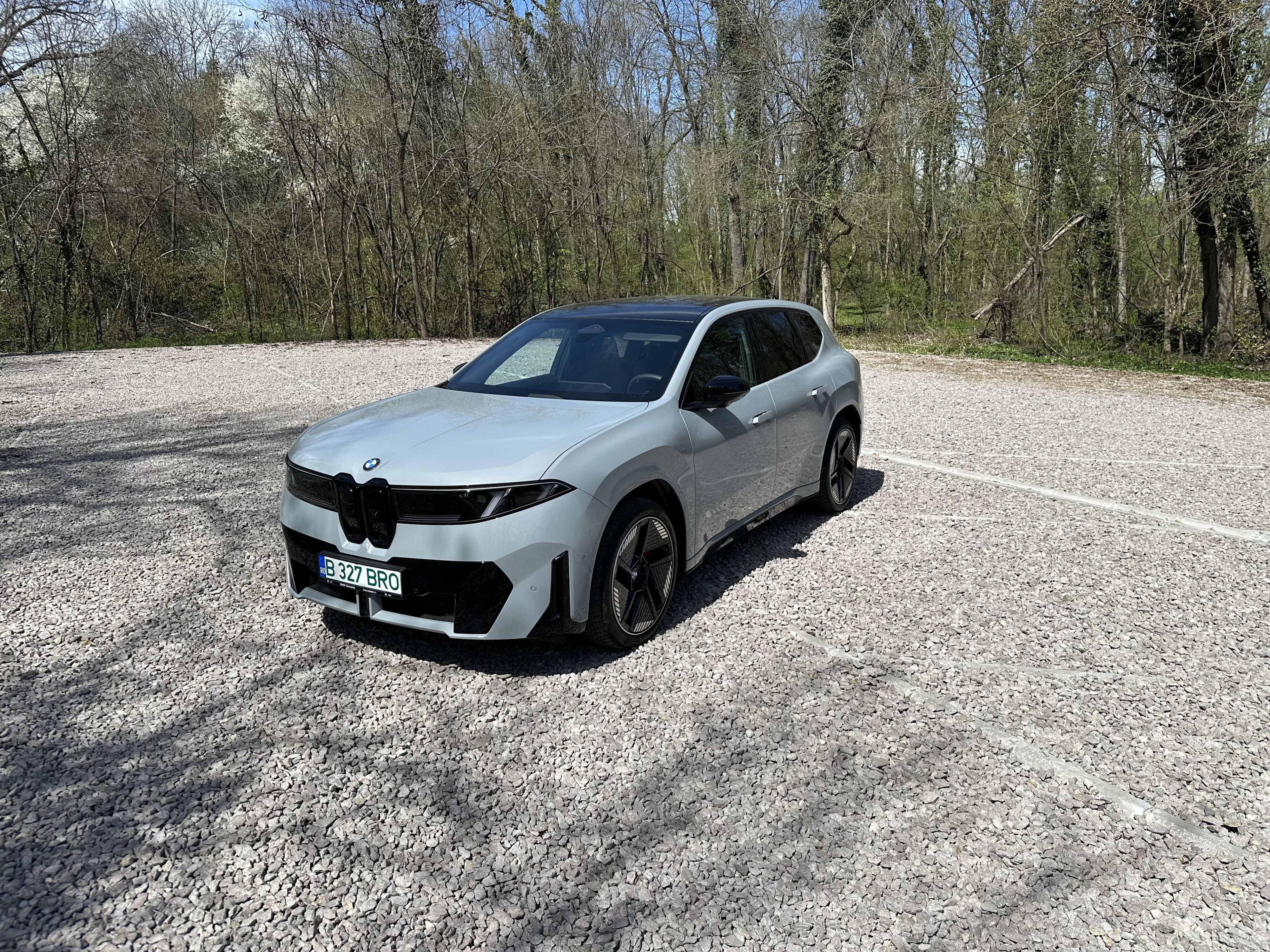
The new iX3 is one of the first BMW models that can supply video data for developing driver-assistance systems. Photo: BMW Group.
BMW will use customer-car cameras to improve driver-assistance systems
BMW is expanding in the European Economic Area a programme through which customer cars can send the company sequences filmed by the exterior cameras, together with GPS position and sensor data. The stated aim is the development of automatic braking, lane-change, parking and partly automated driving systems.
The programme includes the new BMW iX3, but is not limited to it. Also covered are the i3, 7 Series and X5 equipped with BMW Operating System X and the architecture needed for data processing. Collection began in Germany on 1 April 2026 and is being extended gradually to the other countries of the European Economic Area, a category that includes Romania.
The essential point for the owner is that participation is not automatic. BMW states that data are recorded only after the customer’s explicit consent, given from the car’s Privacy menu or through the My BMW/MINI app.
What the car can record
The exterior cameras can capture the roadway, signs, markings, buildings and infrastructure. Images may include other cars, motorcycles, bicycles and pedestrians, including faces, number plates and inscriptions visible near the car.
The video sequence can be associated with several data categories:
- GPS position and the time of recording;
- the car’s speed;
- steering-wheel angle and brake-pedal position;
- information from radar and ultrasonic sensors;
- weather and lighting conditions;
- the direction of movement of objects and other road users.
BMW explains that position is needed to reconstruct the situation correctly and to avoid repeated collection from the same place. The company says it does not create profiles of the driver’s journeys or of people captured by the cameras.
It is not continuous filming
According to the privacy notice, the system does not permanently keep everything the cameras see. Current recordings are overwritten, and a sequence is saved only when a predefined technical event occurs.
Such a trigger can be a warning or intervention from automatic emergency braking, detection of an obstacle, an animal appearing on the road or a sudden evasive manoeuvre. For each event, at most 120 seconds can be recorded.
This mechanism helps engineers study rare situations that are hard to reproduce on a circuit or in a simulation: a partly hidden pedestrian, a cyclist crossing the path of a turning car, or an object left on the roadway.
From September, images can reach BMW servers unblurred
The programme has an important processing change. Between April and September 2026, the system tried to mask faces and number plates in the car before transmission.
Starting gradually from September 2026, images can initially be sent without blurring to BMW’s secure environment, which the company calls a “Blackbox”. There they are analysed automatically. If a developer must exceptionally see the sequence, faces and plates are masked before human access.
BMW justifies the change by the need to keep details such as a pedestrian’s gaze direction or head movement, information that can be distorted by anonymisation done in the car. The company says the software classifies road users only into categories such as “person”, “bicycle” or “car” and that the system is not designed for individual identification.
How the data are protected
Data are stored encrypted in the car and transmitted encrypted. After transfer is confirmed, the temporary copy is automatically deleted from the vehicle. In BMW’s infrastructure, the VIN of the car that made the recording is removed shortly after receipt.
Access is limited to authorised staff, and the processing environment is technically separated from other systems. BMW does not give a fixed retention period: sequences and associated data are reviewed and deleted when they are no longer needed for development. Information required by law or for type approval may be kept until the end of the vehicle’s life cycle.
BMW may make data without the car identifier available to development partners. The company names Qualcomm Technologies International explicitly, with which it develops Level 2 assistance functions and future Level 3 technologies. For certain operations, BMW and Qualcomm are joint controllers under the GDPR.
What happens to pedestrians and other drivers
The BMW owner can decide whether their car takes part, but people captured accidentally in traffic cannot give consent at that moment. BMW cites legitimate interest, under Article 6(1)(f) GDPR, as the legal basis for processing images in which other road users appear.
In principle, a person has rights of access, objection and erasure. Applying them can be difficult in practice, because BMW says it does not identify the people filmed and cannot find a particular sequence without precise information about place, time and situation.
This limit is worth understanding: reducing the possibility of identification protects privacy, but can make it harder to locate a recording in which someone believes they appear. People dissatisfied with the company’s response can turn to the national data-protection authority.
How the driver can control participation
BMW requires prior consent in the car’s Privacy menu or in the app. An owner who does not want these data transmitted does not have to activate the option. If they have given consent and change their mind, they must withdraw it from the same privacy settings.
Switching off participation in the programme does not mean switching off the cameras and sensors needed for the assistance systems to work. The difference is between local processing required by the car and the keeping plus transmission of sequences to the manufacturer for development.
For a second-hand car or one used by several drivers, it is worth checking the Privacy menu and the associated account. Consent given by the holder of the connected services should not be assumed by other users.
Why manufacturers need data from traffic
Modern assistance systems rely on correctly recognising a huge variety of situations. Controlled tests and simulations cover predictable scenarios, but customer fleets can meet unusual markings, roadworks, rare vehicles and behaviour that developers have not anticipated.
BMW wants to use these examples for remote software updates. The potential benefit is improving systems already on the road. The trade-off is that part of the road infrastructure and of the activity of people around the car ends up in a private manufacturer’s systems, even if the process includes depersonalisation measures.
Frequently asked questions
Does the BMW iX3 film traffic continuously?
The cameras work for the car’s systems, but the programme described by BMW keeps sequences only at predefined events. Each saved recording can last at most 120 seconds.
Is the owner’s consent required?
Yes. BMW says transmission for development happens only after explicit consent given in the Privacy menu or through the My BMW/MINI app.
Which other models are covered?
Besides the iX3, the programme includes the i3, 7 Series and X5 that have BMW Operating System X and the necessary equipment.
Can number plates and faces be recorded?
Yes, the cameras can capture them. From September 2026, some images can arrive unblurred in a secure BMW environment, where they are analysed automatically; masking is applied before any human access.
Are the data shared with other companies?
BMW says it can share them, without the vehicle identifier, with selected partners for research and development. Qualcomm is the partner named explicitly in the notice.