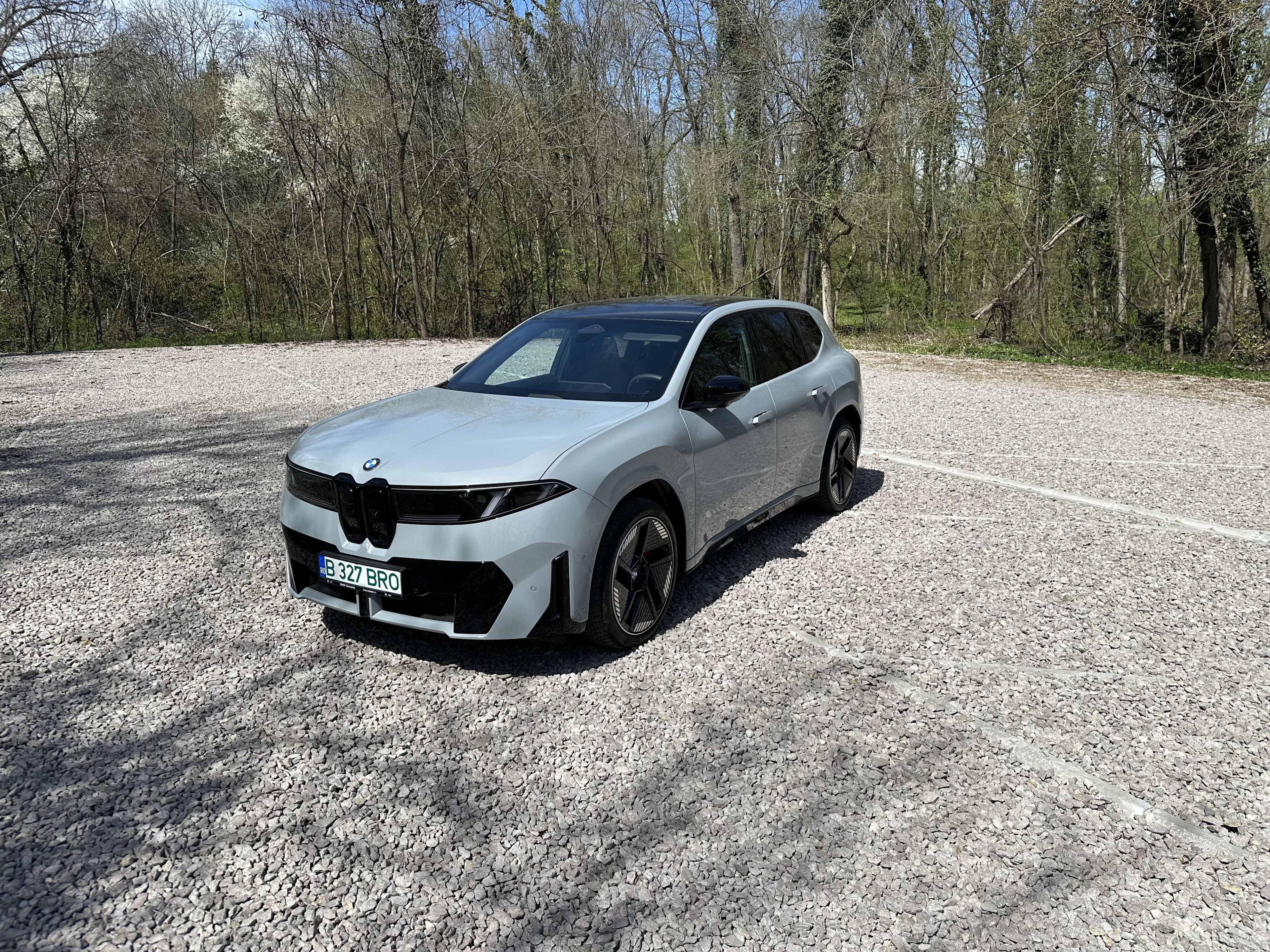
BMW iX3 50 xDrive from the Neue Klasse generation. Archive image Carboratory
BMW iX3 on a long-term test: the range convinces, but the steering-wheel controls and HUD irritate
The new BMW iX3 50 xDrive can cover about 644 km in real use, according to the third report published by Top Gear as part of a long-term test. The distance does not come from a standardised test and should not be confused with the WLTP range of up to 805 km, but it shows that the electric SUV can cover long journeys without frequent stops.
Daily use has, however, also brought out problems that do not appear on the specification sheet: the head-up display is tiring on uneven surfaces, some steering-wheel controls are hard to reach, and phone integration worked inconsistently at times.
About 644 km between charges, under the British test conditions
Writer Ben Pulman says the observed real-world range is about 400 miles, equivalent to roughly 644 km. Before a trip to Cornwall, he did not consider it necessary to look up charging stations on the route in advance.
The result should be read in context. Top Gear did not publish for this figure the temperature, average speed, exact consumption or remaining battery percentage at the end. It is therefore not a promise that every iX3 will cover 644 km in Romania. Winter, predominantly motorway driving, cabin heating and larger wheels can reduce range. Urban traffic and moderate temperatures can produce better results.
BMW quotes for the iX3 50 xDrive a range of 717–805 km WLTP, depending on equipment. The battery has a usable capacity of 108.7 kWh, and official consumption is between 15.1 and 17.1 kWh/100 km.
The optional HUD was switched off almost permanently
The car used by the British magazine has a head-up display included in an optional pack. The test author says he deactivated it almost from the first day. The horizontal line in the graphics seems to jump in the field of view on uneven surfaces, and the characters were perceived as unclear.
The criticism does not apply to all display systems in the iX3. On the contrary, BMW Panoramic Vision, the band at the base of the windscreen, was praised for readability and for placing important information close to the line of sight. That band is precisely what makes the classic HUD seem redundant in the tested configuration.
For a buyer, the observation has a practical consequence: both displays are worth trying before ordering an expensive pack. Driving position, driver height and eye sensitivity can change the experience, and a short run on good tarmac does not necessarily reproduce behaviour on an uneven road.
The steering-wheel controls are too close to the centre
The most persistent complaint concerns the touch buttons on the steering wheel. The control zones are mounted close to the hub, not towards the outer part of the spokes. Even a driver with large hands has to move a hand to reduce the volume or skip a track.
There is also a problem of separation between functions. The command for the next track is very close to the one for the phone. In the test, trying to skip quickly through a podcast opened the call menu and led to the accidental selection of a number.
These may seem small details, but they are frequently used commands and must be operated without the driver looking at the wheel. Their layout matters more over several months of use than in a static presentation or a test lasting a few hours.
Android Auto and calls had episodes of inconsistent operation
Top Gear also mentions two incidents that did not recur permanently. Android Auto alternated between a full display and keeping a BMW shortcut bar, and for about 48 hours the phone connected and played music, but calls were not played through the car speakers.
The report does not establish the cause and does not indicate whether the problem came from the car, the phone or Android Auto software. There are also insufficient data to claim that all iX3 examples are affected. Such episodes are nonetheless relevant for a model in which many functions depend on the new BMW operating system and the phone connection.
What the BMW iX3 50 xDrive officially offers
The tested version has two electric motors, all-wheel drive and develops 345 kW, equivalent to 469 hp, plus a maximum torque of 645 Nm. Acceleration from 0 to 100 km/h takes 4.9 seconds.
| Characteristic | BMW iX3 50 xDrive |
|---|---|
| Power | 345 kW / 469 hp |
| Torque | 645 Nm |
| Usable battery | 108.7 kWh |
| WLTP range | 717–805 km |
| DC rapid charging | maximum 400 kW |
| 10–80% charging | minimum 21 minutes, in optimal conditions |
| Kerb weight | 2,360 kg |
| Boot | 520–1,750 litres |
| Front compartment | 58 litres |
At a compatible station, BMW says the car can recover energy for 309–372 km WLTP in ten minutes. The maximum power of 400 kW is not held throughout the session, and the real time depends on battery temperature, the initial charge level and the station’s capacity.
What the test means for a buyer in Romania
The long-term report does not change the main technical conclusion: the large battery and the efficiency of the Neue Klasse platform make the iX3 50 xDrive an electric SUV suited to interurban travel. A reported real-world range of about 644 km leaves a useful reserve against the Bucharest–Cluj-Napoca distance, but winter conditions or motorway speed can still require a stop.
At the same time, the test shows why a car should not be chosen only by range and charging power. Touch controls, display readability and the stability of the phone connection are used on every journey. For the iX3, a trial that includes uneven tarmac, connecting your own phone and using all the steering-wheel controls can say more than a few minutes spent in the configurator.
Frequently asked questions
What real-world range did the BMW iX3 achieve in the Top Gear test?
The magazine indicates about 400 miles, or around 644 km. It is not a result obtained in a standardised protocol and can vary with weather, route and driving style.
What is the official range for the BMW iX3 50 xDrive?
BMW communicates 717–805 km in the WLTP cycle, depending on the car’s configuration.
What problems appeared in the long-term test?
The author criticised the readability of the head-up display on uneven surfaces and the positioning of the steering-wheel controls. There were also temporary incidents with Android Auto and call playback through the audio system.
How long does rapid charging take?
BMW indicates a minimum of 21 minutes between 10% and 80% at a station that can supply the required power and when the battery is at the right temperature.