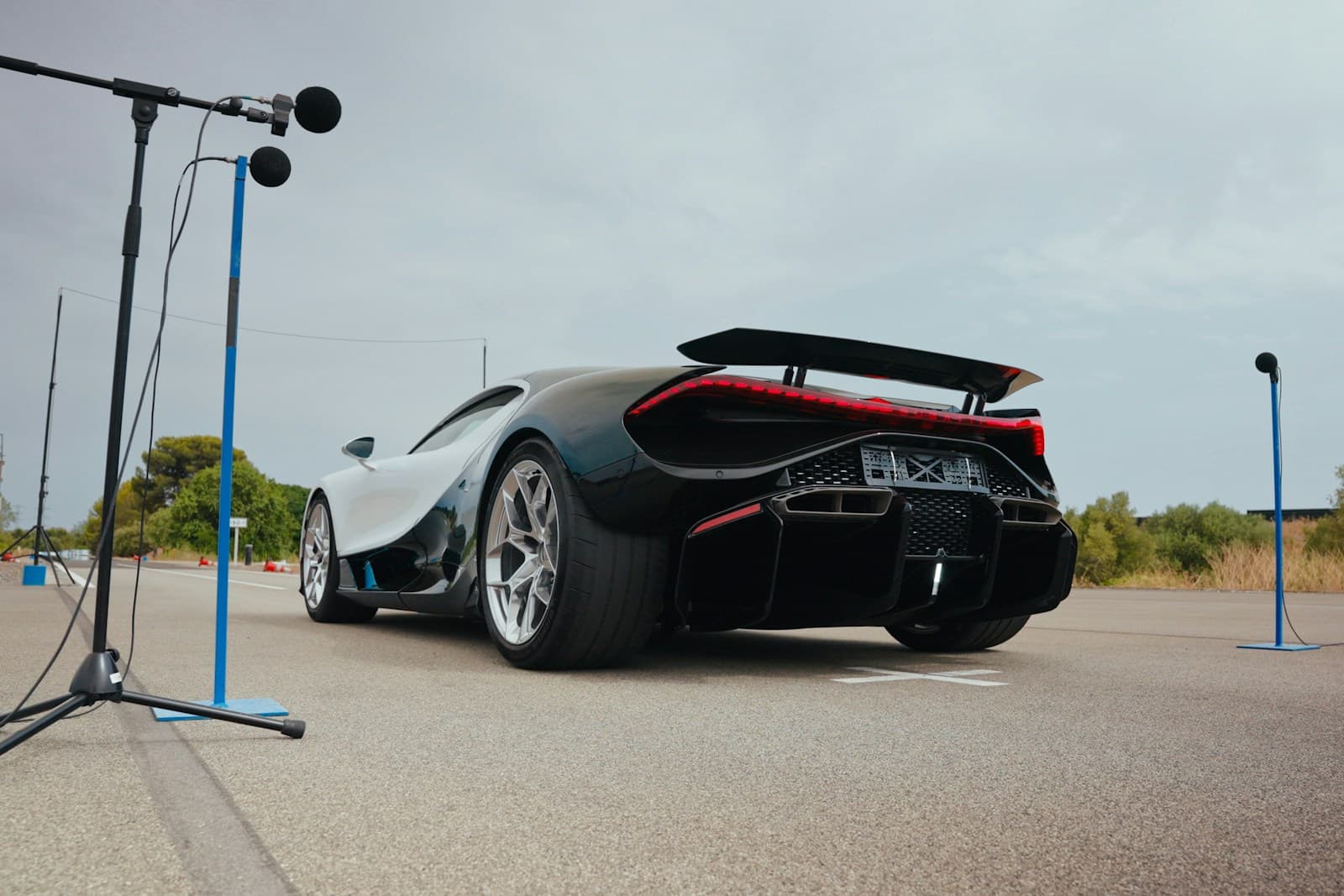
The microphones used in homologation tests record the noise of the whole car, not just the exhaust. Photo source: Bugatti
How the new Bugatti Tourbillon’s V16 engine sounds at 9,000 rpm
Bugatti has published a new recording of the Tourbillon’s naturally aspirated V16, captured during acoustic homologation tests. The 8.3-litre engine reaches 9,000 rpm and produces 1,000 hp without turbochargers, before the three electric motors are included in the total power figure.
The material is part of the documentary series “A New Era” and shows that settling the final sound is not simply a matter of choosing a louder exhaust. Engineers have to coordinate intake, exhaust, cabin comfort and legal noise limits.
The full recording can be watched on Bugatti’s official channel.
A naturally aspirated V16 in place of the old twin-bank W16 with four turbos
The Tourbillon changes the mechanical architecture Bugatti used for more than two decades. The Veyron and Chiron were powered by an 8.0-litre W16 with four turbochargers. The new car uses an 8.3-litre V16, developed with Cosworth, which breathes naturally and can rev much higher.
The combustion engine delivers 1,000 hp at 9,000 rpm and 900 Nm. The hybrid system adds three electric motors, and the announced combined power is 1,800 hp. One electric motor is integrated into the rear-axle assembly, next to the eight-speed dual-clutch transmission, and the other two drive the front axle.
| Element | Bugatti Tourbillon |
|---|---|
| Combustion engine | naturally aspirated V16, 8.3 litres |
| Combustion engine power | 1,000 hp |
| Combustion engine torque | 900 Nm |
| Maximum engine speed | 9,000 rpm |
| Electric motors | 3 |
| Declared total power | 1,800 hp |
| Transmission | dual clutch, 8 speeds |
The difference in sound comes first of all from this architecture. Turbos mute some of the exhaust pulses and change gas pressure. Without them, the V16 can respond more directly to the throttle, and the rise in engine speed becomes more obvious to the ear.
Thousands of simulations for intake and exhaust
Bugatti says the team ran thousands of simulations for the intake and exhaust systems. The aim was to keep a recognisable mechanical character, but also to avoid tiring resonances inside the car in ordinary driving.
Romain Volatier, Bugatti’s noise and vibration lead, explains in the film that the brand’s engines have not in the past chased a perfectly even sound. Engineers deliberately kept a rougher component, rather than eliminating every irregular pulse and frequency.
The result is not created through cabin speakers. The manufacturer describes the V16 sound as mechanical in origin, produced by the engine, intake and exhaust. The hybrid system also allows electric driving in some situations, so the same car has to move from silence to a 16-cylinder engine at work.
Why tyres, bodywork and the active rear wing matter
In homologation, microphones placed beside the track do not isolate the exhaust. They measure the car’s total noise, which includes the tyres, airflow over the body and moving aerodynamic parts.
On the Tourbillon, the active rear wing produces downforce and changes the airflow around the rear. Its position can affect the measurement, along with rolling noise from tyres developed specifically for the car.
The procedure includes constant-speed passes and accelerations. Temperature and wind speed have to stay within accepted ranges, and a gust can invalidate an attempt. For that reason the team carried out several preliminary tests before the final session.
Bugatti says the main stage of acoustic validation ended after about three years of developing the car. Fine-tuning continues, but the basic sound configuration has been approved.
Strong sound outside, acceptable comfort in the cabin
A hypercar has to meet the same acoustic homologation principles applied to production cars, even if its production volumes are very small. Maximum level is not the only issue: low frequencies can generate vibration, and certain constant engine speeds can produce a buzz that disturbs occupants.
Engineers aimed for the V16 to be clearly heard when the driver accelerates, without the engine dominating the cabin all the time. Exhaust flaps, gas-path geometry and sound insulation can change the car’s character depending on load and engine speed.
The recording published by the company, however, captures the car from outside. The sound heard in a clip depends on the microphones, audio processing and the device it is played on, so it cannot fully reproduce the intensity or the low frequencies heard next to the car.
What performance the Tourbillon claims
Bugatti announces for the Tourbillon acceleration from 0 to 100 km/h in about 2 seconds. The declared top speed reaches 445 km/h with the dedicated function activated.
These figures appear in the manufacturer’s specifications and are not, for now, the results of an independent test with a production car. The Tourbillon is still ahead of complete final homologation, and Bugatti notes that the model does not yet have the type approval required to publish European consumption and emissions figures.
Production is limited to 250 examples. For buyers, the V16 sound will be one of the most obvious differences from the Chiron: the new engine drops the four turbos, revs to 9,000 rpm and works in a hybrid system that almost doubles the power supplied by the combustion engine alone.