
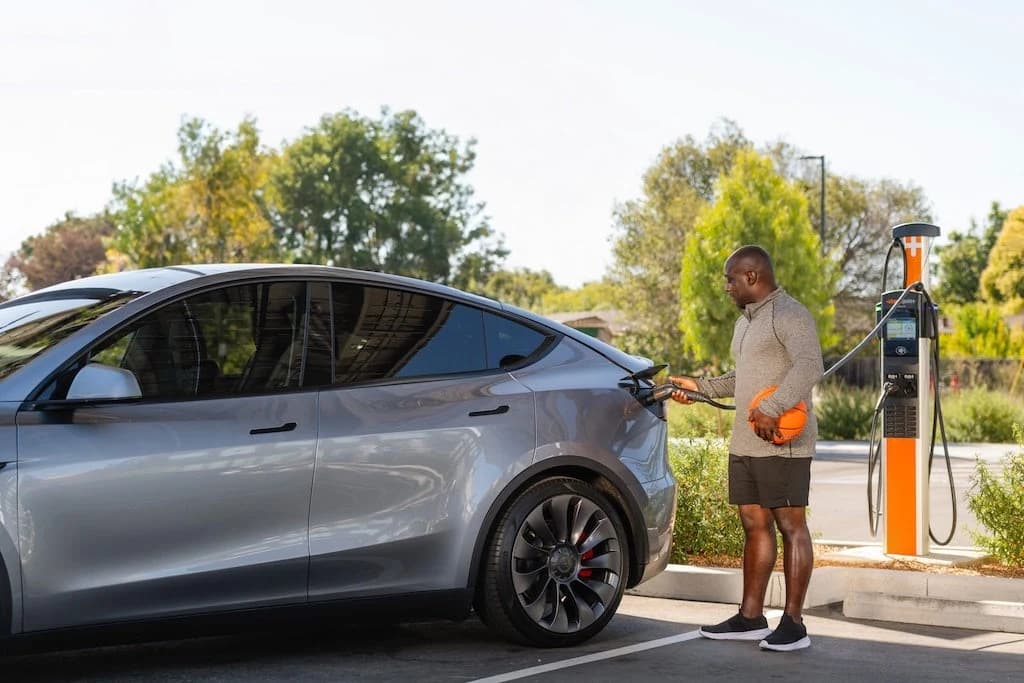
Electric vehicle charging demand is growing faster than the number of new charging ports, according to data published by ChargePoint. The company analysed more than 100 million charging sessions enabled by its network over the past year and reported a 34% increase in session volume in 2025, compared with 16% growth in new ports.
The figures do not represent every charger or EV driver worldwide. They describe ChargePoint’s own network and the ports that drivers can access through its platform. ChargePoint has combined the network data with vehicle-sales information to argue that charging capacity needs to expand faster if it is to match actual use.
What the 100 million sessions show
ChargePoint says it enabled more than 100 million charging sessions during the year covered by its analysis. More than one million EV drivers use the company’s platform each month. Both figures are network indicators rather than a census of the global EV market, so they should not be treated as a direct measure of all public charging activity.
During 2025, session volume on the ChargePoint network grew by 34%. The company also says that 190,000 additional ports became available to drivers through its network, while new-port growth was 16%. Utilisation therefore grew almost 20% faster than the number of new ports, based on ChargePoint’s calculation.
For charging operators, that gap has a practical meaning. Adding a new connector does not automatically create more spare capacity if the number of sessions rises faster. Busy locations can experience longer waits, and operators need to consider power delivery, dwell time, grid connection, site layout and reliability rather than counting connectors alone.
Port numbers are not the whole capacity story
A charging port can serve several vehicles during a day, and its usefulness depends on output, session length and the type of driver using it. An AC charger at a workplace or retail site has a different role from a high-power DC charger on a motorway. The number of installed ports therefore does not fully describe how much charging capacity is available at a given time.
ChargePoint says vehicles identified as plug-in hybrids account for about 16% of all commercial AC charging sessions managed by its platform. That shows how public infrastructure can serve different types of electrified vehicles. It is also a ChargePoint-platform figure and should not be applied automatically to every market or charging network.
The company gives drivers access to more than 900,000 roaming ports and directly manages approximately 375,000 public and private ports. Those categories are not identical. Roaming ports are available through network partnerships, while directly managed ports are connected to ChargePoint’s own platform and services.
The link with EV sales
ChargePoint places its network figures alongside broader EV sales data. For 2025, it cites a 20% increase in global EV sales based on Rho Motion data. It cites 33% growth in Europe and describes the United States as having its second-best EV sales year. These figures are not measurements produced by ChargePoint; they are context for its view that the number of vehicles on the road is becoming a more important demand indicator than annual sales alone.
Vehicles remain in service after the year in which they are sold. As the fleet grows, charging demand accumulates across workplaces, homes, retail destinations, depots and public road corridors. That is why a single year of new-port additions may not be enough to match the number of vehicles needing energy over time.
ChargePoint also says that nearly 60% of the 19.3 billion electric miles enabled by its platform over almost 18 years took place during the last two years. This is a measure of the company’s activity, not a forecast for a particular country. It does show how ChargePoint is tracking the rising use of the network rather than relying only on vehicle registrations.
Technologies proposed for the next stage
ChargePoint’s 2026 Charging Forward report highlights vehicle-to-everything charging, artificial intelligence, higher-power DC systems and commercial-fleet electrification. V2X can allow a compatible vehicle to exchange energy with a home, building or grid. That requires a compatible vehicle, bidirectional hardware, software and electricity-market arrangements; the concept is not automatically available to every EV.
The company also describes AI applications including demand forecasting, predictive maintenance, time-of-use pricing and real-time fault diagnosis. These are product and strategy claims from ChargePoint, not independent performance results for every operator.
ChargePoint lists up to 600 kW for its Express Solo standalone charger for mass-market passenger vehicles. Actual charging power depends on the vehicle, battery state, temperature, charger configuration and grid connection. A charger’s maximum rating does not mean that every car can accept 600 kW.
What the figures mean for drivers and operators
Drivers may need to choose chargers by checking live availability rather than relying on the number of connectors shown on a map. Operators face a broader task: installing enough ports, securing grid capacity, keeping equipment working and managing the time each vehicle occupies a connector.
ChargePoint estimates that, since 2007, its network helped avoid 714 million gallons of gasoline use, more than $2 billion in fuel costs and over 4.5 million metric tonnes of greenhouse-gas emissions. These are company estimates, not an independent audit, and the original figures use US units and a ChargePoint-defined methodology.
The narrower verified conclusion is that ChargePoint’s own network recorded session growth ahead of new-port growth in 2025. The next question is whether public and private operators can increase port numbers, available power and reliability quickly enough to meet demand as the EV fleet continues to expand.


