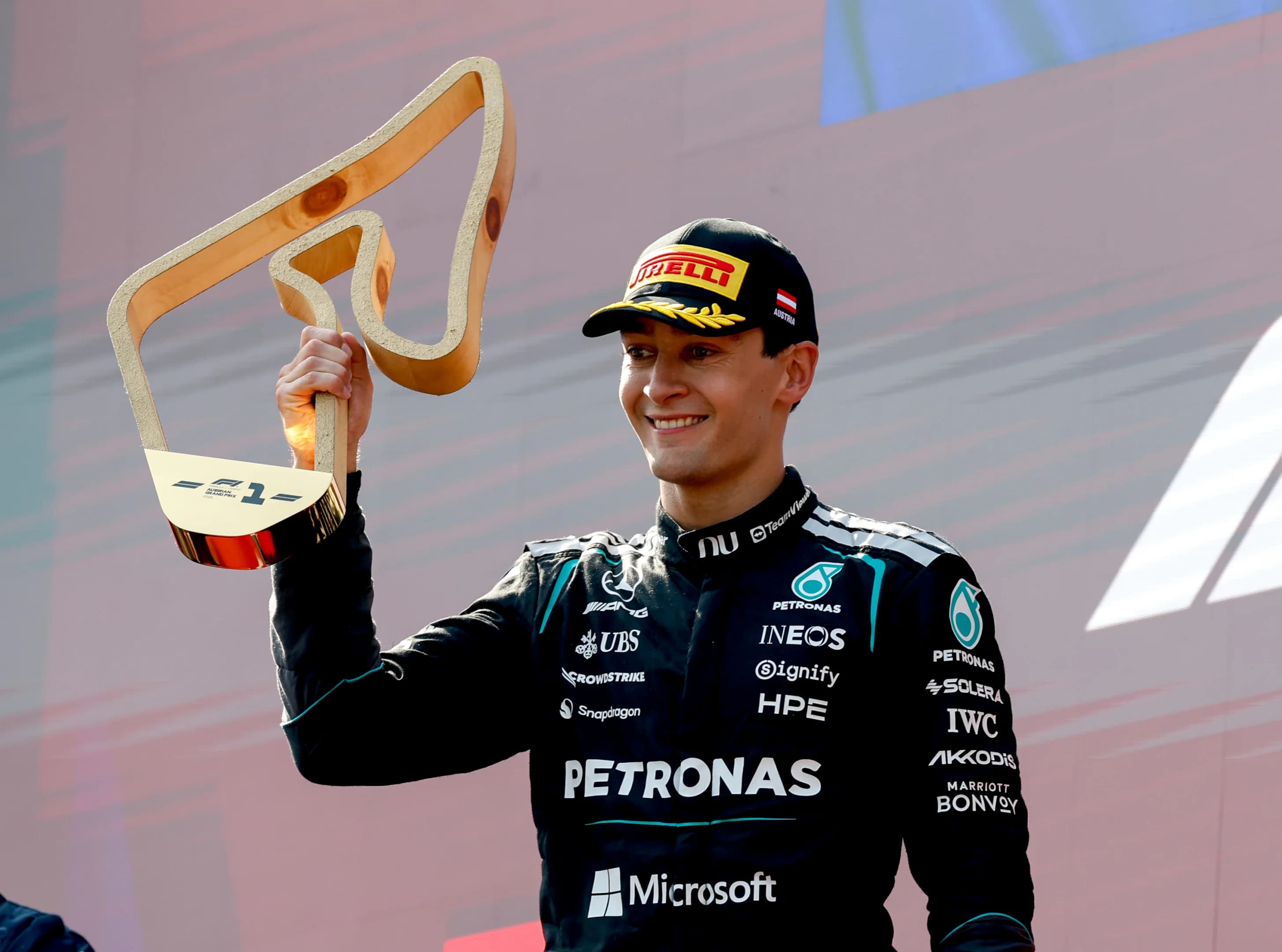
The changes prepared for 2027 will shift a larger share of the load onto the internal-combustion engine. Photo: Mercedes-AMG Petronas F1 Team.
Formula 1 races could be shortened to 290 km in 2027. The reason is the fuel use of the new engines
Formula 1 Grands Prix could become shorter in the 2027 season. Teams have agreed on a solution that allows race distances to be adjusted to offset the higher fuel consumption that follows from the way the new hybrid power units work.
The British titles Top Gear and Autosport point to a target distance of 290 km, against about 305 km for most current races. The FIA has officially confirmed measures on race distances at certain circuits, but has not yet published the full list of rounds and the final number of laps for the 2027 calendar.
It is therefore not yet certain that every Grand Prix will be exactly 290 km. The regulations allow adjustment where energy demand requires it.
Why the fuel does not last for the current distance
The power units introduced in 2026 greatly increased the role of the electric motor. In real circuit use, drivers and teams have reported that energy management can force cars to slow or harvest energy at moments that hurt close racing.
For 2027, the FIA, Formula 1, the teams and the engine manufacturers have accepted an increase in the contribution of the internal-combustion engine and a reduced dependence on electric energy. Paddock sources indicate a split close to 58% thermal power and 42% electric power, instead of the near 50:50 balance originally pursued.
More thermal power requires a higher fuel energy flow. The tank and chassis of the 2027 cars are already at an advanced design stage. Enlarging the tank would require structural changes, would add mass and would generate extra cost.
Shortening the distance thus becomes a temporary solution: it lets the combustion engine work harder without teams having to redesign the car entirely for a larger tank.
How much a race would shrink
Moving from 305 to 290 km means a cut of about 15 km, or nearly 5%. The number of laps removed depends on circuit length. On some tracks two or three laps could disappear; on others, four.
Actual duration would, in normal conditions, fall by only a few minutes. The sporting impact can still be larger than the clock suggests: pit-stop windows compress, tyres cover fewer kilometres, and two-stop strategies can become harder to justify.
Monaco is already an exception to the standard distance, because of the low average speed and race duration. The new rules will have to be adapted separately for circuits that already use special distances.
The FIA is not saying cars “run out of battery”
The issue is not electric range in the sense known from a road car. The single-seaters recover energy under braking every lap, and the battery is charged and discharged repeatedly. The difficulty is the balance among available electric energy, the power demanded and the fuel allowed over the full distance.
Raising the combustion engine’s contribution is intended to reduce periods when drivers must manage energy artificially and to allow running at high intensity for longer. The side effect is higher consumption, which tanks designed for the original rules cannot cover on every circuit.
What the FIA has officially approved
The World Motor Sport Council has ratified a package of changes for 2027 and 2028. It includes adjustments to combustion-engine power, fuel energy flow, recovery and use of electric energy, and more flexibility in energy management.
The FIA and Formula 1 have also confirmed measures linked to race operations and the distance of some rounds. The uniform 290 km figure is reported by specialist media on the basis of discussions among teams, but the public documents cited by the FIA do not yet provide a final table for each Grand Prix.
Changes for 2028 may bring a broader solution, because manufacturers and teams will have more time to adapt the hardware. The 2027 adjustment answers a problem that appeared after car design was already advanced.
What changes for spectators
A cut of about 5% does not turn a Grand Prix into a sprint race. The grid, pit stops and points allocation remain those of a main race. The visible difference will be fewer laps and, possibly, a slightly reduced duration.
On the other hand, if the adjustment lets drivers use available power more consistently, the quality of on-track fighting may matter more than the minutes removed. A real assessment will only be possible after official distances are published and after the first races of 2027.
Frequently asked questions
Will all F1 races be 290 km in 2027?
There is not yet a complete official list. Specialist media point to the 290 km target, and the FIA has confirmed the possibility of adjusting distance on certain circuits.
Why do teams not enlarge the tanks?
The 2027 cars are already largely designed. A larger tank would require chassis changes, extra cost and extra mass.
Do the cars run out of electric energy?
Not in the sense of a street electric car. The issue is the balance among electric recovery, combustion-engine power and the amount of fuel available over the race.
How much shorter will a Grand Prix be?
If distance falls from about 305 to 290 km, the cut is around 15 km or 5%, equivalent to a few laps depending on the circuit.