Dacia is reportedly preparing the three-metre Hipster electric concept for production in 2027, but the manufacturer has not confirmed a launch. Autocar attributes the programme to sources close to the project and says the target UK price is equivalent to roughly €11,100, with an upper objective below about €11,700. Those euro figures are currency conversions, not prices announced for any eurozone market.
The same report points to a battery of around 15 kWh, a motor close to 15 kW and L7e heavy-quadricycle approval. Dacia design director David Durand is quoted as saying that development is under way but still needs final approval from senior management. The distinction matters: the Hipster remains officially a concept, and none of the alleged production specifications is yet part of a Dacia order book.
Shiyan is said to be the proposed production site
Autocar says manufacturing is planned for the eGT New Energy Automotive plant in Shiyan, China. The joint venture involving Renault Group, Dongfeng and Nissan previously built the first-generation Dacia Spring there. That production reportedly stopped in July 2026, leaving the site in need of another programme.
Frank Marotte, Dacia's senior vice-president for global sales, marketing and operations, told the publication that a plan was being prepared with the other two shareholders to preserve activity at the factory. He identified competitive costs, development capabilities and annual Renault Group capacity of 45,000 vehicles as reasons to retain it. He did not announce a Hipster production decision.
Internal sources cited in the report say engineers in Shiyan are contributing to the motor, battery and chassis. Parts from the outgoing Spring would be reused where possible to reduce investment and manufacturing cost. Dacia has not published a component list, production agreement or schedule.
The price target needs a geographical label
The reported objective is a UK launch price around the equivalent of €11,100 and below approximately €11,700. The conversion uses a sterling-euro relationship close to that published in European reference data during September 2026. Exchange rates will move before any possible 2027 launch.
More importantly, a converted British price is not a continental price. VAT, transport, registration, standard equipment and national commercial strategy differ. No price, sales date or allocation has been announced for Romania, France, Germany, Italy or Spain.
Dacia's official 2030 plan includes four battery-electric vehicles, with the second-generation Spring presented as the first. The company has not named Hipster as one of the remaining three. The strategy provides room for another small EV but does not confirm this specific programme.
L7e homologation would define what the Hipster is
The reported plan places Hipster in the EU's L7e heavy-quadricycle category rather than the conventional M1 passenger-car class. Regulation 168/2013 sets a 450 kg mass-in-running-order limit for passenger-carrying L7e vehicles, with propulsion batteries excluded from the relevant electric-vehicle mass calculation. Certain L7e subcategories are capped at 15 kW of maximum continuous rated power.
Autocar expects the production vehicle to use roughly 15 kW and reach about 90 km/h. That would make it more usable beyond dense city centres than an L6e light quadricycle limited to 45 km/h, but still poorly suited to sustained motorway travel. It would be an urban and suburban mobility product, not a direct replacement for every use of a normal small car.
Quadricycle approval also brings a different regulatory framework. Buyers will need clarity on crash protection, driver-assistance equipment, licence rules, registration and insurance in each country. The 2025 concept had two front airbags; Dacia has not released safety equipment or test results for a production vehicle.
What Dacia officially confirmed for the concept
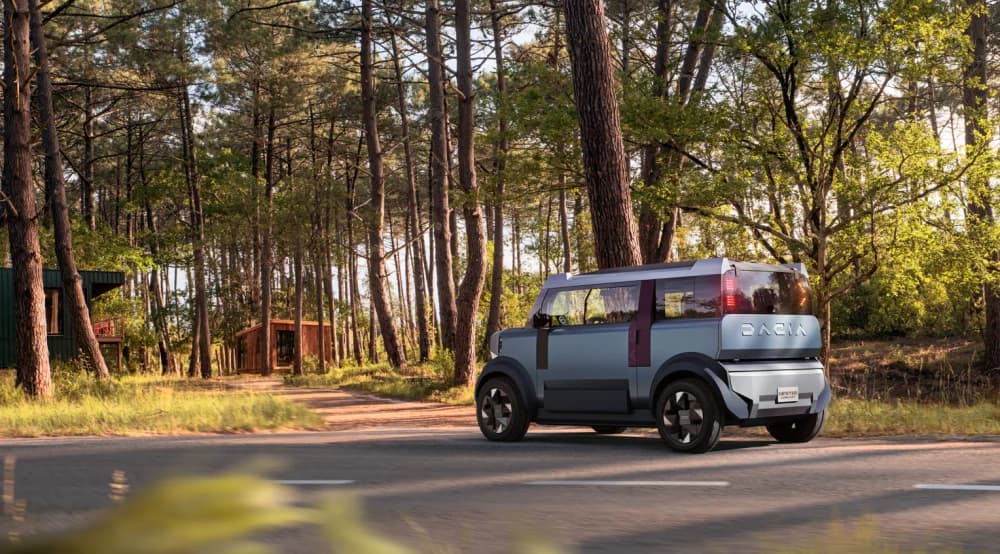
The Hipster Concept unveiled in October 2025 is 3.00 metres long, 1.55 metres wide and 1.53 metres high. Dacia described it as 20% lighter than the Spring and listed a kerb weight below 800 kg. Its box-shaped cabin provides four seats, while luggage volume ranges from 70 litres with the rear bench occupied to 500 litres with it folded.
Nearly vertical glass and wheels pushed towards the corners maximise usable cabin space. The design study used sliding side windows, fabric exterior door pulls and only three painted body pieces. Starkle side protection contains recycled material. Inside, 11 YouClip attachment points accept accessories, while a docked phone acts as digital key, navigation display and the source for a removable Bluetooth speaker.
Dacia never stated a battery capacity or homologated range for the concept. It said two weekly charges should cover the intended daily use and cited its own reference that 94% of French drivers travel less than 40 km per day. That claim cannot be converted into a WLTP range figure.
Patent drawings reportedly show production changes
According to Autocar, recent design filings keep the concept's dimensions within a few centimetres but revise the bumpers, grille and lighting. The front windows would be split, with a lower section hinging upwards. At the rear, the concept's two-piece opening would give way to a side-hinged door.
Steel rather than plastic body panels is reportedly being studied because Dacia considers moulded plastic more expensive for this application. Meeting the L7e mass ceiling while reaching the reduced price target is described as the engineering team's central problem. Battery chemistry has not been decided, according to the report, so even the claimed 15 kWh capacity is provisional.
The next meaningful step is management approval, followed by an official production reveal. Until that happens, 2027 timing, Shiyan manufacturing, 15 kWh battery and the roughly €11,100 target remain claims attributed to Autocar's reporting rather than specifications confirmed by Dacia.
Image: official Dacia media material, photograph credited by Dacia to Luc Lacey.