
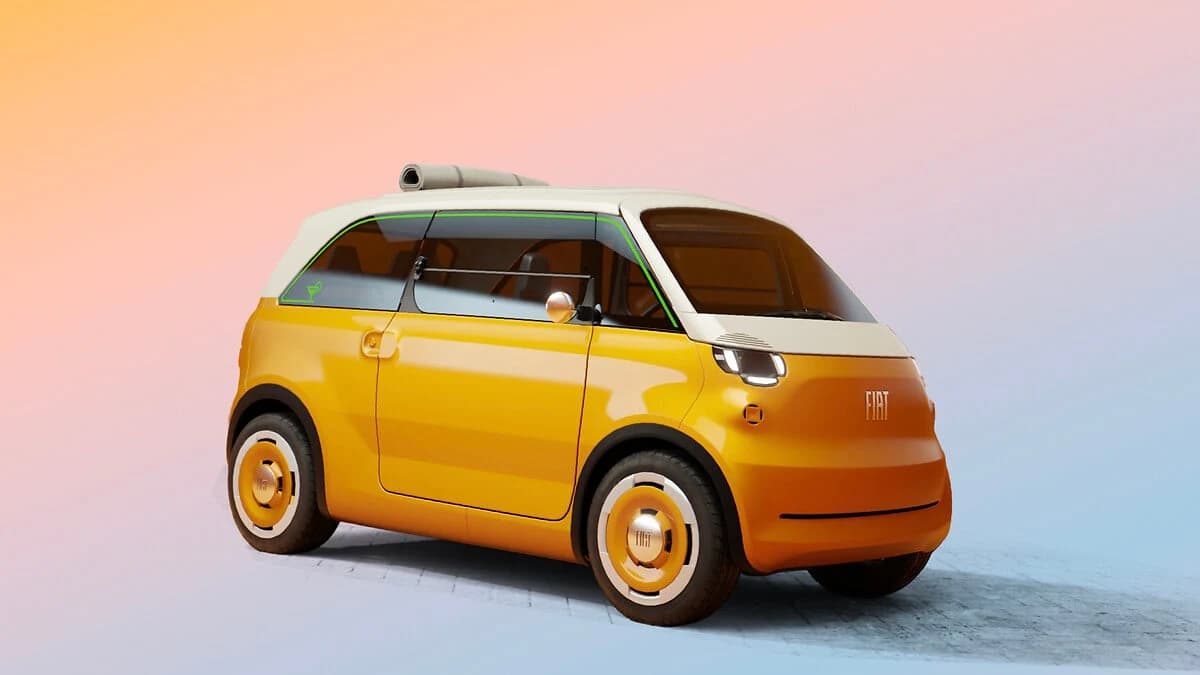
Image: FIAT/Stellantis Media. Official press asset downloaded from the Stellantis media archive and converted locally to WebP.
Fiat Multiplina previews a four-seat electric city quadricycle
FIAT is preparing a second small electric mobility product to sit above the two-seat Topolino. Called Multiplina, the concept is designed for four occupants and is described by the company as the missing link between Topolino and a conventional city car. FIAT has not released a complete production specification, so the concept should not be treated as a finished model with confirmed pricing, range or market availability.
A larger answer to the Topolino
The current Topolino is a 2.53-metre electric quadricycle with a 45 km/h top speed and a 5.4 kWh battery offering up to 75 km of range, according to FIAT’s own product communication. It is built around short urban journeys and easy access to city streets. Its two-seat layout is part of that brief, but it also limits who can use it on a daily basis.
Multiplina addresses that limitation with four seats while keeping the dimensions in the microcar rather than conventional supermini area. FIAT’s June 2026 announcement describes an electric companion for four people in roughly three metres of length. A later German-market FIAT release says the concept is intended for the L7e heavy quadricycle class and can reach up to 90 km/h. Those figures describe the direction of the project; the final homologated car may receive different specifications.
The distinction between L6e and L7e matters. Topolino’s 45 km/h limit places it in the lighter end of European quadricycle mobility. An L7e vehicle is designed for higher performance within the quadricycle framework, but it remains different from a normal passenger car in its legal classification, equipment requirements and likely use case. FIAT has not yet provided the final mass, motor output, battery capacity, charging time or official range for Multiplina.
The Multipla reference
The name is a deliberate reference to the Fiat 600 Multipla, introduced in 1956. FIAT says the historic model could carry six people in a body of about 3.5 metres. The later Multipla launched in 1998 also used an unusual six-seat arrangement in two rows and stayed below four metres long. Both examples focused on extracting useful cabin space from a short exterior.
Multiplina does not revive the six-seat layout and FIAT has not presented it as a direct successor to the 1998 Multipla. The connection is about packaging. A tall cabin, a short front section and a body that puts the wheels close to the corners can leave more room for people without creating a large vehicle. That same principle appears in several historic small Fiat products, even though the modern concept adds a battery-electric drivetrain and quadricycle regulations.
The official image shows a rounded, upright body with a short nose and a high glasshouse. It also uses retro cues associated with the Topolino and the older Multipla. Design details may change before production. FIAT has not confirmed the final number of doors, the exact opening system for the windows, the production wheels or the availability of the open roof suggested by the concept presentation.
Four seats in a very short body
Four seats sound straightforward until the vehicle is only around three metres long. The design must divide that length between crash structures, battery space, suspension, luggage and two rows of occupants. A production Multiplina therefore cannot be assessed by seat count alone. Rear legroom, the position of the front seats, the width of the cabin and the way people enter the back row will determine whether the layout works for adults, children or occasional passengers.
FIAT says the architecture is human-centred and intended to maximise space efficiency. It has not published interior measurements or a boot volume. The concept is consequently a design statement rather than a promise of a particular comfort level. The company’s description is useful because it establishes the goal, but it does not replace the dimensions needed to compare Multiplina with a conventional A-segment hatchback.
The potential use case is clear enough. A Topolino can serve one driver and one passenger for school runs, short commutes or local errands. Multiplina could add children, another adult or two friends without immediately moving to a full-size city car. That would make the format relevant to households that want a small second vehicle but do not want to restrict every journey to two occupants.
Range and speed are still unknown
FIAT has said Multiplina will have more range than Topolino and that speed will be linked to the L7 category. The brand has not announced a battery figure or a test-cycle result. Auto Express reported comments from FIAT Europe chief Gaetano Thorel that a larger battery and higher range and speed should be expected, but those remarks are not a substitute for a final technical sheet.
A bigger battery would add weight and cost, while four seats would increase the number of situations in which the vehicle is used beyond a short central-city trip. The engineering balance will therefore be important. If Multiplina is too close to Topolino in range, it may not justify its extra seats. If it becomes too expensive or too large, it could overlap with entry-level electric cars. FIAT has not published the price corridor and has not confirmed whether the model will be sold across all European markets.
The L7e target could also make the vehicle more useful on roads where a 45 km/h microcar is inconvenient, but it does not automatically turn Multiplina into a motorway car. Buyers will need to know the approved top speed, safety equipment, braking system, charging capability and legal restrictions in their country before comparing it with a Dacia Spring or another small electric passenger car.
A product idea, not a launch specification
Multiplina forms one part of FIAT’s micromobility vision alongside Topolino and the TRIS three-wheeler. The company has framed the three products as complementary: personal urban transport, a four-seat bridge toward a normal car, and last-mile commercial mobility. That portfolio explains why FIAT is keeping the concept compact rather than turning it into a conventional hatchback.
European automotive publications have reported a possible 2028 production arrival, but FIAT has not published a market-by-market launch plan or final price. Before a showroom version can be assessed, the company must clarify the powertrain, battery, charging, safety, cabin packaging and homologation. For now, the confirmed story is the concept’s role: a four-seat electric vehicle intended to occupy the gap between a two-seat quadricycle and a traditional small car.


