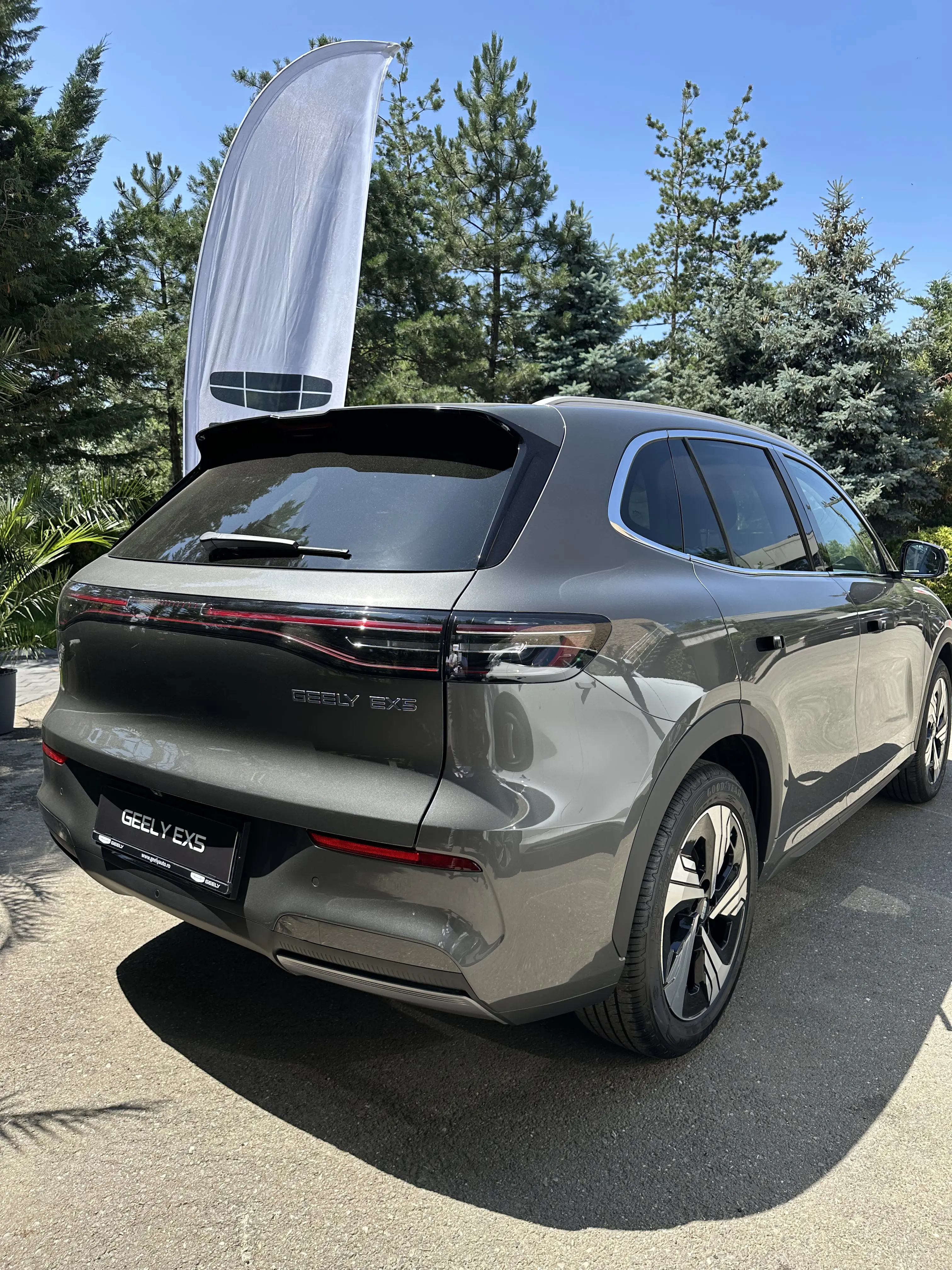
The Geely EX5 is one of the models that use the GEA architecture. The future Ford SUV will have its own design and calibration, if the platform information is confirmed. Photo: Geely.
Ford’s next European SUV could use a Geely platform. It will be built in Valencia
Ford’s next SUV for the European market could be built on the GEA architecture developed by Geely and produced at the Valencia plant in Spain. The model is expected in 2029 and would offer several types of electrified propulsion, not only a fully electric version.
The information about the platform comes from sources cited by the international motoring press and has not been officially confirmed by Ford or Geely. The two companies did, however, announce in July 2026 a joint venture that will manage shared production in Valencia and build cars of both brands.
Ford will hold 66% of the new company, and Geely 34%. Operations should start in the first half of 2027, after approvals are obtained, and the first new models are scheduled to leave the assembly line in 2028.
What is confirmed and what remains unofficial
The official Ford–Geely statement confirms the following:
- the establishment of a joint company for the Almussafes plant in Valencia;
- stakes of 66% for Ford and 34% for Geely;
- production of Ford and Geely cars intended for Europe;
- low- and zero-emission vehicles, offered with several propulsion solutions;
- the start of production of the new models in 2028;
- a potential plant capacity of about 500,000 cars a year.
Ford and Geely have spoken of five models: three Ford cars with multiple powertrains and two electric Geelys, according to the global statement. Some regional versions of the announcement mention two Ford models, so the number and timetable of each product should still be treated as provisional.
The GEA platform, the name of the future Ford SUV, its positioning versus the Kuga and the exact year of the commercial launch have not been officially confirmed. The information that the Ford model will arrive in 2029 is a press report, not a contractual deadline announced by the manufacturer.
The GEA platform can support electric, PHEV and range-extender layouts
GEA is the abbreviation of Global Intelligent New Energy Architecture. Geely designed the architecture for several car sizes and several electrified propulsion systems.
The platform can be configured for:
- fully electric cars;
- plug-in hybrids;
- electric systems with a combustion engine used as a range extender;
- front, rear or all-wheel drive, depending on the model.
The Geely Galaxy E5, sold on some international markets as the EX5, was the first production model based on GEA. Using the same technical family does not mean the future Ford will be an EX5 with a different badge. Ford can change dimensions, body, suspension, steering, software, safety systems and battery configuration.
The main advantage is lower cost and development time. Ford no longer has to fund an entirely new architecture alone for a single European model, and Geely can increase local production and access to the European supplier network.
The new SUV could take Kuga’s place
The Valencia plant currently builds the Ford Kuga, one of the few remaining Ford volume models in Europe. The future car based on Geely technology is described as a compact or family SUV, which places it in the same area of the market.
It is not clear whether it will be the Kuga’s direct successor, whether it will use a name from the Bronco family, or whether it will be sold in parallel with the current model. Ford has reduced the European range after withdrawing the Fiesta, Focus, Mondeo, S-Max and Galaxy, and an SUV with several powertrains could cover a large part of the lost volume.
An electric and plug-in hybrid range would allow adaptation to very different markets. In Norway or Denmark, the electric version could be the priority. In Italy, Spain, Central Europe and Romania, a PHEV or a range-extender system may attract buyers who do not have constant access to charging.
Why Ford is again using another manufacturer’s platform
Cooperation with Geely is not a first for Ford Europe. The current electric Ford Explorer and Capri use the Volkswagen Group’s MEB architecture and are produced in Cologne. Ford has also announced cooperation with Renault on two compact electric models due from 2028.
The strategy reduces the investment needed at a time when Ford volumes in Europe have fallen, and simultaneous development of electric and combustion platforms is expensive. The risk is losing part of the technical differentiation: if several brands use the same base, design, calibration and software become decisive.
Ford will have to show that the finished product keeps the characteristics its customers expect. A shared platform does not by itself determine the car’s behaviour, but it does limit certain choices of architecture, dimensions and battery integration.
What Geely gains from production in Spain
For Geely, the Valencia plant offers local production in an existing factory, skilled staff and access to a European supplier network. The two electric Geely models planned for the plant will be able to be sold as cars produced in Europe.
That matters in the context of the countervailing duties the EU applies to electric cars imported from China. A model assembled in Spain does not automatically fall under the same duties, although the origin of the battery and components remains relevant for cost and for future European rules on local content.
Geely already owns or controls brands with a European presence, including Volvo Cars, Polestar, Lotus and LEVC, and takes part in the Smart company alongside Mercedes-Benz. Production of Geely-badged models in Valencia would, however, be a different step: a direct entry into the European volume segment.
The Valencia plant is looking for a new role
The Almussafes plant opened in 1976 and over time produced models such as the Fiesta, Escort, Focus, Mondeo, S-Max and Galaxy. Today its activity depends largely on the Kuga, and the reduction of Ford’s range has left unused capacity.
The joint company aims to take the plant closer to its potential capacity of 500,000 units a year. The announcement does not guarantee that volume will be reached and does not specify how many cars each brand will produce.
Geely will invest €221 million for the 34% stake, according to documents communicated to the market and Spanish press reports. The transaction values the joint company at about €650 million.
What it means for buyers in Romania
For the Romanian market, a Ford produced in Spain on a Geely platform could bring an electrified SUV at a more competitive price than a model developed entirely by Ford. European production could simplify logistics, homologation and parts supply.
The decisive elements for the buyer remain unknown, however:
- price and launch date in Romania;
- battery capacity and WLTP range;
- the existence of a PHEV or range-extender version;
- charging power;
- battery warranty and service responsibility;
- the price and size relationship with the Ford Kuga.
Until Ford confirms the platform and specifications, the future SUV should be treated as a project reported by sources, not as a model with a final configuration. What is certain is that the industrial alliance exists and that Valencia will produce Ford and Geely cars from 2028.