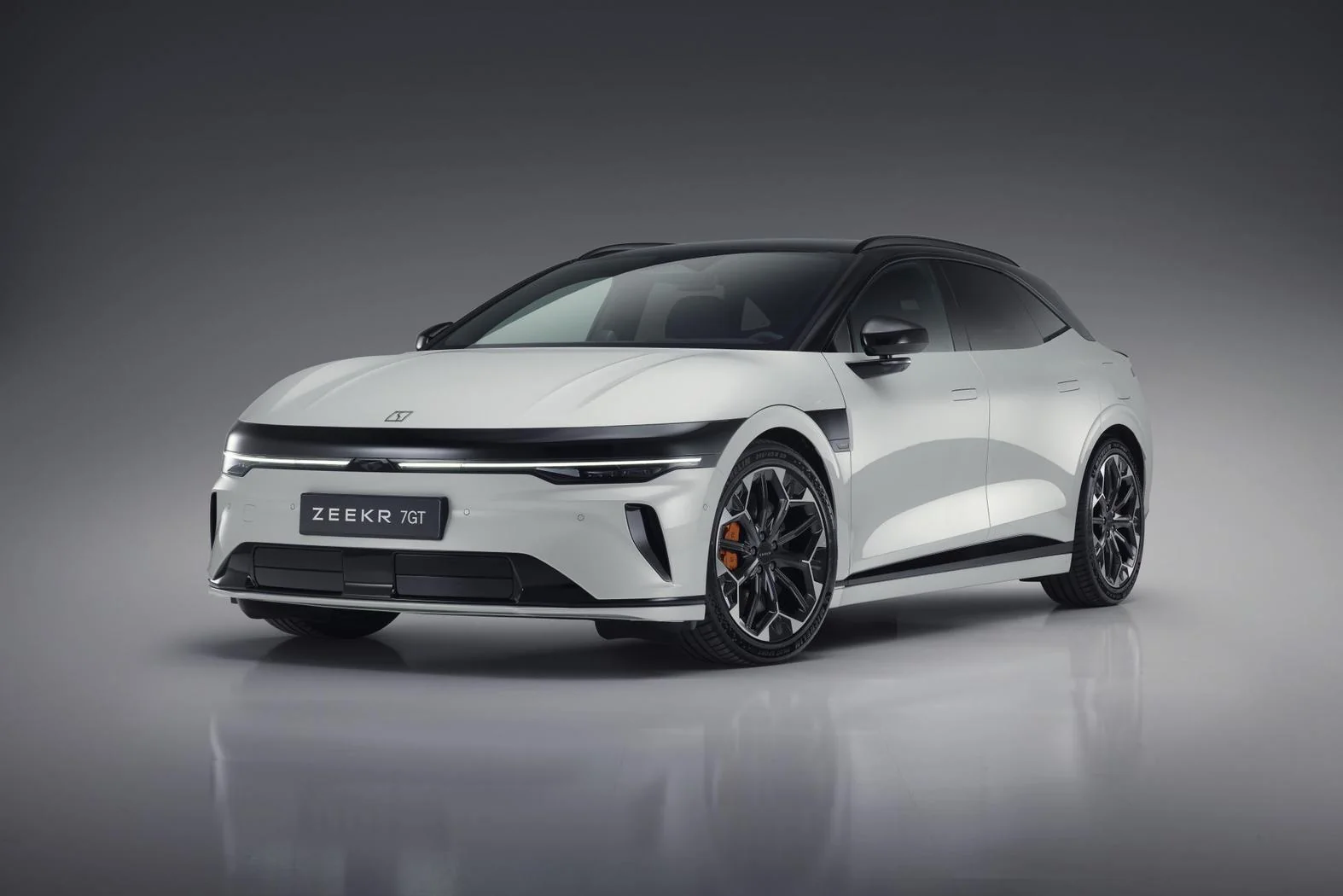
Zeekr 7GT. The range of up to 655 km on the European site is that of the current battery, not the solid-state one. Photo source: Zeekr
Geely: solid-state batteries in validation in 2026; brand pilot in 2027
Geely Holding wrote, in August 2026, on its LinkedIn page that battery operations had started real-world validation in 2026 and that a pilot across portfolio brands is planned for 2027. The text speaks of energy densities that reach 500 Wh/kg, of a range “comparable to diesel cars” and of charging “measured in minutes”.
It is not a commercial launch release. The holding has not published on geely.com a sheet with cell chemistry, the cell/pack distinction, models or a series-production date. It has not said either that a Volvo, a Zeekr or a Geely in a Romanian showroom will receive this battery in 2027.
What the holding said, and what it did not
The official wording is short: the technology is “coming soon to vehicles across the Geely Holding ecosystem”, validation started this year, and “pilot deployment across portfolio brands” is planned for 2027.
CarNewsChina, on 18 August 2026, treated the message as an official timetable and listed the ecosystem: Geely, Zeekr, Lynk & Co, Volvo, Polestar, Lotus, smart, Proton, Farizon. The list describes the group, not an assembly order. The holding did not name the first model.
On the same page, the publication writes that the top variant would reach 500 Wh/kg at pack level and that a car with this battery would pass 1,000 km on one charge, by analogy with diesel. Geely has not published a WLTP figure, a homologation cycle or an independently measured prototype. 500 Wh/kg is not specified in the post as cell or pack density.
On LinkedIn, Bo Tong, technical account lead at Dow, wrote that Dow is a partner in materials development. CarNewsChina attributes to it an adhesive for solid-state cells stable between −40 °C and 120 °C. That is a supply-chain part, not a battery homologation.
What the CTO said in February: 1,000 cars, not series
In February 2026, Shen Yuan, senior vice-president and CTO of Geely Holdings, gave a more granular timetable, taken by CarNewsChina from Cailian Press:
- 2026: vehicle prototypes;
- 2027: small-scale industrialisation, with 1,000 demonstration cars in circulation;
- 2030: industrial architecture and mass production on top models, with cell density expected above 500 Wh/kg.
The same Shen Yuan said solid-state batteries still have materials-science and interface-contact problems, plus engineering difficulties (electrolyte thickness, slurry sedimentation, short circuits under pressing). The August timetable fits “prototype 2026 / demonstration 2027”. The target of 500 Wh/kg at cell level in 2030 is not identical to “reaching 500 Wh/kg” in the current post. The two figures must be kept separate until Geely publishes a measurement.
One million kilometres: that is the current LFP battery, not solid-state
The figure of one million kilometres circulates alongside the August announcement. In the Geely Auto release of 27 June 2024, it belongs to the Short Blade lithium iron phosphate battery with liquid electrolyte: 3,500 cycles, equated by the manufacturer with 1 million kilometres. It is not a durability result published for the solid-state cell.
CarNewsChina puts Golden Brick / liquid cell density around 250 Wh/kg. The August post does not repeat the millions of kilometres. Until a cycle test for SSB, lifespan remains a target, not a measurement.
What it means for a buyer in Romania
In Romania the group is already visible. Volvo Cars sells the EX30 from €38,470; Long Range is homologated up to 475 km WLTP. Zeekr, through importer SEEAG, opened orders from October 2025 for the 7X, 001 and X; on zeekr.eu, the 7GT is listed with up to 655 km and from €45,990. Geely sells SUVs such as the Starray locally.
None of these sheets mentions a solid-state battery. The ranges above are those of the current chemistry. A 2027 pilot, if it starts, may mean test fleets, prototypes or a small volume on one group brand. It is not a buying argument for an EX30, a 7GT or a Starray ordered now.
On the used market, checking the battery remains about the state of the pack fitted, not a roadmap.
2027 is also others’ year. It is not mass production
CarNewsChina notes that CATL and BYD have also spoken of pilot production in 2027. CATL chairman Robin Zeng placed the group’s technology at level 4 of 9 on the TRL scale; scientist Wu Kai spoke of a TRL target of 7 or 8. That is advanced laboratory and prototype, not a million-car line.
Toyota keeps a separate 2027–2028 timetable for solid-state batteries on electrics, distinct from the new batteries for hybrids.
Geely Holding has not given a price, a series year or a launch market. Until then, the figure that counts on a Volvo, Zeekr or Geely listing remains the range on the homologated sheet, not the diesel analogy.
Frequently asked questions
Will Geely solid-state batteries be sold in 2027?
Not as an announced series product. The holding speaks of validation in 2026 and a pilot in 2027. The CTO spoke in February of 1,000 demonstration cars.
Is 500 Wh/kg measured at cell or pack?
Geely Holding has not specified. CarNewsChina reads 500 Wh/kg as pack. Shen Yuan put above 500 Wh/kg at cell as a 2030 horizon.
Does range pass 1,000 km?
It is the holding’s analogy with diesel, not a WLTP value. The Zeekr 7GT is listed in Europe with up to 655 km. Volvo EX30 Long Range, up to 475 km.
Does the battery last a million kilometres?
The figure published by Geely Auto in 2024 is for Short Blade LFP, 3,500 cycles. It is not a published test for the solid-state cell.
Does the technology reach a Volvo or Zeekr in Romania?
The holding has not named markets. Models sold here have the batteries on the current sheets.
Sources
- Geely Holding — LinkedIn post, solid-state batteries, 2026 validation, 2027 pilot
- CarNewsChina — 18 August 2026, Geely Holding timetable and 500 Wh/kg
- CarNewsChina — 12 February 2026, Shen Yuan / Cailian Press: 1,000 cars in 2027, 500 Wh/kg at cell in 2030
- Geely Auto — 27 June 2024, Short Blade LFP, 3,500 cycles / 1 million km
- Zeekr — SEEAG, Romania launch
- Zeekr Europe — 7GT, up to 655 km, from €45,990
- Volvo Cars Romania — EX30, up to 475 km WLTP, from €38,470