General Motors has filed a US safety recall covering 67,380 electric vehicles because brake control software can temporarily interrupt braking during a particular low-speed manoeuvre. The affected population spans certain Chevrolet Blazer EVs and Cadillac Lyriq, Vistiq and Celestiq models. GM's proposed correction changes the software's wheel-slip calculation, with an over-the-air route for eligible vehicles and a dealer alternative.
The filing, submitted to the National Highway Traffic Safety Administration on 29 October 2026, is campaign 26V717. GM identifies the same action as N262570900. Those references matter for owners checking service records: this is a new campaign that also includes some vehicles associated with an earlier Lyriq braking recall.
A tight turn and an uneven driveway can trigger the fault
GM reproduced the problem during preliminary testing. Its description brings together light brake application, low vehicle speed, a sharp turn and a bump or depression. The end of a driveway is the manufacturer's example of the kind of surface change involved. A momentary brake release and reapplication can then cause the software to misinterpret wheel movement when calculating slip.
In some instances, that sequence results in a temporary loss of braking. According to GM, normal operation returns on the next brake application. The consequence recorded in the safety report is an increased crash risk at low speeds. The document does not give an interruption time, an additional stopping distance or a numerical speed threshold, so none should be inferred from the phrase low speed.
This is a software fault in the brake system control module, or BSCM. The recall report identifies the corrected slip calculation as the difference between the replacement software and the recalled version. It does not describe a programme to replace every vehicle's discs, brake pads or hydraulic hardware. Owners should use the campaign instructions for their vehicle rather than attempting to reproduce the manoeuvre themselves.
Which versions are included
The model-year ranges are 2023–2027 for the Cadillac Lyriq, 2024–2027 for the Chevrolet Blazer EV, 2025–2026 for the Cadillac Celestiq and 2026–2027 for the Cadillac Vistiq. These are model years, not dates of first registration. GM used manufacturing information to identify vehicles carrying the suspect software.
For the Lyriq and Blazer EV, the population descriptions specifically restrict coverage to Performance All-Wheel Drive, abbreviated pAWD and identified by RPO code X0E. Other drive configurations of those two models are outside this campaign. On the Blazer EV, GM says the relevant configuration is available only in SS and PPV trims; PPV denotes the police vehicle version.
Adding the report's year-by-year figures produces 44,585 Lyriqs, 18,802 Vistiqs, 3,911 Blazer EVs and 82 Celestiqs. The largest individual group is the 2024 model-year Lyriq, with 22,819 vehicles. Vistiq contributes 13,627 vehicles from model year 2026 and another 5,175 from 2027. The two Celestiq entries contain 51 vehicles from 2025 and 31 from 2026.
GM estimates that the software defect exists in 100% of the recalled population. That estimate concerns the presence of the defect, rather than a prediction that every owner will experience brake loss. The 67,380 total is not a count of failures or crashes, and a familiar badge alone cannot establish whether a particular vehicle is included.
An earlier update did not address this sequence
A GM technical expert raised the issue through the company's Speak Up for Safety programme on 10 April 2026 after reviewing a 2024 Lyriq that had struck a garage at low speed. The circumstances resembled those behind recall 24V589. However, the vehicle had been built with the software improvements used to remedy that earlier action.
After reproducing the behaviour, GM confirmed that certain pAWD implementations could encounter a set of conditions outside the earlier remedy's coverage. A new product investigation opened on 18 August 2026. GM's Safety Field Action Decision Authority approved a recall on 22 October, followed by the regulatory submission a week later.
The company's review of legal records, TREAD reporting and NHTSA owner questionnaires identified 24 field complaints potentially connected with the condition. GM received them between 28 February 2024 and 11 June 2026. They include 20 minor accidents, two involving allegations of minor injuries. Those qualifications are part of the filing: the report does not present every complaint as an independently established causal finding.
Vehicles covered by 24V589 that have pAWD are also included in the new recall. GM says the latest BSCM update addresses both conditions and allows the earlier campaign to be closed for those vehicles. A service invoice recording an older brake software update therefore does not, by itself, establish completion of N262570900.
What the remedy schedule actually means
GM plans to update the BSCM software. Owners of vehicles capable of receiving the change wirelessly, and who have accepted the applicable terms, can accept an OTA installation without visiting a dealership. All owners have the dealer route available under the remedy programme. NHTSA's consumer guidance explains that safety recall repairs are provided without charge at the manufacturer's dealership.
The filing schedules dealer notification for 29 October 2026 and estimates that owner notification will begin on 14 December. It lists 29 October as the date VINs become searchable. These dates describe notification and identification; they are not evidence that a particular vehicle has already received the correction. Owners need confirmation of remedy availability and completion against their own VIN.
GM also records production corrections: the 2027 Celestiq programme received revised software, with Blazer EV changes dated 8 August 2026, Lyriq changes 7 September and Vistiq changes 21 October. Those production measures do not automatically update vehicles already delivered. For a US-market vehicle now overseas, check the American recall record and ask GM how the campaign can be completed in its present location; the US filing does not establish an identical European recall population or local service arrangements.
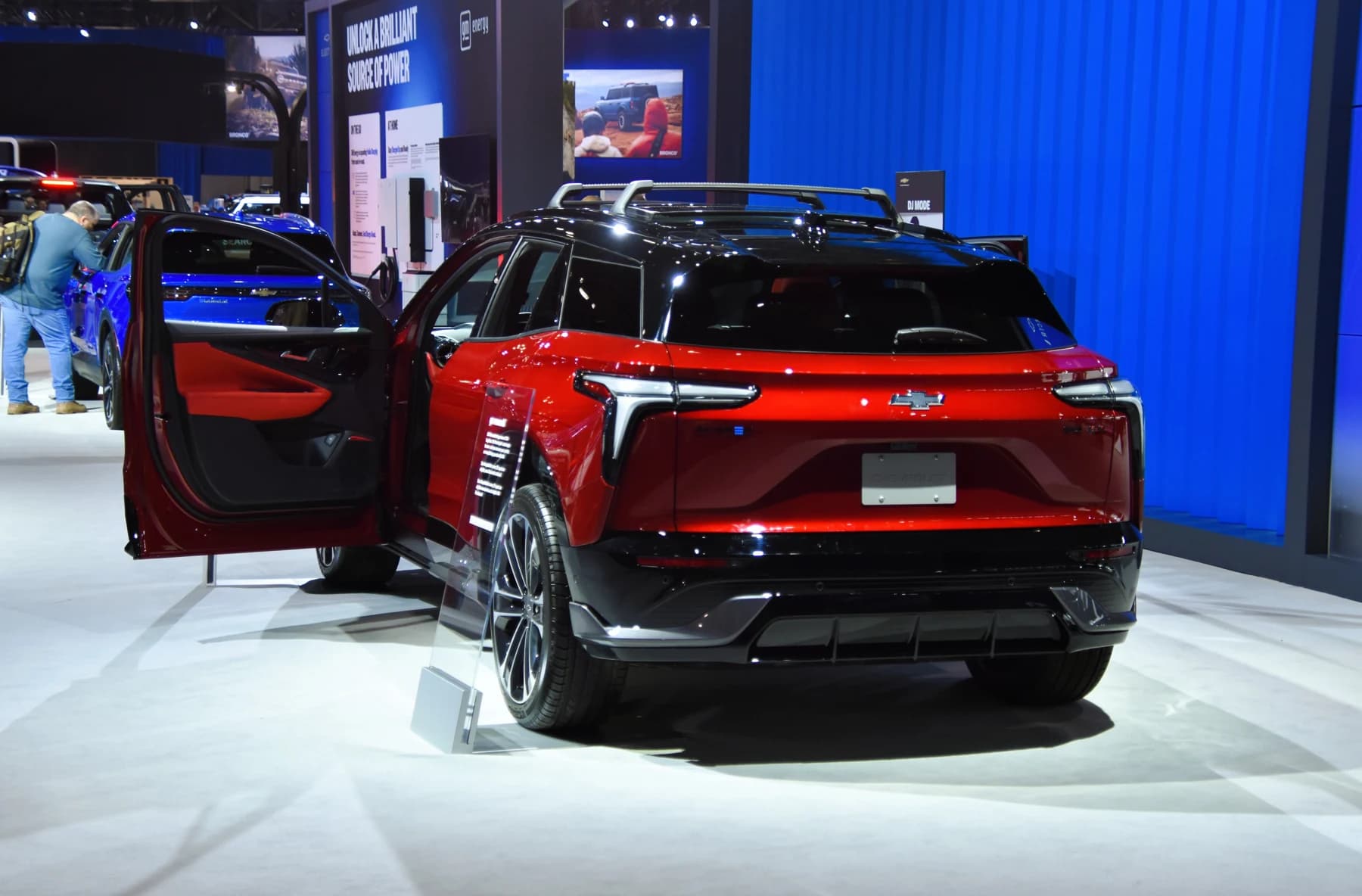
Photo: Charles via Wikimedia Commons, CC0 1.0. Blazer EV SS at a motor show, used for illustration; the pictured vehicle is not established as recalled or involved in an incident. Resized and converted to WebP.