
Honda has developed the underlying technology for a road that can transfer electricity to an electric vehicle while it is moving. The project is being developed with Taisei Corporation and Taisei Rotec Corporation. Honda says the first practical target is not private passenger cars, but logistics and commercial vehicles that spend long periods on the road and cannot easily absorb lengthy charging stops.
A road, a vehicle and a magnetic field
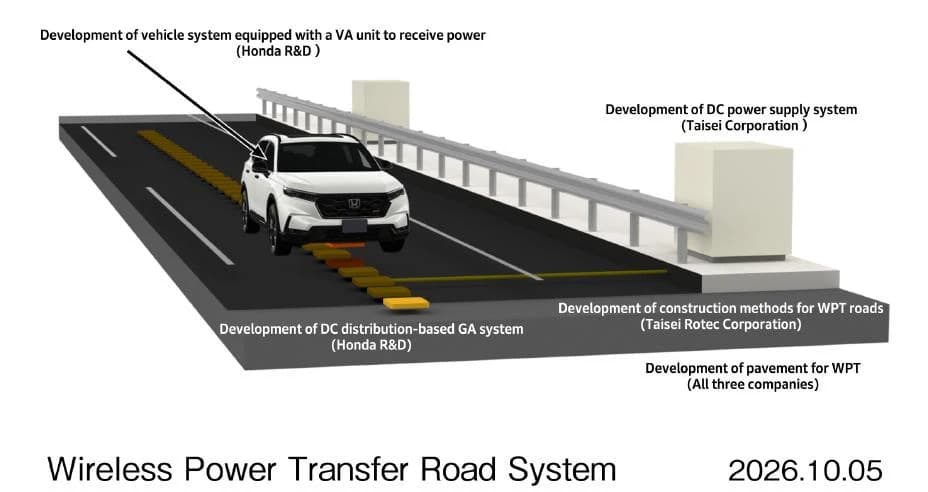
The system uses Ground Assembly, or GA, units embedded in the pavement and a Vehicle Assembly, or VA, receiver fitted to the vehicle. Electricity is transferred without physical contact through magnetic coupling between coils on the road and the vehicle. The road provides power as the vehicle passes over the embedded units, while the receiver converts the transferred energy into electricity for the vehicle system.
Honda has been working on dynamic wireless power transfer since 2021. Its joint research with Taisei and Taisei Rotec on this magnetic-coupling road system began in 2025. The announcement issued on October 6, 2026 describes a technical foundation and a programme of future tests. It does not announce a commercial charging lane that drivers can use today.
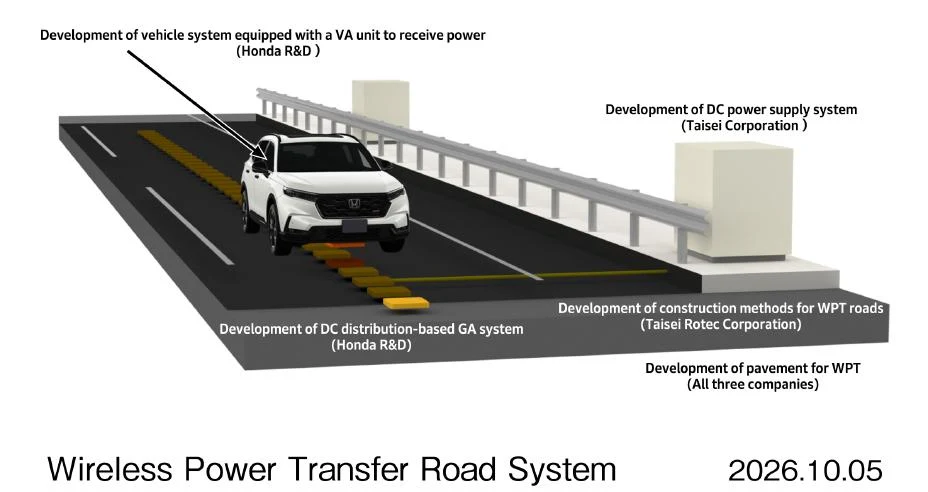
Official Honda image: the road-side GA units, DC power supply and vehicle-side receiver form one system.
The installation problem matters as much as the charging hardware
Wireless charging on a public road has to survive traffic, weather and road maintenance. Honda and Taisei Rotec are developing GA units that can be embedded by milling the existing pavement. The aim is to make the units suitable for new pavement and for renewal work on roads already in service.
The design combines the inverter and coil in each GA unit. Electricity is distributed to the embedded system as direct current, and each unit handles its local conversion. Honda says that this can simplify the wiring between the power source and the road units, reduce the number of components and make installation and future replacement easier. Those are engineering targets, not a published cost or maintenance result. The amount of road that would need to be equipped, and the effect on construction budgets, remain open questions.
Taisei Corporation is responsible for a high-response DC power-supply system. Taisei Rotec is developing the construction methods for placing the equipment in pavement. Honda is working on the vehicle receiver, the road-side wireless transfer system and the vehicle-side architecture. The partnership is therefore testing infrastructure as well as vehicle technology.
What the late-2026 tests will measure
From late 2026, the partners plan to construct a test roadway at Taisei Group's Future Technology Field/TAMURA site. The programme includes a durability evaluation equivalent to one million wheel loads. The stated basis is a 49-kilonewton load per wheel, applied with actual vehicles. The test is intended to check whether the embedded GA units and the surrounding pavement can withstand repeated loading from heavy commercial traffic.
The same phase will examine wireless power-transfer performance and electromagnetic-field leakage. A system that puts high power into a moving vehicle must be assessed not only as an electrical device, but also as part of a road that people and vehicles occupy. Honda has not yet published a final operating specification, efficiency figure or public-road safety result from this programme.
The next development stage is expected to verify output levels of up to 150 kW for potential large-commercial-vehicle use. Engineers will also examine whether the system remains reliable when vehicles travel at higher speeds. The practical result will depend on the spacing of the GA units, the vehicle's alignment over them, the available grid connection and the length of equipped road.
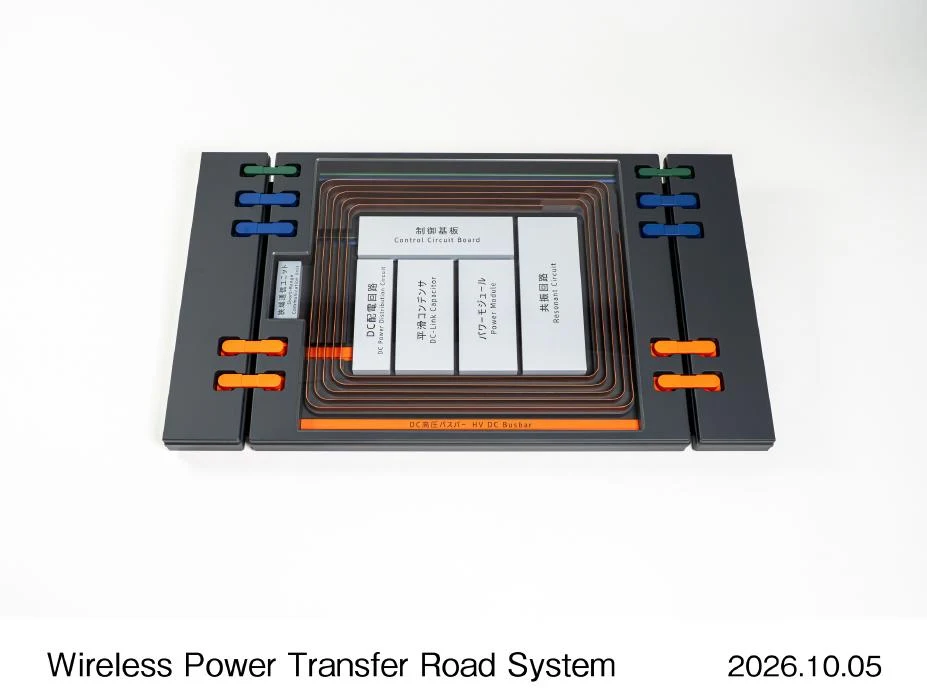
Official Honda image: a prototype GA unit for the wireless power-transfer road system.
Why Honda is starting with trucks
Electric trucks face a different operating pattern from most passenger cars. A fleet operator may need a vehicle to run for much of the day, while a very large battery adds mass and requires more time to recharge. In-motion power transfer could reduce the need for long stationary charging sessions on routes that include equipped sections.
That benefit is conditional. A charging road only helps where the vehicle actually drives over it, and the infrastructure must be available at a useful power level. The road also needs payment, access, repair and inspection arrangements if it becomes a public service. Honda's announcement does not give a commercial price, a final business model or a timetable for a wider rollout.
Honda also presents dynamic wireless charging as one part of its work toward carbon neutrality by 2050. Renewable electricity could be connected to the road-side supply, but the company has not published a specific energy mix for the planned trials. Emissions cannot be assessed from the charging hardware alone; electricity generation, construction, maintenance and utilisation would also matter.
A planned public-road demonstration in Japan
The three companies intend to take part in the Tateyama Project, a demonstration led by East Nippon Expressway Company, or NEXCO East. Public-road testing is planned from Japan's fiscal 2027, which begins on April 1, 2027, on the Tateyama Expressway in Chiba. The release does not yet define the final test schedule, the participating vehicles or the operating rules for the road section.
For now, Honda is describing a technology under validation rather than a new charging service. The next milestones are structural durability, electromagnetic safety, power-transfer performance and operation at speed. Only after those questions are answered will it be possible to judge whether dynamic wireless charging is practical for fleets, passenger cars or a larger road network.


