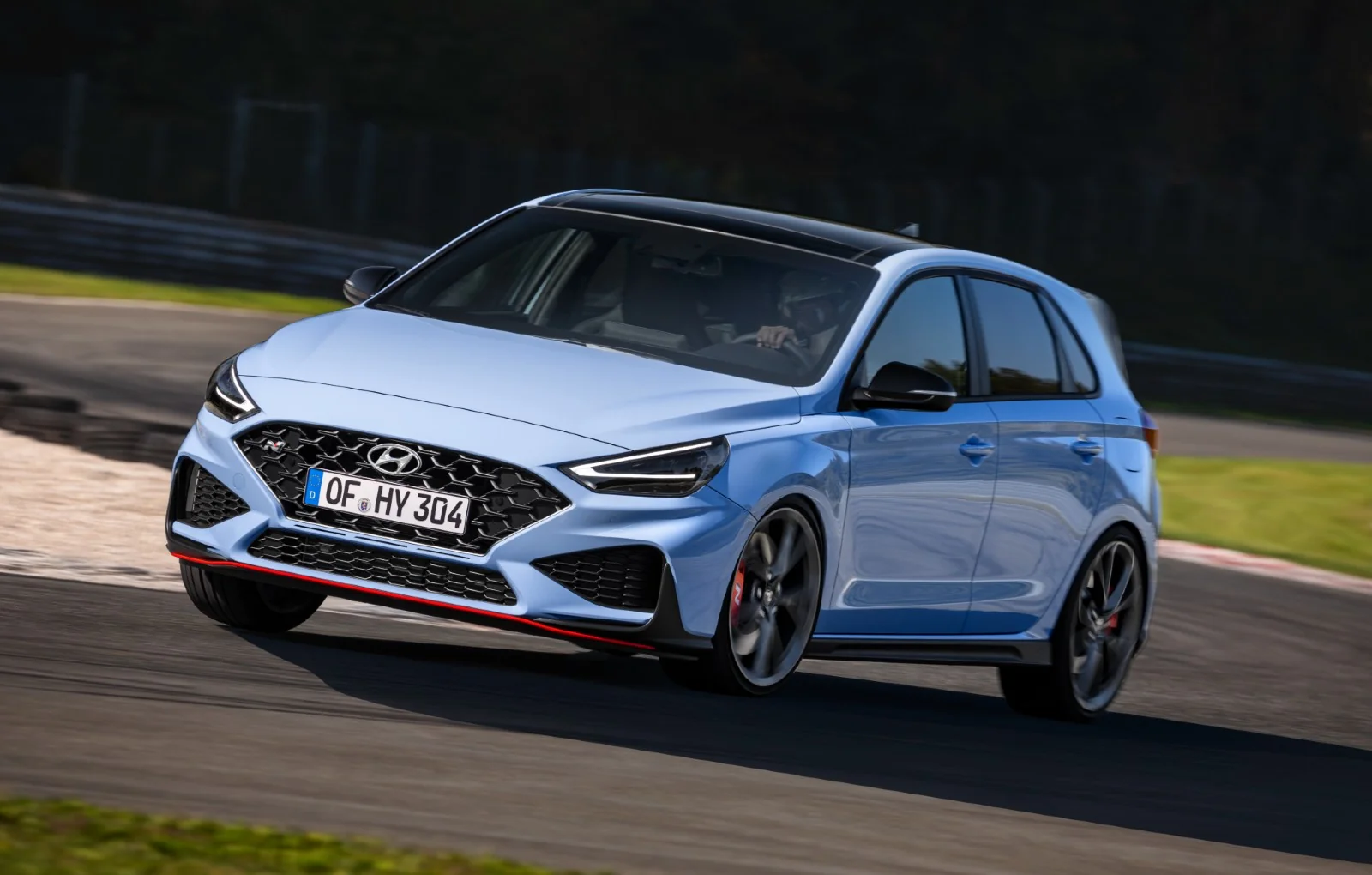
Hyundai i30 N represents the division's current generation of combustion models. Illustrative image
Hyundai N will have at least seven models by 2030
Hyundai wants to expand the N performance range to at least seven models by 2030 and is targeting global sales of more than 100,000 cars a year. The plan will combine electric cars, hybrids and combustion-engine models, without the division giving up the hot hatches that built its reputation in Europe.
The target was published by Hyundai at CEO Investor Day. The manufacturer confirms the size of the future range, but has not officially announced the names of all seven cars. Some of the models associated with the plan come from information Auto Express obtained from the investor presentation and remain unconfirmed individually.
This distinction matters: Hyundai promises a range of at least seven models, not seven named launches already scheduled for Europe.
From five models to a more diverse range
In Hyundai documents from 2025, the N range was described through five models: IONIQ 5 N, IONIQ 6 N, Elantra N, i20 N and i30 N. Their availability differs from region to region, however, and some combustion models have been withdrawn temporarily from certain European markets because of emissions rules.
For 2030, Hyundai is also preparing models that have no direct counterpart in the current range. Auto Express reports that the plan groups projects into four types of architecture and includes models with front-wheel drive, rear-wheel drive, all-wheel drive and electric propulsion.
The manufacturer thus wants to cover both the accessible hot-hatch segment and larger, more expensive cars. In parallel, Hyundai is preparing an intermediate category of sporty versions, positioned between current N Line trims and full N models.
A new hybrid i20 N is in the plan
Auto Express indicates a new-generation i20 N as one of the front-wheel-drive projects. The B-segment hot hatch would keep a combustion engine, but would also use some form of electrification to meet European rules.
Hyundai has not communicated displacement, power or the type of hybrid system. It is not clear whether the car will use a conventional hybrid, a 48 V system or a different solution.
The current i20 N has been praised for its low mass and 1.6-litre turbo engine, but the successor cannot simply replicate the same formula. Electrification adds components and mass, and engineers must preserve the steering response, braking and agility that define a small hot hatch.
A compact SUV could continue the Kona N idea
The second direction is a compact performance SUV with front-wheel drive, described as a conceptual successor to the Kona N. The model does not yet have an official name, and Hyundai has not specified the platform or launch market.
The old Kona N used the 2.0-litre turbo engine and dual-clutch automatic from the i30 N, but sent power only to the front wheels. The new project is expected to include electrification, which can change both performance and price positioning.
Auto Express also includes a possible C-segment N model based on the future Elantra, known in South Korea as Avante. The publication estimates that the saloon could take the role left open by the i30 N, as the current European i30 approaches the end of its life cycle.
An Elantra N return to Europe is not confirmed, however. The saloon body and its dimensions place it in a different zone from the i30 N hatchback familiar to European buyers.
Hyundai is analysing a rear-wheel-drive model
The biggest change would be the arrival of an N car with a front-mounted engine and rear-wheel drive. The final form is not established publicly, but Auto Express considers a four-door saloon or fastback likely.
Propulsion would combine a combustion engine with Hyundai hybrid technology. There could also be an all-wheel-drive version, configured so that the rear axle plays the main role in dynamic behaviour.
The timetable, platform and power are unknown. The British publication estimates that the project could use components or solutions associated with future Genesis models, but Hyundai has not confirmed that link.
Nor should the N Vision 74 concept be automatically confused with the future model. The two-door concept demonstrated electric propulsion fed by a hydrogen fuel cell, while the project now described would use a hybrid system with a combustion engine.
IONIQ 3 N and Tucson N are still estimates
For the electric side of the range, the most plausible candidate is the IONIQ 3 N. The compact IONIQ 3 has entered the European range, and a performance version would allow the N division to offer a smaller, more accessible car than the IONIQ 5 N.
Hyundai has not officially announced an IONIQ 3 N and has not published data on motors, battery or launch. The existence of the IONIQ 5 N and IONIQ 6 N shows, however, that the brand already has the software components and experience needed for a third N electric.
The last name circulating is the Tucson N. Such an SUV would occupy a class above the former Kona N and would have greater commercial potential, but Auto Express presents the project as a possibility, not a confirmed model.
The list of seven should therefore be treated as an indicative map:
- a new-generation i20 N;
- a compact performance SUV;
- a C-segment model associated with Elantra/Avante;
- a rear-wheel-drive hybrid;
- a possible all-wheel-drive version of the higher project;
- a possible electric IONIQ 3 N;
- a possible Tucson N.
The composition can change before 2030, and Hyundai has not publicly assigned a timetable to each position.
A new step between N Line and N
Hyundai is also preparing a family described as “everyday high performance”. It would sit between N Line packages, focused mainly on design and mildly sporty tuning, and N models developed for sustained performance including on track.
The intermediate versions could use engines already available on higher trims of production models, together with revised suspension, brakes and transmission responses. The strategy resembles Volkswagen GTI positioning below R versions, or the BMW M Performance range below full M models.
Hyundai has not announced the commercial name of this family, nor the first models that will receive it. Its introduction would allow volume to grow without applying the full N badge to cars that do not meet the division's technical criteria.
What the plan means for Romania
The Romanian market has previously received the i20 N and i30 N, and Hyundai has announced the return of the i30 N with a petrol engine. The global 2030 target does not, however, guarantee that all seven models will be sold locally.
For Romania, the most relevant projects would be the i20 N successor, a possible IONIQ 3 N electric and a compact performance SUV. Availability will depend on European type approval, emissions rules, production capacity and price.
For hybrid models, the important data will be mass, system power, how the electric motor intervenes and the ability to sustain repeated performance. For the electrics, battery cooling, charging speed, real-world range and claimed acceleration will matter.
Frequently asked questions
How many models will Hyundai N have in 2030?
Hyundai announces a range of at least seven models by 2030 and a target of more than 100,000 annual sales.
Are all seven names confirmed?
No. The manufacturer confirms the size of the range, but has not published the full list. IONIQ 3 N and Tucson N are among the models estimated by the British press.
Will Hyundai still produce N models with combustion engines?
Yes. The plan includes electrified combustion projects, alongside fully electric cars.
Will there be a new Hyundai i20 N?
Auto Express reports that a new-generation i20 N is included in the plan and will use electrification. Specifications and launch date are not yet public.
Will all N models reach Romania?
There is no such confirmation. The range and timetable will vary by region.