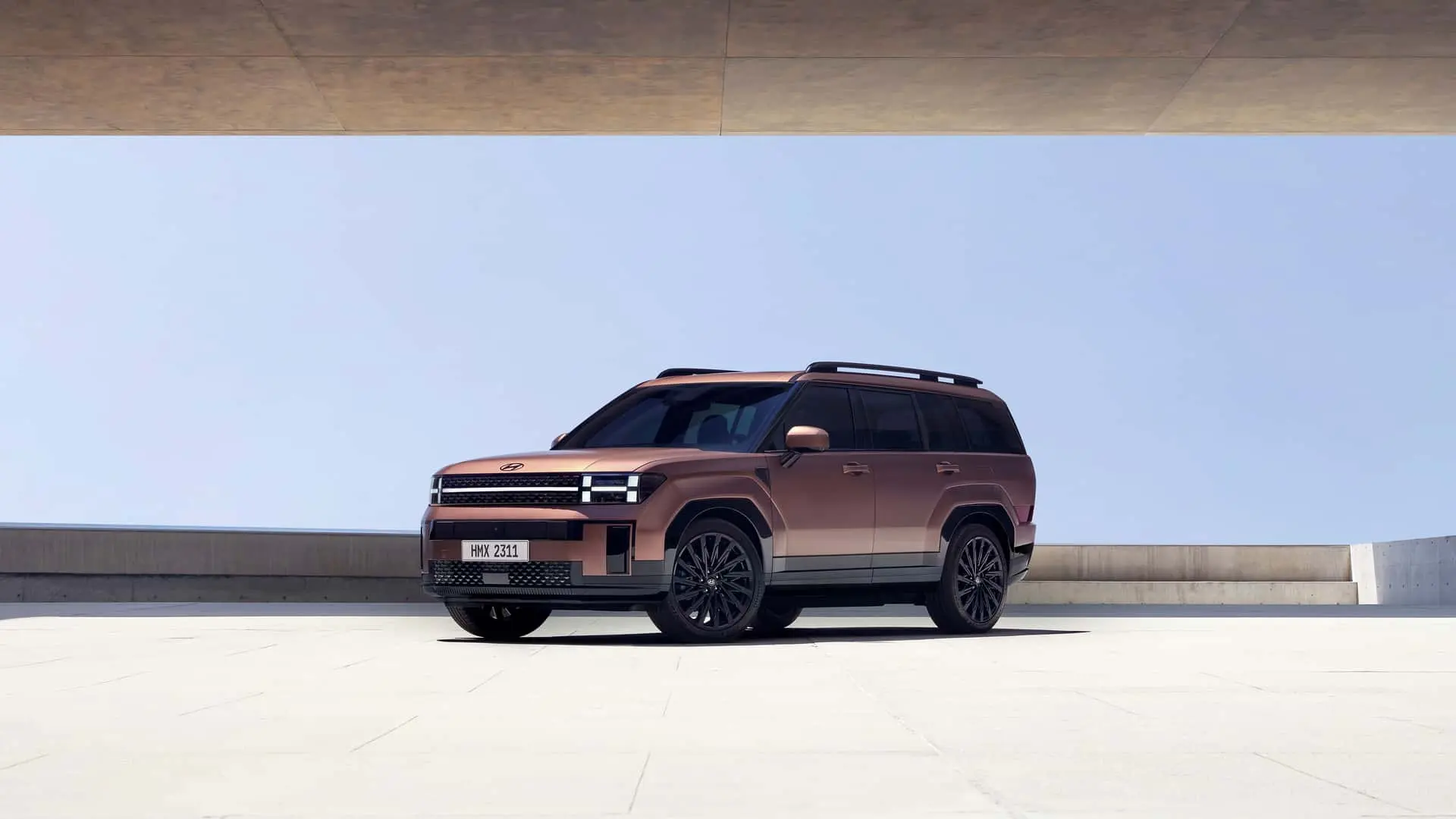
The current Hyundai Santa Fe generation. The forthcoming EREV version has not yet been shown in official images
Hyundai Santa Fe and a Genesis SUV will get EREV systems in 2027
Hyundai will launch a Santa Fe EREV in the first half of 2027, with total range estimated at more than 965 km. Genesis, the group's premium brand, is preparing its own extended-range SUV for early 2027 and is targeting more than 1,030 km between stops.
Both models use the same basic idea: the wheels are driven electrically, and the combustion engine generates energy when the battery can no longer sustain the journey on its own. The intended result is the linear behaviour of an electric car, without exclusive dependence on charging stations on long trips.
Hyundai confirmed the plans at CEO Investor Day 2026. The company has not yet published prices, exact battery capacity, fuel consumption or complete engine specifications.
Santa Fe will be Hyundai's first EREV
The first model named by the manufacturer is the Hyundai Santa Fe EREV. Launch is scheduled for the first half of 2027, and the announced total range exceeds 600 miles, equivalent to about 965 km.
That figure does not describe the distance covered solely with energy stored in the battery. It is the combined range obtained when the battery is charged and the generator engine's tank is filled. Hyundai has not yet communicated separately measured electric range.
The manufacturer says the battery will have less than half the capacity of a pack used by a comparable electric car. Reducing battery size should cut cost and mass, while the combustion engine takes on the generator role on longer trips.
Santa Fe is a logical choice for the technology's debut. The large SUV is often used for long journeys, towing and family transport, situations in which charging time and available infrastructure matter more.
Genesis is preparing an SUV with more than 1,030 km of range
Genesis will add an EREV SUV to its range in early 2027. The company is targeting more than 640 miles, or about 1,030 km of total range.
The model name has not been announced. Hyundai Motor Group speaks only of a Genesis SUV and does not confirm whether the system will be offered on the GV80, the future GV90 or a different model. Any association with one of those names remains, for now, a guess.
Genesis is also due to introduce its first conventional hybrid, the GV80 Hybrid, before the EREV version. The strategy shows that the brand is no longer relying solely on a choice between combustion engines and fully electric cars, but is adding several intermediate electrification steps.
For the EREV model, the group has not communicated power, battery capacity or the size of the generator engine. Price and exact launch markets are also unknown.
How an EREV works
EREV stands for Extended-Range Electric Vehicle. In the architecture described by Hyundai, propulsion is provided by electric motors, and the internal combustion engine is used to generate electricity.
The energy flow can be summarised as follows:
- the car starts and runs using energy from the battery charged at a socket;
- the electric motors deliver torque to the wheels;
- when battery level falls, the combustion engine starts and drives a generator;
- the energy produced feeds the electrical system and allows the journey to continue;
- the driver can refuel quickly, then recharge the battery at a socket when infrastructure is available.
Hyundai had previously announced a configuration with two electric motors and all-wheel drive. The company aims to keep the immediate response and running character of an EV even when the thermal generator is operating.
EREV versus PHEV: the important difference
Both an EREV and a plug-in hybrid have a socket-chargeable battery and a combustion engine. The difference is the role given to the internal combustion engine.
In a conventional PHEV, the combustion engine can drive the wheels directly, alone or together with the electric motor. In the EREV system announced by Hyundai, propulsion at the wheels remains electric, and the combustion engine is used as a generator.
That separation can offer behaviour closer to an electric car, without the gear changes and response variations associated with connecting the combustion engine to the wheels. Converting fuel into electricity and then into motion nevertheless involves losses. An EREV used permanently with a depleted battery does not automatically become more efficient than any conventional hybrid.
The practical advantage appears when the owner charges regularly and covers daily trips electrically, keeping the generator for routes that exceed battery range.
A smaller battery, but not without trade-offs
Hyundai says future EREVs will use less than half the battery capacity of a comparable EV. In the plan presented in 2025, the company spoke of a reduction of about 55%.
A smaller battery requires fewer materials and can reduce price compared with a long-range electric SUV. The car still retains two energy systems: the battery and electric motors, plus the combustion engine, tank, exhaust and auxiliary systems.
That means extra complexity versus a fully electric car. There will still be servicing for the combustion engine, refuelling and emissions when the generator is running.
Range of more than 965 or 1,030 km is attractive, but it does not by itself say how economical the car will be. A real assessment will require electric range, consumption with a depleted battery, charging speed and the final price.
Will these models reach Romania?
Hyundai's first plans for EREV technology indicated production in North America and China, with Hyundai and Genesis SUVs initially oriented toward the North American market. The 2026 announcement confirms the models and timetable, but does not offer a separate launch for Europe.
Therefore, the Santa Fe EREV and the Genesis EREV SUV are not yet confirmed for Romania. Hyundai Santa Fe is sold locally in hybrid and plug-in hybrid versions, but that does not guarantee import of the extended-range configuration.
For Europe, emissions rules, type approval, price and the group's regional strategy will matter. Any eventual offer in Romania can be assessed only after WLTP electric range and official consumption with a depleted battery are published.
Frequently asked questions
When does the Hyundai Santa Fe EREV arrive?
Hyundai is scheduling the launch for the first half of 2027.
What range will it have?
The manufacturer estimates more than 965 km of total range. The figure includes energy from the battery and fuel used by the generator.
Which Genesis model will receive the EREV system?
Genesis has confirmed an SUV, but has not yet communicated its name. The target is total range of more than 1,030 km.
Can an EREV be charged at a socket?
Yes. The battery is externally chargeable, and the combustion engine extends range by generating electricity.
Does the combustion engine drive the wheels directly?
In the system described by Hyundai, the wheels are driven electrically, and the combustion engine acts as a generator.
Will the Santa Fe EREV be sold in Romania?
There is not yet confirmation for the Romanian market or for Europe.