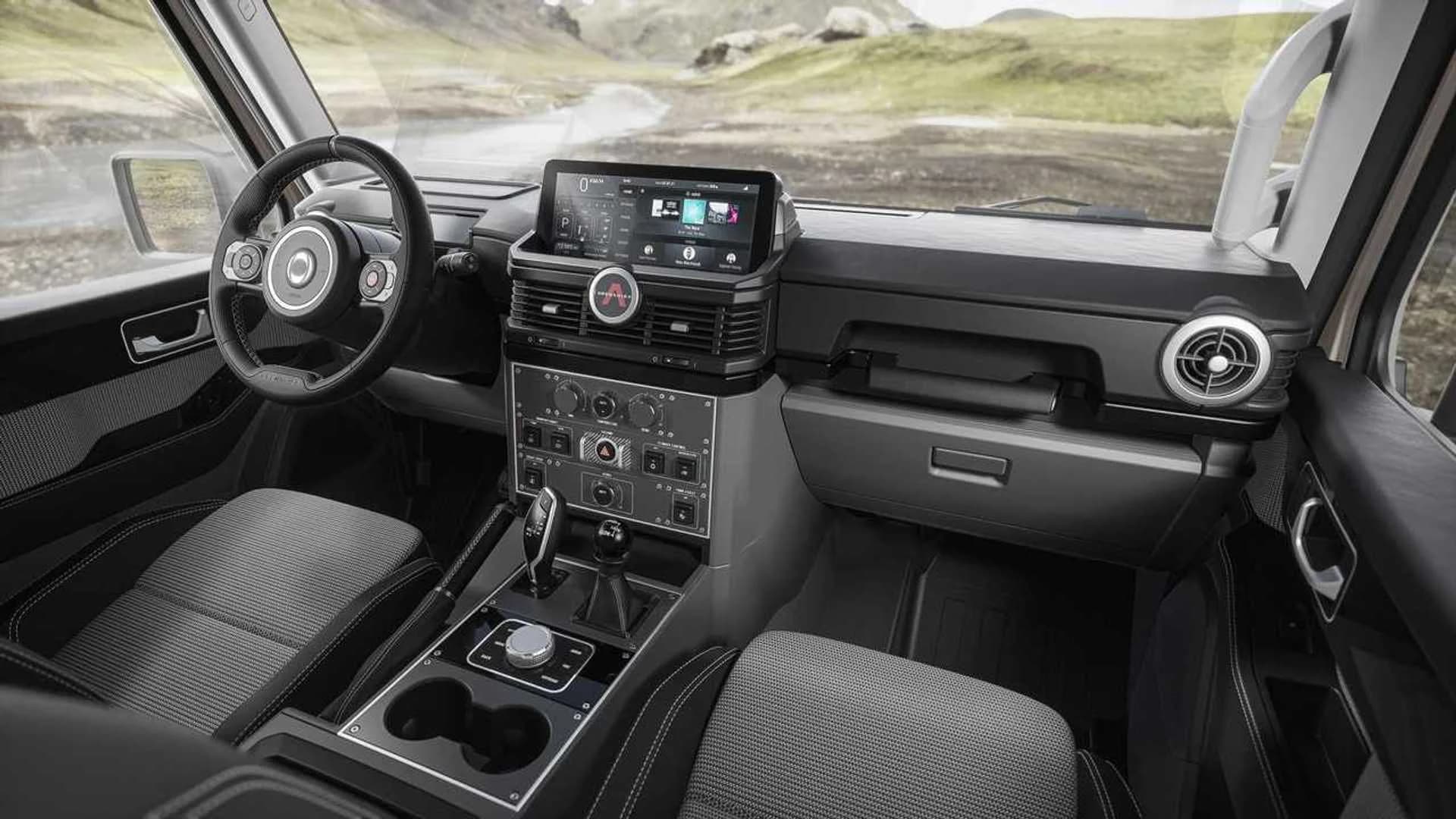
The Grenadier uses a separate chassis and rigid axles, a suitable base for professional and military conversions. Photo: INEOS Automotive.
INEOS Grenadier gets an armoured version for the British Army
INEOS has turned the Grenadier into an armoured military vehicle, prepared to enter evaluations organised by the UK Ministry of Defence. The prototype is called the Enhanced Protection Vehicle, abbreviated EPV, and is part of the Multi-Role Light Vehicle family developed by the Team Grenadier consortium.
The distinction between presenting a candidate and awarding a contract matters. The Grenadier EPV has not been chosen as the British Army’s future vehicle. The team is preparing it for tests in the Light Mobility Vehicle programme, which is expected to start at the earliest on 19 October 2026.
Armoured cabin and STANAG 4569 Level II protection
The main difference from the civilian Grenadier is the cabin made from armour steel. According to information given at the presentation held in Leamington Spa, the structure is designed for a protection level of up to STANAG 4569 Level II.
The NATO standard covers several categories of ballistic and explosive threats, but the exact level achieved by a vehicle depends on configuration and the certification carried out. Team Grenadier has not yet published the prototype’s mass, the payload remaining after armouring, or the results of independent tests.
The EPV is the version intended for missions in which the crew needs extra protection. The base platform can also be configured for lighter roles, in which mobility, load capacity and the ability to fit equipment matter more than armour.
Two wheelbases and up to nine configurations
Team Grenadier wants to use the same technical family for the nine variants required by the British programme. Two wheelbases are planned, of about 2.92 metres and 3.23 metres, corresponding to the Grenadier and Quartermaster models.
The civilian architecture already offers a separate chassis, permanent all-wheel drive and rigid axles. These elements allow a special body and communications, medical or logistics equipment to be installed without developing a completely new vehicle for each mission.
The final configurations have not yet been announced. The manufacturer says only that the Grenadier and Quartermaster platforms can cover the entire Light Mobility Vehicle requirement. It should therefore not be assumed that all nine variants will have the same armoured cabin as the EPV.
Who is building the military Grenadier
The project brings together several companies under the name Team Grenadier:
- INEOS Automotive is the prime contractor and supplies the base vehicle;
- NMS UK, the British division of armoured-vehicle manufacturer Nurol Makina, works on protection and integration;
- SMT Defence contributes to the military conversions;
- Hobson Industries and TVS Supply Chain Solutions provide industrial and logistics support.
INEOS is expected to build the base vehicles and carry out the common modifications at its plant in Hambach, France. Specialised military work would be done in the United Kingdom by NMS UK and SMT Defence.
This split explains why the project is presented as a British industrial collaboration, even though the series-production Grenadier is built in France. A large share of components comes from the civilian model’s European supplier network.
A candidate to replace some ageing fleets
The Light Mobility Vehicle programme aims to replace several vehicles that have been in service for a long time, including Land Rover and Pinzgauer models. The UK Ministry of Defence is looking for a flexible family able to cover personnel transport, logistics and specialised missions.
The Grenadier enters a competition in which more than the civilian version’s known off-road performance will count. The military evaluation will analyse protection, reliability, payload, ease of repair, equipment integration and costs over the full service life.
For INEOS, a possible contract could take the model beyond the recreational-vehicle market. The Grenadier is already adapted for police, fire, rescue and other professional fleets, but an army’s requirements are stricter and involve separate testing and certification.
What has not yet been announced
Team Grenadier has not communicated the price of the EPV version, total mass, the powertrain chosen for the armoured prototype or the number of vehicles it could deliver. There is also no confirmation that the model will be offered to civilian customers.
The series-production Grenadier is available with BMW six-cylinder engines and a ZF automatic gearbox, but the technical configuration of the military candidate must be confirmed separately. Armour changes mass, centre of gravity, braking and consumption, so the civilian model’s performance cannot be transferred automatically to the EPV version.
The first relevant answers will come after the Ministry of Defence tests. Until then, the prototype shows primarily how far the Grenadier architecture can be adapted, not that the British Army has already decided to buy it.
Frequently asked questions
What is the INEOS Grenadier EPV?
It is a higher-protection variant of the Multi-Role Light Vehicle military platform, based on the Grenadier and fitted with an armour-steel cabin.
What protection level does it have?
The project targets protection of up to STANAG 4569 Level II. The final configuration and certification must be confirmed after testing.
Has the British Army bought the model?
No. The Grenadier EPV is a candidate for the Light Mobility Vehicle programme and is due to take part in evaluations.
Where would it be produced?
The base vehicle and common modifications would be carried out at Hambach, in France, and specialised military integration would take place in the United Kingdom.