Mate Rimac says Bugatti stopped work on an electric CUV project after the Rimac Group became involved with the marque. The production successor to the Chiron became the Bugatti Tourbillon, a plug-in hybrid hypercar with a naturally aspirated V16 engine. The distinction matters: the available evidence describes a development direction that was halted, not a fully approved electric production model that had already received a public launch programme.
The detail comes from a December 2022 Auto Express interview in which Rimac discussed the future of both companies. At that point he was CEO of Bugatti Rimac and was also leading the Rimac side of the business. His account provides a useful explanation of why the two brands were kept technically and emotionally separate, even though they share a corporate relationship.
The electric CUV idea
Rimac told Auto Express that Stephan Winkelmann, then Bugatti’s chief executive, had approached Rimac several times about the next car after the Chiron. The idea was an electric CUV with a role similar to the Ferrari Purosangue’s broad concept. The planned technical starting point was the Rimac C_Two powertrain, later associated with the production Nevera.
That description does not establish that a production-ready vehicle existed. It identifies a proposed body style and a possible engineering route. Rimac also recalled that Volkswagen Group’s head of strategy later asked whether he wanted to take over Bugatti. He said the transaction took two years from that point. Once the ownership and management structure changed, the CUV project was stopped and the brand moved towards a different successor for the Chiron.
Rimac was direct about the SUV question in the interview: Bugatti had no plan for such a car, and the direction had been stopped immediately. His comments were about product strategy. They were not a technical statement that a high-performance electric SUV could not be built.
Why the packaging question mattered
The explanation is tied to what Rimac considered an acceptable hypercar proportion. In the same interview he discussed a possible four-seat Rimac car and described the compromises involved. A low body can make rear seating too upright. A long bonnet or rear section is needed for an engine or a battery, while a taller roof can push the design towards SUV proportions and raise the centre of gravity.
Those constraints are relevant to an electric CUV proposal because a battery pack is a major structural and packaging element. It affects floor height, occupant position, cooling, crash structure and mass distribution. For an ordinary family vehicle, the compromise can be acceptable. For a Bugatti, the product has to meet a more specific brief involving speed, seating position, aerodynamics and the visual relationship between the body and the wheels.
Rimac did not say that he had rejected electric propulsion in general. The company that carries his name remained focused on electric hypercars. The decision was to assign a different technical identity to Bugatti.
The Tourbillon solution
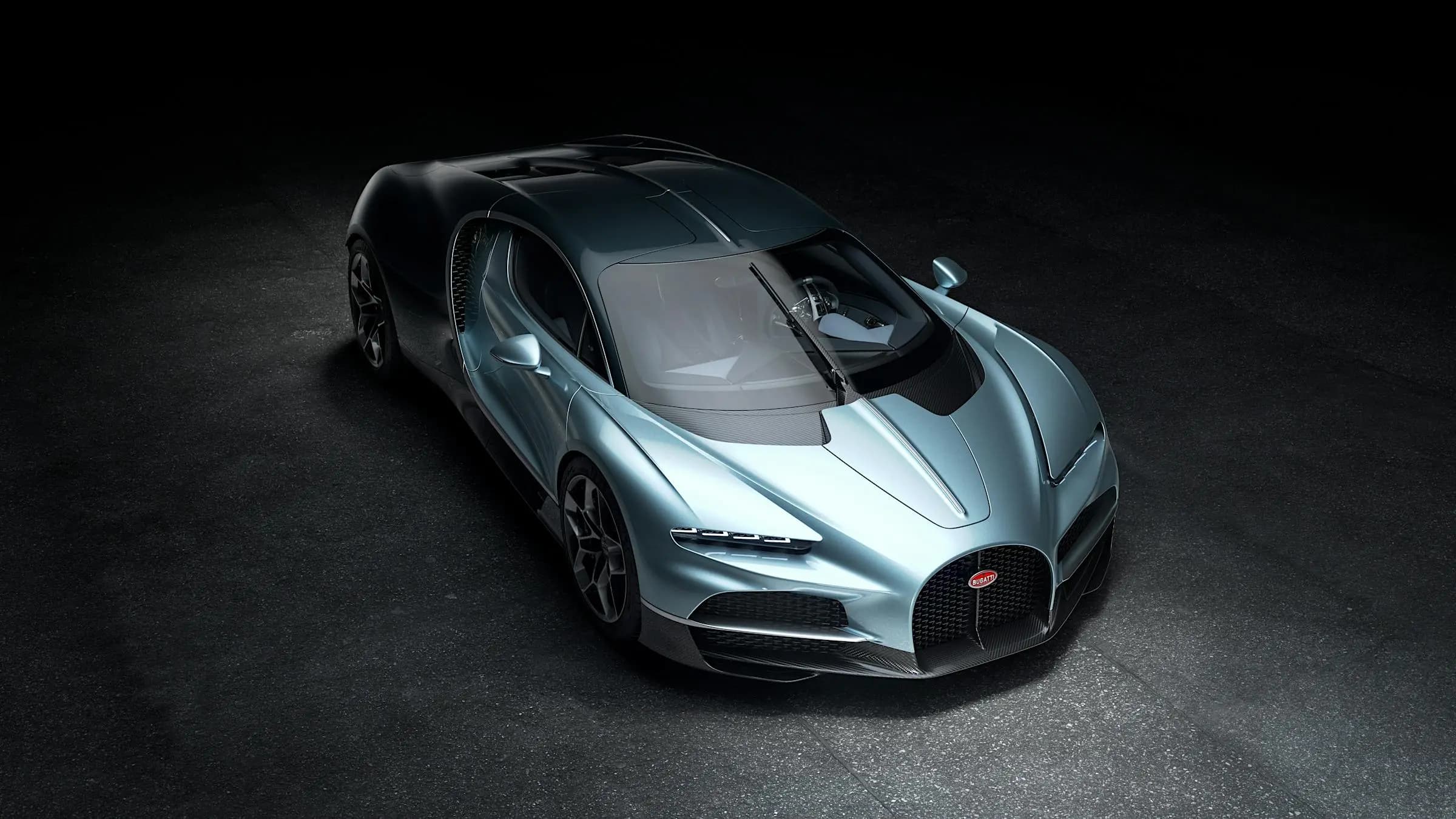
Bugatti presented the Tourbillon in June 2024. The model uses a new 8.3-litre naturally aspirated V16 engine developed with Cosworth, combined with three electric motors. Two motors are mounted on the front axle and one sits at the rear. Bugatti quotes a total system output of 1,800 hp, with 1,000 hp from the combustion engine and 800 hp from the electric motors.
The battery has a 25 kWh capacity and a T-shaped layout integrated into the chassis. Bugatti quotes more than 60 km of electric range. The hybrid system operates at 800 volts. The rear electric motor is rated at 250 kW and can spin to 24,000 rpm. These are manufacturer figures; Carboratory has not independently tested the car.
The architecture shows what Bugatti means by electrification. Electric motors provide immediate response, all-wheel-drive capability and torque support while the V16 remains the central mechanical component. Bugatti’s own material says the electric system is intended to enable the combustion engine rather than replace it. That is the manufacturer’s design philosophy, not a general verdict on electric or hybrid powertrains.
Bugatti plans to build 250 Tourbillon cars at its Molsheim atelier. The launch price was announced as €3.8 million net, and customer deliveries were planned for 2026. Bugatti said the prototypes had entered testing. Availability, customer configuration and final homologated figures can still depend on the production and approval process.
Rimac and Bugatti are taking different routes
The contrast with the Rimac Nevera makes the strategy easier to see. Rimac’s official technical information describes the Nevera as an all-electric, two-seat hypercar limited to 150 units. It uses four electric motors, a 120 kWh battery and an 800-volt electrical architecture. It is a different product with a different brand promise and a different relationship with sound, heat and mechanical complexity.
Bugatti’s public approach is therefore not a rejection of electrification. It is a decision to use electrification inside a combustion-led hypercar. The Tourbillon can drive on electric power for a limited distance, but it is not a battery-electric car designed around a large cruising range. The Nevera fills the group’s fully electric role, while Bugatti keeps its own emphasis on an analogue, high-speed and highly mechanical experience.
What has not been confirmed
The official sources reviewed do not provide a timetable for a fully electric Bugatti. They also do not say whether the old CUV concept could return in another form. The defensible conclusion is narrower: an electric CUV direction was stopped, and the successor to Chiron was developed as the hybrid Tourbillon instead.
That distinction prevents a simple reading of the story as “Rimac rejected electric cars”. Rimac’s own company sells an electric hypercar. The decision concerned Bugatti’s product brief, the compromises of a particular CUV proposal and the identity the joint venture wanted each marque to keep. For now, the public product plan leaves Bugatti with a V16 plug-in hybrid and Rimac with the fully electric Nevera family.