
Mazda is considering expanding its electric-car range through its partnership with Chinese manufacturer Changan Automobile. In its official electrification strategy, Mazda says that a third and fourth model are being considered after the Mazda EZ-6 and the second crossover developed through the same collaboration. The statement is not a launch announcement: Mazda has not given names, prices, specifications or delivery dates for those possible products. It does show that the Changan partnership is being treated as a broader product route rather than a one-off sedan project.
The two models already on the record
The first car in this family is the Mazda EZ-6, which launched in China in October 2024. Its European version is called the Mazda6e and went on sale in September 2025. Mazda says the car was developed with Changan Automobile and combines Mazda design and driving characteristics with electrification and intelligent-cabin technology supplied through the partnership.
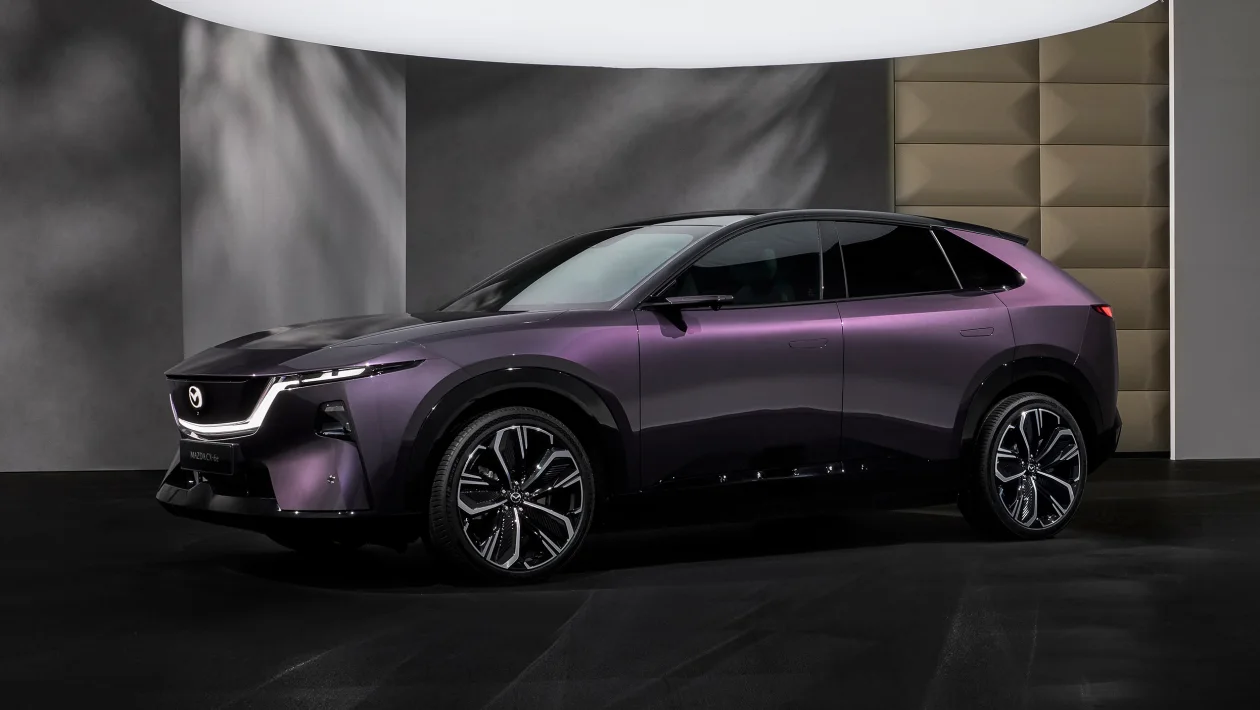
The second model is the Mazda EZ-60 in China and the Mazda CX-6e in Europe and other markets. Mazda unveiled the CX-6e at the Brussels Motor Show in January 2026 and scheduled its European launch for summer 2026. It is an electric crossover based on the EZ-60 programme, with adjustments intended for European customers. Mazda mentions tuning for European driving preferences, advanced driver assistance, voice and gesture recognition and digital side mirrors in selected specifications.
What the third and fourth models mean
Mazda's wording about a third and fourth product is deliberately cautious. The company says development of the second crossover is progressing and that two further models are being considered. It does not announce their body styles, dimensions, batteries, outputs, range figures or target markets.
That means it would be speculation to call the future products a smaller CX-6e, a Mazda3 replacement or a seven-seat SUV. The confirmed information is industrial rather than product-specific: Mazda can use the Changan Mazda joint venture, experience from the EZ-6 and EZ-60 programmes and the existing collaboration to develop additional vehicles.
Why Changan matters to Mazda
Changan Automobile has been Mazda's partner in China for two decades. Through their joint venture, Changan Mazda, the companies develop and produce vehicles for the Chinese market. Mazda contributes its design language, driving priorities and market adaptation, while Changan brings experience with electric systems, software and connected functions.
This arrangement can reduce the time and investment needed to create a new EV. Mazda's Lean Asset strategy describes collaboration and the use of existing technical bases as a way to expand exports without building a separate factory for every product. The shared origin does not mean all versions are identical. The Mazda6e and EZ-6 carry different market names, and Mazda says the European car was refined for regional requirements.
What the CX-6e adds in Europe
The CX-6e is the clearest example of a China-developed Mazda becoming a European product. Mazda describes it as an electric crossover that combines the brand's design and Jinba-Ittai driving approach with intelligent technology from the Changan collaboration. The official announcement lists advanced assistance systems, voice and gesture recognition and digital side mirrors, depending on specification.
A European introduction does not guarantee the same equipment or timing in every country. Prices, trim levels and order schedules can vary between national markets. For buyers in Romania, the local importer and price list matter more than the global model name. Availability, service arrangements and warranty terms should be checked when the vehicle is actually offered.
Mazda is keeping a multi-solution plan
More Changan-developed EVs are only one part of Mazda's product strategy. The company continues to describe a multi-solution approach that includes battery EVs, hybrids and more efficient combustion engines. Its technology plan also refers to the SKYACTIV-Z petrol engine, which is expected to work with electrification and to be used in the next-generation CX-5 by the end of 2027.
Mazda has separately announced an in-house dedicated EV platform planned for 2027. That is not the same project as the Changan-developed cars. The distinction shows that Mazda is not relying on one technical route for every market: it is using collaboration to accelerate selected products while preparing its own architecture for a later stage.
What buyers should check
For a European buyer, a China-developed Mazda should be assessed through the same practical criteria as any new car: official price, battery warranty, service network, charging power, WLTP range and parts availability. It also matters whether a model announced for Europe is actually offered in the buyer's country.
For the unconfirmed third and fourth products, prices, range figures and launch dates from renders or reports should not be treated as final. Mazda has not announced their names or timing. Once the products are approved, the company will need to publish market information, homologation data, battery specifications and ordering conditions.
The wider meaning
Mazda already has two Changan-developed electric vehicles with European versions: the Mazda6e and CX-6e. The company confirms that two more products are under consideration, but it has not described them enough to call them finished models or guaranteed launches. The next useful evidence will be sales and market plans for the Mazda6e and CX-6e, followed by an official product announcement for any additional vehicle.
For now, “more models are being considered” is a strategic option, not a confirmed list of future cars. That wording is less dramatic than a launch promise, but it is the accurate reading of Mazda's published plan.


